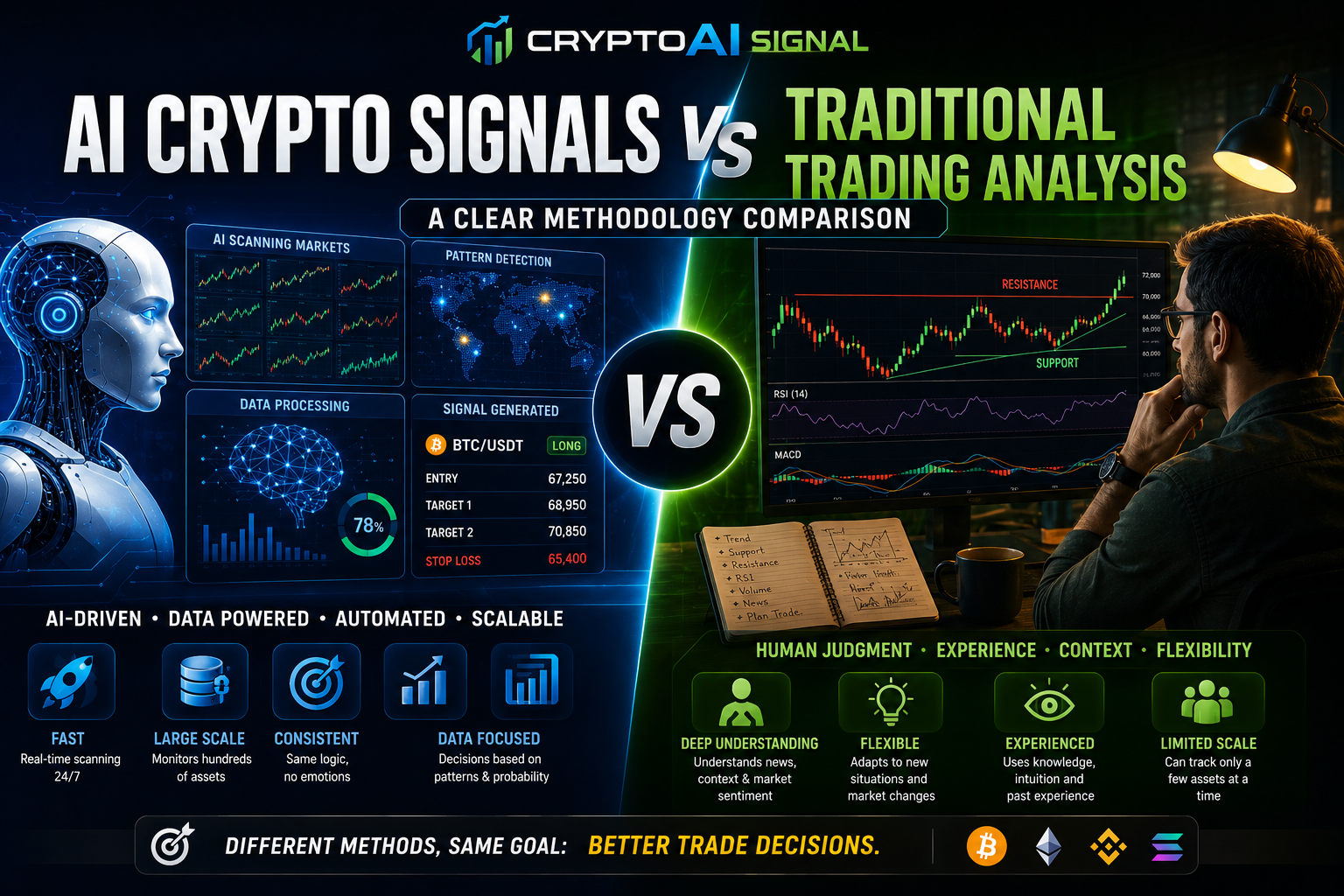
Quick Overview
Traditional trading analysis is human-driven. A person studies the market and decides using knowledge, experience, and judgment.
AI crypto signals are software-driven. A model processes large amounts of market data and produces a structured trade idea, often much faster and across many more assets than a human can.
The important nuance is that these two methods are not always opposites. Many AI signals are built on the same technical ideas that traditional analysis uses. The difference is often the speed, scale, and automation, not the core idea itself.
What Is Traditional Trading Analysis?
Traditional trading analysis is the human study of a market to make trade decisions. A trader looks at price, volume, news, and market structure, then forms a view.
It usually combines two main methods.
Technical analysis studies price charts. Traders use tools like support and resistance levels, trendlines, moving averages, RSI (Relative Strength Index), MACD, and volume. The core idea is that past price behavior can hint at possible future movement.
Fundamental analysis studies the value behind an asset. For crypto, this can include the project's use case, tokenomics (how the token's supply and demand are designed), development activity, adoption, and on-chain data.
Many traders also read market sentiment — the general mood of buyers and sellers, often taken from news and social media.
The key feature of traditional analysis is that a human makes the final call. Experience, interpretation, and even intuition play a large role. Two skilled traders can look at the same chart and still disagree.
What Are AI Crypto Signals?
AI crypto signals are trade ideas generated with the help of software and machine learning, not only human judgment.
An AI system takes in large amounts of market data — price, volume, volatility, and sometimes on-chain or sentiment data. It then applies statistical models or machine learning to find patterns. When certain conditions are met, it produces a structured output, such as an entry price, a target level, and a stop loss.
The main promise of AI signals is scale and speed. Software can watch hundreds of trading pairs at once and process far more data than a person can in the same amount of time.
It helps to understand one thing early. Many AI signals still rely on the same technical concepts used in traditional analysis, such as momentum, volume, and trend. The AI mostly automates and scales those concepts. It is a change in the method of processing, not always a completely new idea about markets.
![IMAGE 1 [17A].png](/uploads/webp/f5252ba749cc5ba1755881cdf648d469.webp)
The Core Methodology Difference
The real difference between the two methods is how a decision gets made.
Traditional analysis is discretionary. A human reviews the market and decides, using knowledge and judgment. The same information can lead two people to different conclusions.
AI signals are systematic. A model applies fixed rules or a trained algorithm to data and produces an output the same way every time, based on its design. Given the same inputs, it will usually give the same result.
In simple terms:
Traditional analysis = human interpretation of data.
AI signals = automated processing of data at scale.
This single difference creates most of the strengths and weaknesses you will see on both sides.
How Traditional Analysis Works Step by Step
A typical traditional workflow often looks like this:
Study the trend. The trader checks whether price is moving up, down, or sideways across different timeframes.
Mark key levels. Support, resistance, and important price zones are identified on the chart.
Add indicators. Tools like RSI or moving averages help confirm momentum or a possible reversal.
Check the context. News, sentiment, and fundamentals are considered.
Decide the trade. The trader sets an entry, a stop loss, and a target based on their view.
The strength here is context. A human can understand a surprise news event or a change in market mood that a rigid model might miss. The weakness is that humans are slower, can watch only a few assets at a time, and are affected by emotion and bias.
![IMAGE 2 [17A].png](/uploads/webp/1c03306074cfe38fc944f07051dbb03f.webp)
How AI Crypto Signals Are Generated
An AI signal process usually follows these stages:
Data collection. The system gathers market data such as price, volume, and volatility across many assets.
Data processing. Raw data is cleaned and turned into features the model can use.
Pattern detection. Statistical models or machine learning look for setups that match certain conditions.
Signal generation. When the conditions are met, the system outputs a structured signal — for example, an entry price, target levels, and a stop loss.
Filtering and ranking. Some platforms rank the signals and publish only the strongest setups.
The strength of this process is scale, speed, and consistency. The model does not get tired, bored, or emotional, and it applies the same rules to every asset. The weakness is that a model only knows what its data and design allow. It can miss real-world context, and it can fail when the market behaves in a way it has never seen before.
![IMAGE 3 [17A].png](/uploads/webp/cf8cb85151445a176e5a3af3c8f61ba3.webp)
Side-by-Side Comparison
The table below sums up the methodology difference across the factors that matter most.
Factor Traditional Analysis AI Crypto Signals Decision method Human judgment Automated model Speed Slower Very fast Assets watched at once Few Many Emotional bias Higher Lower in execution Reading news and context Strong Often weak Consistency Varies by person and mood High and repeatable Transparency of reasoning Usually clear Can be a "black box" Reacting to new, unseen events More flexible Can struggle Dependence on data quality Lower High
No single column is "correct." Each row is a trade-off. A strength in one method is often a weakness in the other.
Strengths and Weaknesses of Each Method
Traditional analysis — strengths: strong context, flexible thinking, clear reasoning you can explain, and the ability to adapt to unusual events.
Traditional analysis — weaknesses: it is slower, covers only a few assets, and is affected by emotion and bias. Results can also be inconsistent, because they depend on the person and their mood.
AI signals — strengths: speed, large-scale coverage, consistency, and less emotion during execution. Software can screen many pairs and apply the same rules to all of them.
AI signals — weaknesses: they depend heavily on data quality and model design. A model can also overfit, which means it looks accurate on past data but performs differently in live markets. It may struggle with events it has never seen, and its reasoning can be hard to understand.
One honesty point matters here. A signal system that looks strong in a backtest — a test on historical data — is not guaranteed to perform the same way in real trading. Careful testing helps, but no test removes future uncertainty.
Where AI and Traditional Analysis Overlap
Many "AI versus human" debates set up a false choice. In practice, the two methods overlap far more than people assume.
Most AI signal systems are built on ideas that come straight from traditional technical analysis, such as trend, momentum, and volume. The AI does not invent a secret new market law. It automates and scales the same concepts a human trader already uses.
Because of this, the strongest real-world approach is often a mix of both. AI handles the heavy work of scanning many markets quickly and flagging setups. A human then adds context, checks the risk, and makes the final judgment. This is usually called an AI-assisted approach, and it is more common than a fully automatic one.
Seen this way, AI signals and traditional analysis are not enemies. They are tools that cover each other's weak spots.
Which Approach Is Better?
The honest answer is that neither method is automatically better. It depends on your goals, your skill level, and how much time you have.
If you need speed and want to cover many assets at once, AI leans strong. If you want deep understanding of a single asset or a specific news event, human analysis leans strong. For most people, a combination of both works better than either one alone.
There is a more useful question than "AI or human." It is: "How do I verify this?" A good method — of any type — should give you a clear setup, a defined risk, and results you can check. That standard matters more than the label on the front.
Common Misunderstandings About AI Signals
"AI predicts the future." It does not. It estimates probability from past patterns, and patterns can break.
"AI removes risk." No method removes market risk. AI can reduce emotional mistakes, but the market can still move against a signal.
"More data always means better signals." Not true. The quality and relevance of the data matter more than the amount.
"AI signals guarantee profit." They do not. If any service promises guaranteed wins or 100% accuracy, treat it as a red flag.
"AI has no bias." A model can inherit bias from the data it was trained on. It is not automatically neutral.
How to Evaluate an AI Signal Service
Whatever method a service uses, judge it by the same practical standard. Ask these questions:
Does it give a clear, structured setup with an entry, a target, and a stop loss?
Does it report results transparently, including losing trades and not only winning ones?
Can you check past signals against real market prices?
Does it avoid guaranteed-profit or fixed-accuracy claims?
Is the methodology explained, at least at a high level?
Does it define the risk clearly before you act?
For example, a platform like CryptoAI Signal publishes structured setups with a defined entry price, target levels, and a maximum stop loss, and it posts a clear "No Signal Today" note when no setup qualifies. That kind of transparency — showing when there is nothing to trade — is a useful sign, because it shows the service is not forcing signals just to stay active. Whatever provider you consider, look for this same honesty and the ability to verify results yourself.
Risk Considerations
Crypto is a volatile market. Prices can move quickly and sharply, and both AI signals and traditional analysis can be wrong.
A stop loss helps control risk, but it is not a full guarantee. On futures markets, a stop loss is based on the underlying asset price. Depending on your leverage and position, a trade can still be liquidated before the stop-loss level is reached. A signal provider does not control your leverage or your position size — those are your own execution choices.
Because of this, risk management often matters more than the source of the signal. Sensible position sizing, a defined stop loss, and not risking money you cannot afford to lose protect you far more than the "AI" or "human" label on any method.
Conclusion
The core difference between AI crypto signals and traditional trading analysis is simple to state. Traditional analysis is human interpretation of the market. AI signals are automated processing of market data at scale. Everything else — the speed, the coverage, the consistency, the blind spots — flows from that one difference.
Neither method wins outright. Traditional analysis brings context and flexibility. AI brings speed and scale. In real trading, the two often work best together, and many AI signals are really automated versions of traditional ideas.
The most important takeaway is this. Do not judge a method by whether it is labelled "AI." Judge it by how transparent it is, whether you can verify its results, and how clearly it defines risk. A method you can check and control is worth far more than one that only sounds advanced.
Frequently Asked Questions
Are AI crypto signals more accurate than traditional analysis?
There is no fixed answer. Accuracy depends on the quality of the model or the trader, the market conditions, and the time period. Neither method is guaranteed to be more accurate, so the safer approach is to verify results rather than trust a claim.
Can AI replace human traders completely?
In most cases, AI assists rather than fully replaces. It is strong at scanning data and finding setups quickly, but context, risk decisions, and final judgment still benefit from a human. Fully automatic systems exist, but they still depend on careful human design.
Do AI crypto signals still use technical analysis?
Yes, very often. Many AI systems automate the same concepts used in traditional technical analysis, such as trend, momentum, and volume. The main change is the speed and scale of how those concepts are applied.
Are AI crypto signals safe to follow?
No signal, AI or human, is risk-free. Crypto is volatile, and any prediction can be wrong. The safer way to use signals is with proper risk management, a clear stop loss, and position sizing that fits your own limits.
Should beginners use AI signals or learn analysis first?
Learning the basics of analysis is useful either way. Even if you plan to use AI signals, understanding trend, support and resistance, and stop losses helps you evaluate whether a signal makes sense before you act on it.