Quick Answer
Crypto signal accuracy usually means how often a signal reaches its target before it hits the stop loss. It sounds simple, but a single accuracy number rarely tells the full story.
A signal service can show a high accuracy percentage and still lose money over time. Another service can show a lower accuracy percentage and still stay profitable. The reason is that accuracy only counts how often trades win. It ignores how big the wins and losses are.
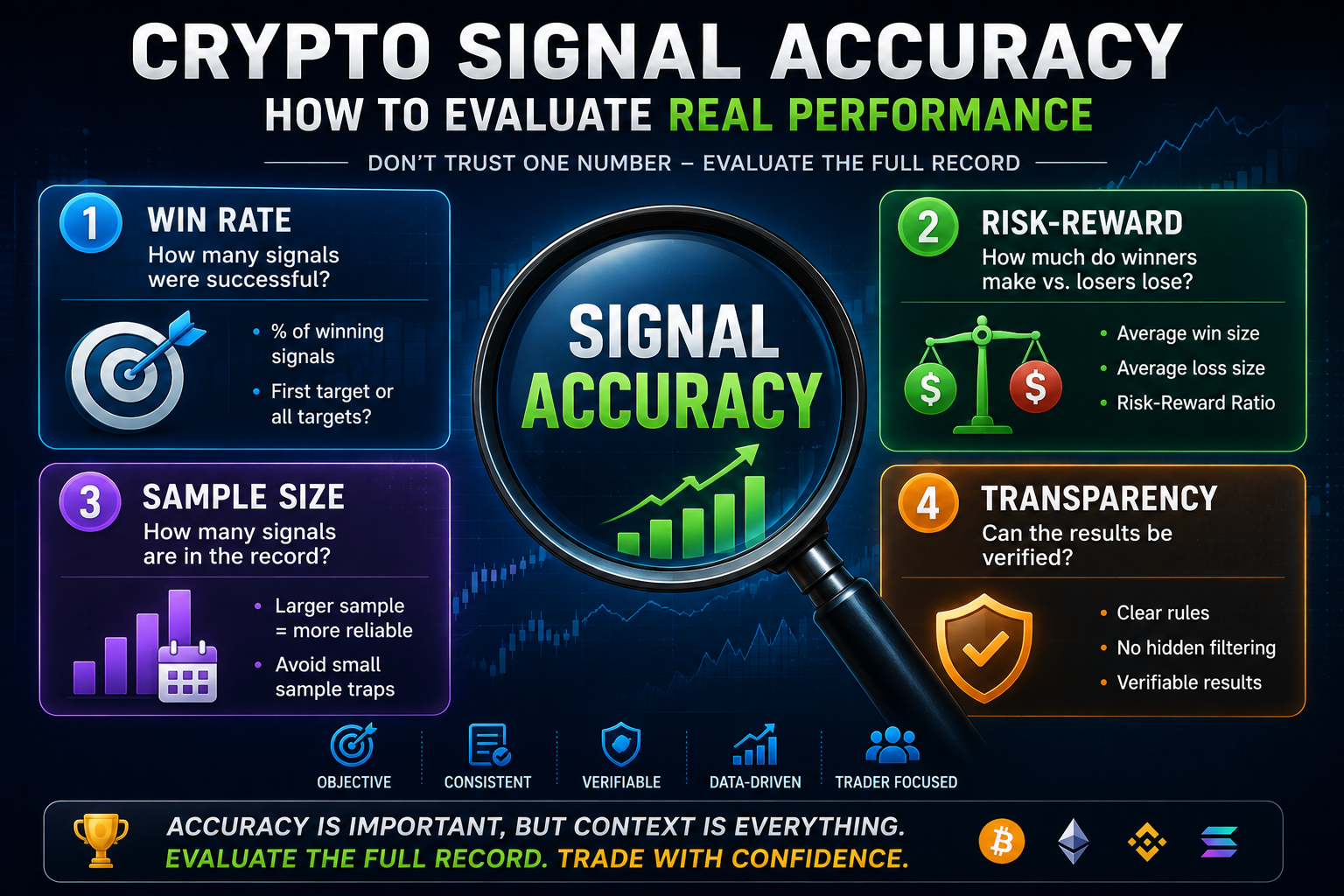
To evaluate real performance, you need to look at accuracy together with risk-reward, sample size, drawdown, and honest record-keeping. This article explains each of these in simple terms.
![IMAGE 1 [A18].png](/uploads/webp/99cb4308085e99b40f032162744b5c12.webp)
What Crypto Signal Accuracy Actually Means
In crypto trading, a signal is a structured trade idea. It usually includes an entry price, one or more target levels, and a stop loss. Accuracy measures how many of these signals reach their target instead of their stop.
The problem is that "accuracy" is not defined the same way everywhere. Different services measure it differently:
Some count a signal as a win if it hits the first target only.
Some count it as a win only if it hits all targets.
Some count a partial result (one target reached, then reversed) as a win.
Some quietly remove signals that did not work.
Because of these differences, two services can both claim "high accuracy" while measuring completely different things. Before you trust any accuracy number, you first need to know exactly how that number was calculated.
Why a High Accuracy Percentage Can Be Misleading
A high win rate feels safe. But win rate alone does not tell you whether a strategy makes or loses money. The size of each win and each loss matters just as much.
Here is a simple hypothetical example. The numbers below are illustrative only and do not represent any real signal service or real market results.
Imagine a service takes 10 trades:
7 trades win, each gaining +2%
3 trades lose, each losing −6%
The accuracy looks strong at 70%. But let us add the results:
Wins: 7 × 2% = +14%
Losses: 3 × 6% = −18%
Net result: −4%
So a 70% accuracy strategy still ended in a loss. The three losing trades were larger than the seven winning trades. This is why a headline accuracy number can be misleading on its own.
(This example uses simple percentages and does not include leverage, fees, or compounding. It is only meant to show how win rate and result size interact.)
![IMAGE 2 [A18].png](/uploads/webp/3bd3e2cece8b8296d0d0d9ea40ef852e.webp)
Accuracy vs Profitability: The Key Difference
Profitability depends on two things working together: how often you win (accuracy) and how much you win versus lose (risk-reward ratio).
The risk-reward ratio compares the size of your potential reward to the size of your risk. A 1:3 ratio means you risk 1 unit to try to gain 3 units.
Now look at the reverse of the earlier example. Again, these numbers are hypothetical.
Imagine another service takes 10 trades:
4 trades win, each gaining +10%
6 trades lose, each losing −5%
The accuracy is only 40%. But:
Wins: 4 × 10% = +40%
Losses: 6 × 5% = −30%
Net result: +10%
Here a "low accuracy" strategy ended in profit, because the winning trades were larger than the losing trades. This is the core lesson of performance evaluation: accuracy and risk-reward must be judged together, not separately.
Traders often combine both ideas into a single concept called expectancy — the average result you can expect per trade over many trades. A positive expectancy over a large enough sample is far more meaningful than any single accuracy figure.
How Signal Outcomes Are Recorded
To measure accuracy fairly, a signal must have clearly defined levels before the trade, not after. This is why structured signals are easier to evaluate than vague market predictions.
A structured signal defines the outcome in advance:
Entry price — where the trade idea begins.
Target levels — the price levels counted as a positive result.
Stop loss — the price level counted as a negative result.
CryptoAI Signal, for example, publishes fixed levels for this reason. Each signal includes an entry price, staged targets (Target 1 at +10%, Target 2 at +20%, Target 3 at +30%), and a maximum stop loss at −25%. These are published price levels, not promises of profit or guaranteed returns. When no setup meets the required conditions, a "No Signal Today" note is published instead of forcing a weak trade.
Outcomes are then recorded against these published levels using status labels such as Full Profit, Partial Profit, or Stop Loss Hit. It is important to understand what these labels mean:
They describe a price event measured against the published levels.
They do not describe your personal account result, because your result also depends on your position size, leverage, entry timing, and fees.
You may also see a term like Maximum Pump, which describes the highest price movement recorded after a signal's entry. This is a market-price measurement of the move, not a user's realized return and not a guaranteed profit.
![IMAGE 3 [A18].png](/uploads/webp/79b2d9a2bab1c1ecf1434f3cb5d419a9.webp)
Key Metrics for Real Performance Evaluation
When you evaluate any crypto signal service, look beyond the headline number. These metrics give a more complete picture.
Win rate (accuracy). The percentage of signals that reached their target. Useful, but never enough on its own.
Average risk-reward. How large the typical winner is compared to the typical loser. This decides whether the win rate is good enough to be profitable.
Sample size. Ten signals prove almost nothing. A large number of recorded signals over time is far more reliable. Small samples can look great by luck.
Time period. Results from a single strong month can be misleading. Look for performance across different market conditions, including sideways and falling markets.
Drawdown. The largest drop from a high point to a low point. Even a profitable approach can have painful losing streaks, and you need to know if you can handle them.
Consistency. Steady, repeatable results are more trustworthy than a few huge wins mixed with many quiet losses.
How "no trade" days are handled. A service that only publishes a signal when conditions qualify is behaving differently from one that publishes something every day just to stay active.
What Honest Accuracy Reporting Looks Like
Transparency is the difference between a number you can trust and a number designed to impress you. Honest performance reporting usually shows the following signs.
It defines its terms. You can clearly see how a win, a partial win, and a loss are counted.
It shows losing trades too. A record that only displays winners is not a performance record. It is marketing.
It uses a meaningful sample. Enough signals over enough time to reduce the effect of luck.
It keeps dated records. Each signal has a clear date and clear published levels that cannot be changed after the result is known.
It explains its method. You understand, at least in general terms, how signals are selected and measured.
Honest reporting also admits its own limits. A newer service, for example, simply has a shorter track record, and stating that openly builds more long-term trust than hiding it.
Common Mistakes When Judging Signal Accuracy
Trusting the headline percentage. A single "X% accuracy" claim without method, sample size, or risk-reward tells you very little.
Believing cherry-picked screenshots. A few winning trades shared on social media are easy to select and prove nothing about overall performance.
Ignoring sample size. Great results from only a handful of trades are usually luck, not skill.
Confusing a price event with your ROI. A "target hit" label means the price reached that level. Your actual return depends on how you traded it.
Forgetting leverage and liquidation. On futures, high leverage can end a position early, before the stop loss is ever reached. More on this below.
Judging over too short a period. Any approach can look brilliant during a strong trend. The real test is across different market conditions.
How to Verify Signal Accuracy Yourself
You do not have to accept any accuracy claim on trust. You can test it.
Track a sample yourself. Pick a set of free or public signals and record each one as it is published, before the outcome is known.
Use the published levels. Note the exact entry, target, and stop loss for each signal at the moment it appears.
Log the real outcome. After each trade closes, record whether price hit the target or the stop, using the original published levels only.
Measure over time. After a meaningful number of signals across different market conditions, you can calculate the win rate and estimate the average risk-reward yourself.
This simple habit turns a marketing claim into something you have personally verified. Free public signals exist partly so that users can do exactly this kind of independent checking before considering a premium tier.
Risk and Limitations You Should Know
A trading signal is a decision-support tool, not a guaranteed prediction. No signal service can know the future, and crypto markets can move sharply and unexpectedly.
If you trade crypto futures, one point deserves special attention. A published stop loss is based on the underlying asset price. It does not guarantee protection from liquidation. Depending on your leverage and position conditions, your position could be liquidated before price reaches the published stop-loss level. Leverage is your own execution choice; it is not part of the published signal, and a signal service does not control it.
For this reason, accuracy is only one part of responsible trading. Position sizing, leverage control, and your own risk management decide how a signal actually affects your account.
Practical Evaluation Checklist
Use this quick checklist before trusting any crypto signal accuracy claim:
Is it clear how accuracy is measured (target 1, all targets, partial)?
Is the sample size large enough to be meaningful?
Does the record cover different market conditions, not just one strong period?
Is the risk-reward ratio shown, not just the win rate?
Are losing trades included, not hidden?
Are signals dated with fixed levels set before the outcome?
Can you verify a sample of signals yourself using published levels?
Do you understand the leverage and liquidation risk on futures?
If a service passes most of these checks, its accuracy figures are far more trustworthy than a single impressive percentage.
Conclusion
Crypto signal accuracy is useful, but it is only one piece of the performance picture. A high win rate means little without risk-reward, sample size, and honest, dated records. In fact, a lower accuracy strategy with strong risk-reward can outperform a higher accuracy strategy with weak risk-reward.
The smartest way to evaluate any signal service is to stop looking for one magic number and start looking at the full method: how outcomes are defined, how transparent the records are, and whether you can verify a sample yourself. Judge the process, not the headline — and let real, repeatable evidence guide your decision.
Frequently Asked Questions
What does crypto signal accuracy mean?
It usually means the percentage of signals that reach their target before hitting the stop loss. However, the exact definition changes between services, so you should always check how accuracy is being measured.
Is a higher accuracy percentage always better?
No. A high win rate can still lose money if the losing trades are larger than the winning trades. Accuracy must be judged together with the risk-reward ratio to understand real performance.
Can crypto signals guarantee profit?
No. A signal is a decision-support tool, not a guaranteed prediction. Crypto markets are volatile, and your actual result also depends on your entry, position size, leverage, and risk management.
How many signals do I need to judge accuracy fairly?
There is no single fixed number, but a larger sample over different market conditions is far more reliable than a handful of trades. Small samples can look great purely by luck.
Why can my result differ from a "target hit" signal?
A "target hit" is a price event measured against the published levels. Your personal return depends on how and when you entered, your position size, your leverage, and any fees, so it can differ from the recorded signal outcome.