Quick Answer
An AI crypto signal is a trade idea created by a computer system that studies market data and looks for patterns. The system collects price, volume, and other market information, processes it through models or rules, and then produces a structured trade setup. This setup usually includes a direction, an entry price, one or more targets, and a stop loss.
AI does not predict the future. It estimates probabilities based on past and current data. The trader still makes the final decision and still carries the risk.
What Is an AI Crypto Signal?
A crypto trading signal is a structured trade idea based on market analysis. An AI crypto signal is the same idea, but the analysis is done mainly by software instead of a person sitting at a chart.
"AI" here is a broad term. In practice, an AI crypto signal system can use:
Rule-based logic – fixed conditions written by developers
Machine learning models – systems that learn patterns from historical data
A mix of both
The goal is the same in every case. The system turns large amounts of market data into a clear, testable trade setup that a human can understand and act on.
One point must be clear from the start. A signal is a decision-support tool. It is not a promise that a trade will work.
The Data Behind AI Crypto Signals
An AI system is only as good as the data it reads. Before any signal appears, the system needs clean and reliable market data.
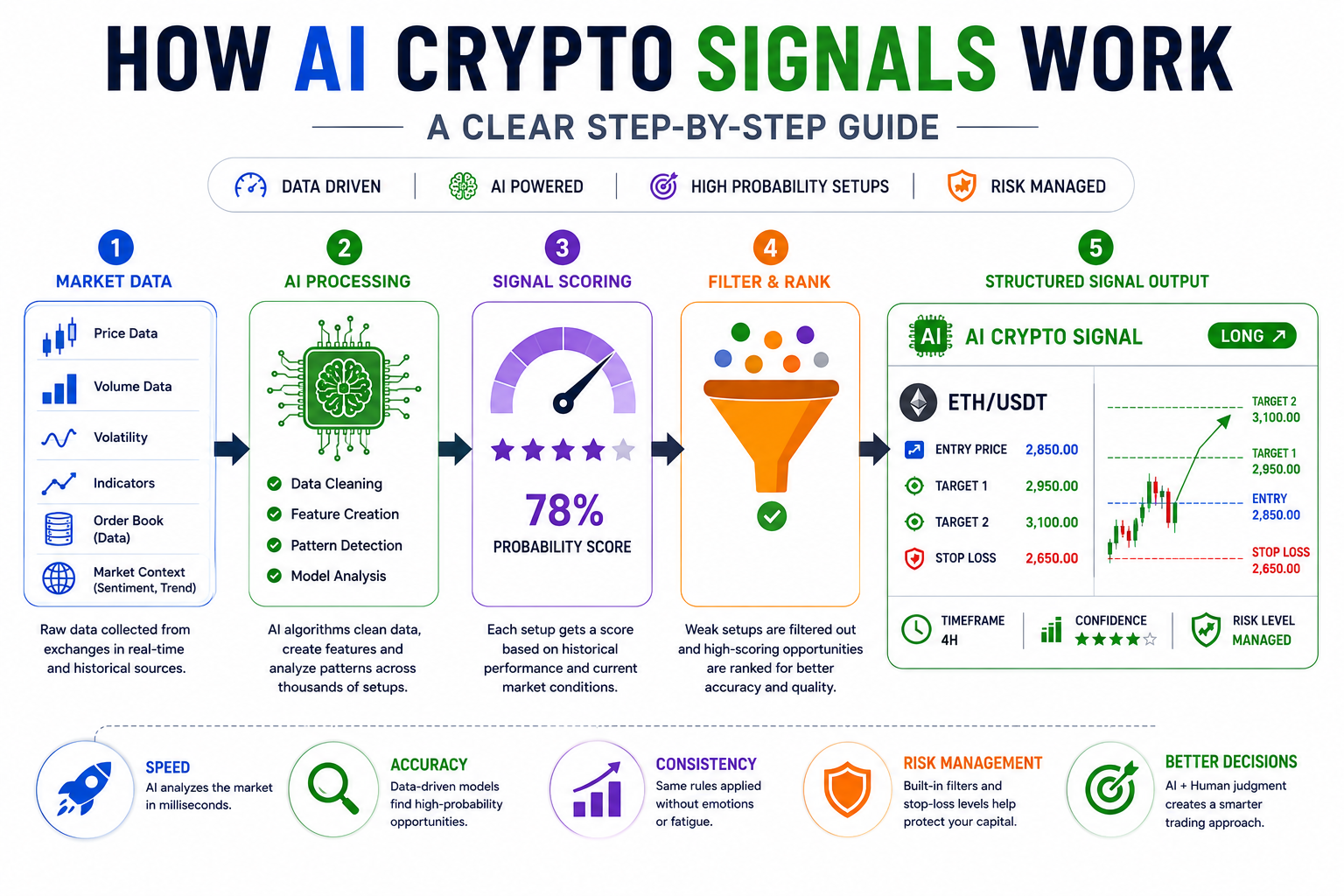
Common data inputs include:
Price data – open, high, low, and close prices across different timeframes
Volume data – how much of an asset is being traded
Volatility – how fast and how far the price is moving
Technical indicators – values like RSI, moving averages, or VWAP that are calculated from price and volume
Order book data – buy and sell orders waiting in the market, when available
Market context – trend direction, higher-timeframe structure, and sometimes market-wide sentiment
The system usually pulls this data directly from an exchange. Bad or missing data leads to weak signals, so data quality is a serious part of the process, not a small detail.
![IMAGE 1 [A13].png](/uploads/webp/e41bf0c385b391330052fecdb91dd526.webp)
How AI Crypto Signals Work Step by Step
Most AI signal systems follow a similar process. The exact method changes from platform to platform, but the stages are usually the same.
Step 1: Data collection The system gathers live and historical market data from the exchange.
Step 2: Data cleaning Raw data often has gaps or errors. The system cleans and organizes it so the models can use it correctly.
Step 3: Feature creation The system turns raw data into useful inputs. For example, it may calculate indicators, measure volatility, or detect chart patterns. These processed inputs are often called "features."
Step 4: Pattern analysis This is the core step. The model studies the features and compares the current market to patterns it has seen before. A machine learning model may score how similar the current setup is to past setups that later moved in a certain direction.
Step 5: Signal scoring The system produces a score or a probability. A higher score means the setup matches stronger historical patterns. This score is not a guarantee. It is a measure of confidence based on data.
Step 6: Filtering and ranking Many setups may pass the first checks. The system filters out weak ones and ranks the strongest opportunities. Some platforms only publish a signal when the score passes a strict level.
Step 7: Signal output Finally, the system converts the result into a structured trade setup with clear levels that a trader can read and act on.
Types of AI Used in Crypto Signal Systems
Not every "AI" system works the same way. It helps to understand the main types before you trust one.
Rule-based systems These follow fixed instructions. For example: "If RSI is below 30 and volume rises, mark a possible setup." They are simple and easy to test, but they cannot adapt on their own when the market changes.
Machine learning systems These learn from historical data. Instead of fixed rules, they find patterns by themselves. They can handle more complex relationships, but they need large, clean datasets and careful testing to stay reliable.
Hybrid systems Many real platforms combine both. Rules handle the basic filters, and machine learning handles pattern recognition and ranking. This mix is common because it balances control with flexibility.
Knowing the type helps you ask better questions about how a service actually produces its signals.
How Raw Analysis Becomes a Structured Signal
Analysis on its own is not useful for trading. The final step is turning it into a clear trade setup.
A structured signal usually contains:
Direction – long or short. Some platforms only publish long setups.
Entry price – where the trade is planned to start.
Target levels – price levels where profit can be taken.
Stop loss – a level that limits loss if the market moves the wrong way.
![IMAGE 2 [ A13].png](/uploads/webp/307cec6c216010f8551fc5b6fde7cdbd.webp)
These levels give the trader a complete plan. A trader can see the possible reward, the possible risk, and the exact point where the idea is no longer valid. This is why structured signals are more useful than a simple "buy now" message with no plan behind it.
The Role of Backtesting and Validation
Before a system is trusted, its logic is usually tested against historical data. This is called backtesting.
Backtesting checks how a strategy would have behaved in the past. It helps developers see if the logic has any real edge, or if it only looked good by chance.
But backtesting has real limits:
Past results do not promise future results.
A model can be "overfit," which means it works well on old data but fails on new data.
Markets change over time, and patterns that worked before can stop working.
Good platforms treat backtesting as one check among many, not as final proof. They also watch live performance over time and stay honest about what the results show.
What AI Can and Cannot Do
This is one of the most important parts to understand honestly.
What AI can do well:
Process huge amounts of data far faster than a person.
Watch many markets at the same time without getting tired.
Stay consistent and remove emotional decisions.
Spot patterns that are hard for people to notice.
What AI cannot do:
Predict the future with certainty.
Know about sudden news, hacks, or black-swan events before they happen.
Guarantee profit on any single trade.
Remove risk from trading.
AI improves the analysis process. It does not remove uncertainty. Any service that promises guaranteed profit or "100% accuracy" is making a claim that real markets cannot support.
![IMAGE 3 [A13].png](/uploads/webp/bc32b728f9c92a9283a4452a0bf6a21e.webp)
AI Signals vs Human Analysis
AI and human analysis both have strengths. They are not enemies.
Humans are good at understanding context, news, and unusual situations. AI is good at speed, scale, and consistency. AI does not get tired, bored, or emotional.
The most practical approach for many traders is to use AI signals as structured input, then apply their own judgment and risk management on top. The signal starts the thinking. The trader finishes it.
How AI Signals Work at CryptoAI Signal
CryptoAI Signal is one example of a data-driven signal platform. It focuses on Binance Futures perpetual markets and publishes structured, long-only trade setups.
Each published signal includes clear levels, such as an entry price, staged targets, and a maximum stop loss. When no setup meets the required conditions, the platform can publish "No Signal Today" instead of forcing a weak trade. Signals are also grouped into free public and premium tiers, so a user can study the methodology before deciding anything.
Two honest points matter here. First, the published levels are trade parameters, not promised returns. Second, on futures markets, a stop-loss level is based on the underlying asset price. Depending on the leverage a trader chooses, a position could still be liquidated before that level is reached. Leverage is the trader's own execution choice, not part of the published signal.
How to Evaluate an AI Crypto Signal Service
If you are comparing AI signal providers, judge them on process and honesty, not on marketing.
Useful questions to ask:
Does the service explain how its signals are actually made?
Does it show past results, including losing trades?
Are the trade setups structured with clear entry, target, and stop levels?
Does it avoid promising guaranteed profit?
Does it explain the risks of trading and leverage?
A trustworthy service is transparent about both its method and its limits. A service that hides its losing trades or promises certain profit deserves more caution, not more trust.
Common Misconceptions About AI Crypto Signals
"AI can predict the market." No. AI estimates probabilities from data. It does not see the future.
"More complex AI is always better." Not true. A very complex model can overfit and then fail in live markets.
"A signal means I will profit." No. A signal is an idea with defined risk, not a guaranteed win.
"AI removes the need for risk management." No. Position sizing and risk control are still the trader's own job.
Conclusion
AI crypto signals work by collecting market data, turning it into useful features, finding patterns, scoring setups, and producing structured trade ideas with clear levels. AI brings speed, scale, and consistency to this process, but it cannot remove risk or predict the future.
The most useful way to treat an AI signal is as a well-organized starting point for your own decision, backed by your own risk management. When you understand the process behind a signal, you can evaluate any provider more clearly and trade with more realistic expectations.
Frequently Asked Questions
Are AI crypto signals accurate?
No signal system is accurate every time. AI can improve analysis by studying data at scale, but markets stay uncertain. Treat any claim of guaranteed accuracy as a warning sign, not a benefit.
Do AI crypto signals guarantee profit?
No. A signal is a structured trade idea with defined risk. It cannot promise profit on any single trade.
Is AI better than a human trader?
Neither is simply "better." AI is faster and more consistent, while humans understand context and news better. Many traders combine both.
Can I follow AI signals without any knowledge?
It is not recommended. You should understand entries, stop losses, risk management, and the risks of leverage before using any signal in real trading.
What data do AI crypto signals use?
Most systems use price, volume, volatility, and technical indicators. Some also use order book data and market sentiment when it is available.