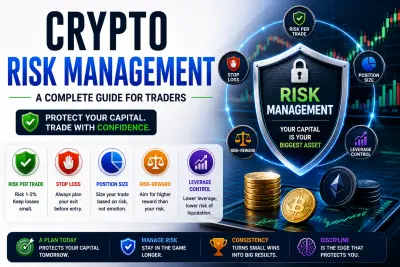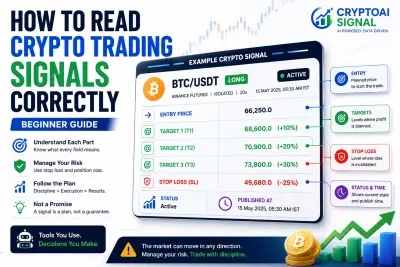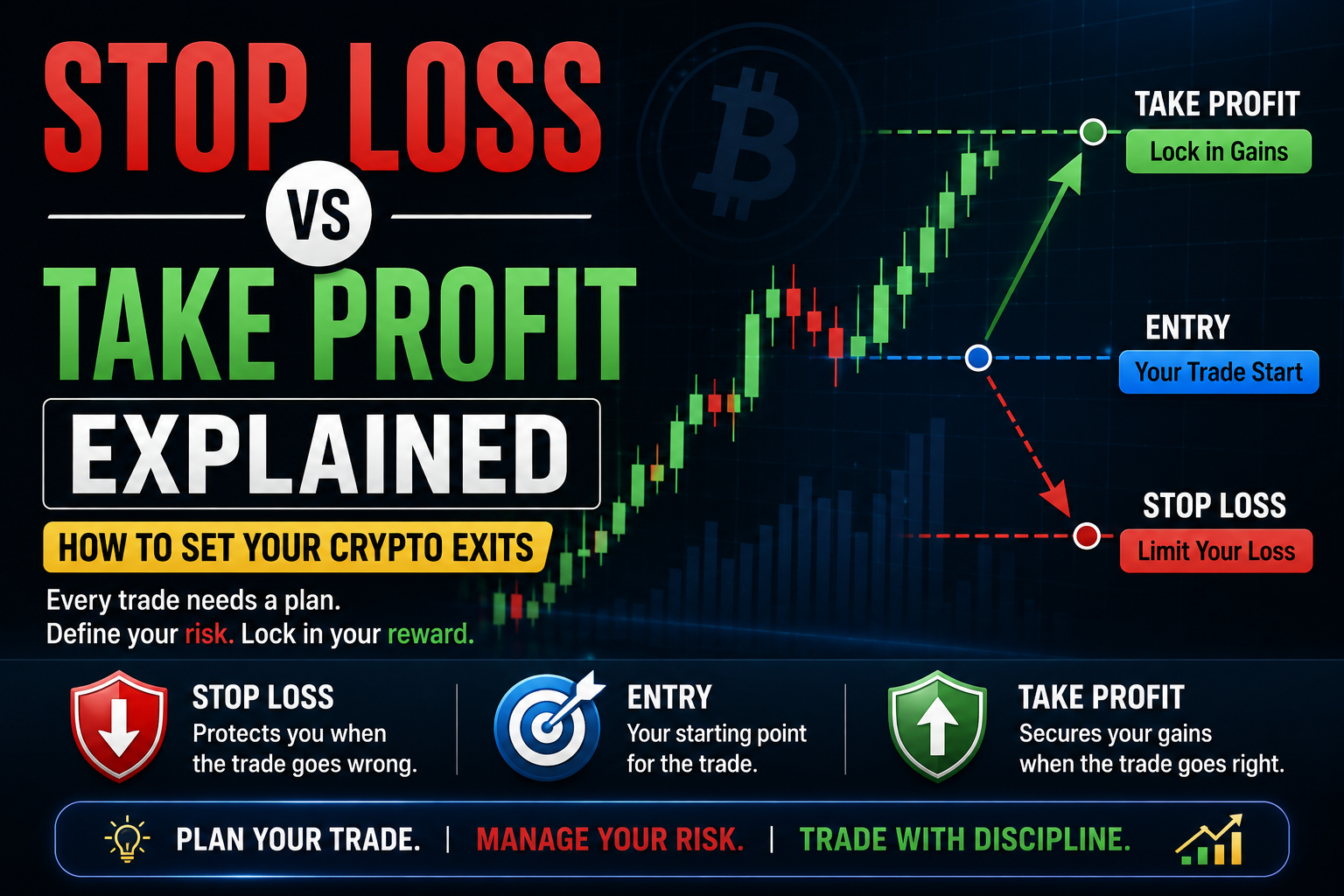
Every crypto trade has two important price levels: one where you accept you were wrong, and one where you lock in that you were right. A stop loss protects you when the trade goes against you. A take profit locks in gains when the trade moves in your favor. Together, they turn a trading idea into a plan with clear limits. This guide explains what each term means, how they work together, and how to set both before you enter a trade.
What Is a Stop Loss?
A stop loss is a price level you set below your entry price (for a long trade) where you plan to exit if the market moves against you. It is not a guarantee against loss. It is a decision you make in advance, so you do not have to make it under pressure while the trade is losing money.
When the market price reaches your stop loss level, your position closes, either through an automatic stop order or a manual exit. The main job of a stop loss is to limit how much you can lose on a single trade.
A stop loss does not promise an exact exit price. In fast-moving or thin markets, the actual exit price can differ from the stop loss level. This gap is called slippage.
What Is a Take Profit?
A take profit is a price level above your entry price (for a long trade) where you plan to close the trade and lock in gains. Like a stop loss, you set it before entering the trade, based on your analysis of the market.
A take profit removes emotion from the exit decision. Without one, many traders hold a winning trade too long, hoping for more gains, and give back profit when the market reverses.
Some traders use a single take profit level. Others split their position across multiple targets, closing part of the position at a first target and letting the rest run toward a second or third target.
Stop Loss vs Take Profit: The Core Difference
The difference is simple. A stop loss defines your maximum acceptable loss. A take profit defines your planned exit for a gain.
Aspect Stop Loss Take Profit Purpose Limit loss Lock in gain Position relative to entry (long trade) Below entry Above entry Triggered when Price moves against you Price moves in your favor Main risk if missing Loss can grow beyond what you planned A gain can turn into a loss if the market reverses
Both levels exist for the same reason: to remove guesswork from the moment you need to act.
![IMAGE 1 [A9].png](/uploads/webp/514477f3a42b72f6d681e1f3506f4e5e.webp)
Why You Need Both in a Crypto Trade
Crypto markets can move fast, sometimes several percent within minutes. Without a stop loss, a losing trade can turn into a much larger loss than planned. Without a take profit, a winning trade can reverse before you decide to exit manually.
Setting both levels before entering a trade has three practical benefits:
It defines your risk before you risk anything.
It removes the need to make decisions during a stressful, fast-moving market.
It creates a trade plan you can review and improve over time, because the rules were set in advance, not during the trade.
How to Set a Stop Loss
There is no single correct stop loss distance. It depends on the asset's volatility, your entry logic, and your own risk tolerance. Common approaches include:
Market structure: placing the stop loss below a recent swing low or a support level, for a long trade.
Volatility: using a measure such as Average True Range (ATR) to set a stop loss distance that matches how much the asset typically moves.
Fixed percentage: setting the stop loss a set percentage below entry, regardless of chart structure.
Whichever method you use, the stop loss should reflect a price level where your original trade idea is actually invalidated, not just a random distance from entry.
How to Set a Take Profit
A take profit should also be based on logic, not guesswork. Traders commonly use:
Resistance levels or prior highs: closing the trade near a price where selling pressure has appeared before.
A fixed risk-reward ratio: setting the take profit at a multiple of the stop loss distance, explained in the next section.
Multiple targets: closing part of the position at each target level to balance locking in gains with staying in the trade for further upside.
Risk-Reward Ratio: Connecting Stop Loss and Take Profit
The risk-reward ratio compares how much you are risking, the distance to your stop loss, with how much you could gain, the distance to your take profit.
Take this hypothetical trade as an example:
Entry: $100
Stop loss: $95 (risking $5)
Take profit: $115 (targeting $15)
This works out to a 1:3 risk-reward ratio. You are risking $5 to target $15.
This example is for illustration only. It does not represent an actual trade or a guaranteed outcome. A favorable risk-reward ratio does not guarantee profit. It only means that, if the trade works out, the potential gain is larger than the potential loss.
![IMAGE 2 [A9].png](/uploads/webp/f23f16f05fe843d1866a4e0a6f05af96.webp)
Stop Loss vs Liquidation: Not the Same Thing
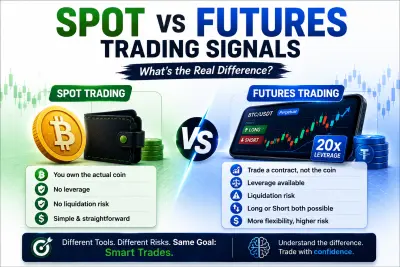
If you trade crypto futures with leverage, it is important to understand that a stop loss and a liquidation price are two different things.
A stop loss is a level you choose, based on the asset's price. A liquidation price is calculated by the exchange, based on your leverage, position size, and margin. If the market moves against your position fast enough, or if your stop loss order fails to execute due to slippage or an exchange issue, your position can be liquidated before, or instead of, hitting your intended stop loss.
Higher leverage brings your liquidation price closer to your entry price. This means a stop loss set at a reasonable distance can still leave you exposed to liquidation under high leverage, even though the stop loss level on the chart has not changed. Leverage is a choice you make when placing the trade, and it changes your real risk even when your stop loss stays the same.
A Simple Hypothetical Example
Imagine a trader identifies a long setup on a crypto asset trading at $50,000.
Entry: $50,000
Stop loss: $48,500 (about 3% below entry)
Take profit: $54,500 (about 9% above entry)
This gives a risk-reward ratio of roughly 1:3. If the price falls to $48,500, the stop loss closes the trade with a defined, limited loss. If the price rises to $54,500, the take profit closes the trade with a defined gain.
This is a hypothetical illustration only. It does not represent a real trade, a guaranteed result, or the performance of any specific signal or provider.
Common Mistakes With Stop Loss and Take Profit
Setting the stop loss too tight. This can close trades on normal price noise instead of a real reversal.
Moving the stop loss further away after entering. This increases risk without a new reason to hold the trade.
Having no take profit plan. This often leads to exiting winning trades based on emotion, either too early or too late.
Ignoring leverage's effect on liquidation. A stop loss alone does not control risk in a leveraged futures position; leverage does.
Risking too much per trade. Even a good risk-reward ratio can hurt an account if the position size is too large.
Quick Checklist Before You Enter a Trade
Have you set a stop loss based on market structure or volatility, not a guess?
Have you set a take profit based on logic, not hope?
Have you calculated the risk-reward ratio for the trade?
Do you know your liquidation price if you are using leverage?
Is your position size appropriate for the amount you are willing to risk?
Conclusion
A stop loss and a take profit are not optional extras. They are the two price levels that turn a trading idea into a defined plan. The stop loss limits what you can lose. The take profit defines what you plan to gain. Setting both before you enter a trade, based on market structure and risk-reward logic, is one of the simplest ways to bring discipline into crypto trading.
Frequently Asked Questions
Can I change my stop loss after entering a trade?
Yes, but changes should be based on new information, such as updated market structure, not on emotional reactions to a losing position.
Is a wider stop loss always safer?
Not necessarily. A wider stop loss can reduce how often normal price movement stops you out, but it also increases the potential loss per trade unless you adjust your position size.
Does a take profit guarantee I will get that exact price?
No. Like a stop loss, a take profit order can experience slippage, especially during fast market moves or periods of low liquidity.