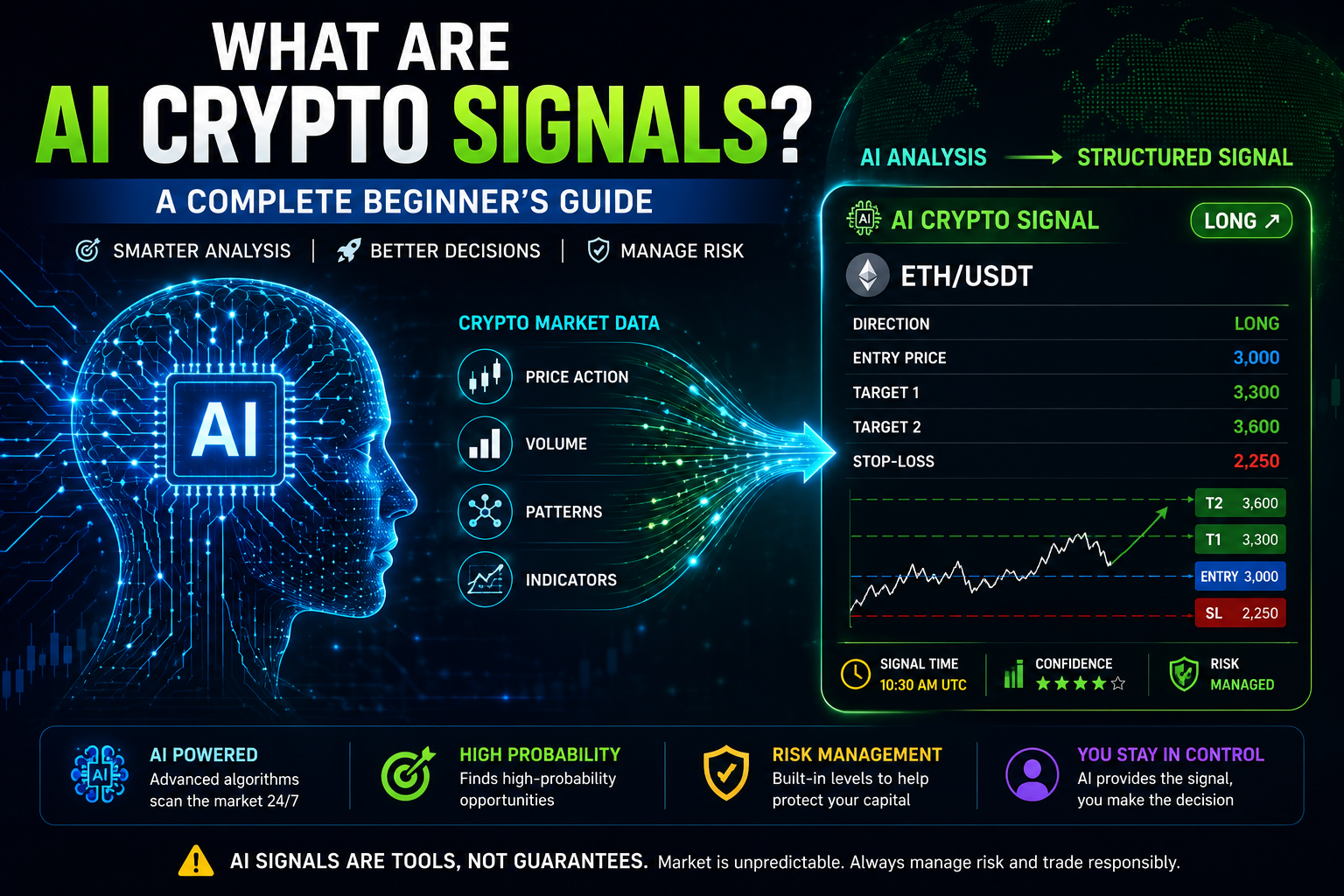
Quick Answer
An AI crypto signal is a structured trade idea for the cryptocurrency market that is created with the help of artificial intelligence. Instead of guessing, the system studies large amounts of market data and turns it into a clear setup. A complete AI crypto signal usually tells you the coin, the trade direction, an entry price, one or more target levels, and a stop-loss level.
A signal is a decision-support tool. It shows you a possible opportunity in a clear format. It does not promise profit, and it does not remove risk. You still make the final decision and manage your own money.
What Are AI Crypto Signals?
To understand AI crypto signals, it helps to break the term into two parts.
A crypto signal is a structured trade idea. It is not a random tip or a vague opinion like "Bitcoin will go up." A proper signal gives you clear numbers you can act on, such as where to enter, where to take profit, and where to exit if the trade goes wrong.
The "AI" part means the signal is created or filtered using artificial intelligence. Here, artificial intelligence is simply software that can study large amounts of data, find patterns, and rank possible setups much faster than a person can by hand.
So an AI crypto signal is a structured crypto trade idea that is built with the help of data analysis and pattern recognition, then presented in a clear format that a trader can review and act on.
The goal is not to replace your thinking. The goal is to save time and to present opportunities in a consistent, organized way.
![IMAGE 1 [A12].png](/uploads/webp/195a592c1839c600b50105b16bbc0ea2.webp)
How AI Crypto Signals Are Different From Normal Signals
A normal crypto signal is usually created by a human trader. The trader looks at charts, checks a few indicators, and decides on a setup. This works, but a human can only watch a limited number of coins at once. People also get tired, and emotions can affect their decisions.
An AI crypto signal works differently. The software can scan hundreds or even thousands of trading pairs in a short time. It applies the same rules to every coin, so the process stays consistent. It does not get bored, tired, or emotional.
But AI is not magic. Its output is only as good as its data and its design. If the market suddenly changes, or if unusual news hits, AI can be wrong just like a human. The best way to see AI is as a fast, consistent assistant, not as a source of perfect predictions.
How AI Analyzes the Crypto Market
AI crypto signals are usually built in layers. Each layer removes weak setups and keeps stronger ones. The exact method changes from one platform to another, but the general idea is similar.
Data collection. The system gathers market data such as price, trading volume, and price movement across many coins. More reliable data leads to more reliable analysis.
Indicator analysis. The system studies technical indicators. Common examples include the RSI, which measures if a coin may be overbought or oversold, moving averages, which show the trend direction, and volume, which shows how much trading activity is happening.
Pattern recognition. AI looks for repeating patterns in price and volume. It compares the current market with many past situations to judge how price might behave.
Filtering and ranking. The system removes weak setups and ranks the stronger ones. Only the setups that pass all the checks become signals.
It is important to remember one thing. This entire process is based on probability, not certainty. AI can say a setup looks strong, but it can never promise the result.
![IMAGE 2 [A12].png](/uploads/webp/bd5cbf8541211abc80d86ca3ed89f5b4.webp)
Anatomy of an AI Crypto Signal
Most complete AI crypto signals share the same basic parts. Once you understand these parts, you can read almost any signal.
Trading pair. The coin and the currency it is traded against, for example BTC/USDT.
Direction. Whether the trade idea is a long, betting the price will rise, or a short, betting the price will fall.
Entry price. The price level where the trade idea becomes active.
Target levels. One or more prices where you might take profit. Many services use several targets, such as a first, second, and third target.
Stop-loss. The price where you exit to limit your loss if the market moves against you.
Extra details. Some signals also include the signal time, the current status, and past performance information.
Here is a simple, hypothetical example to show the format. These numbers are only for explanation and are not a real trade:
Trading Pair: ETH/USDT. Direction: Long. Entry Price: 3,000. Target 1: 3,300. Target 2: 3,600. Stop-Loss: 2,250.
This example shows how a signal turns a trade idea into clear, defined levels. That structure is one of the main reasons traders find signals useful.
![IMAGE 3 [ A12].png](/uploads/webp/a5832e41038c8d94a48cf2ade71a75c6.webp)
AI Crypto Signals vs AI Trading Bots
Many people mix up AI crypto signals and AI trading bots. They are related but not the same.
An AI crypto signal gives you information. You read the signal and then decide whether to place the trade yourself. You stay in control of every action.
An AI trading bot places trades automatically. Once you set it up, it can open and close positions without asking you each time.
A signal can be used to feed a bot, but a signal by itself does not trade for you. If you value control and want to learn as you trade, signals are often the better starting point. Automation adds convenience but also adds new risks, because the software acts without your direct approval each time.
![IMAGE 4 [A12].png](/uploads/webp/b2f1aa3343eda9bcfbcb80c676025e0c.webp)
Types of AI Crypto Signals
AI crypto signals come in several forms. Knowing the types helps you choose what fits your style.
By market. Some signals are for the spot market, where you own the coin, and some are for the futures market, where you trade contracts and can use leverage.
By direction. Some services provide both long and short signals. Others are long-only, meaning they only suggest buying setups.
By trading style. Signals can suit scalping, which uses very short trades, day trading, which uses trades within a day, or swing trading, which uses trades held for days or weeks.
By access. Some signals are free and public. Others are premium and are shared with paying members only.
Benefits of AI Crypto Signals
AI crypto signals offer real, practical benefits when they are used carefully.
Speed and scale. AI can watch many coins at the same time and react quickly to new data.
Consistency. The same rules are applied to every setup, which reduces emotional and random decisions.
Clear structure. A good signal gives defined entry, target, and stop-loss levels, so you always know your plan before you trade.
Time saving. You do not need to analyze every coin yourself. The system does the heavy screening for you.
Learning support. Beginners can study how signals are built and slowly learn how professional setups look.
Limitations and Risks of AI Crypto Signals
This part is just as important as the benefits. Any honest look at AI crypto signals must include the limits.
AI learns from the past. It studies historical data to find patterns. But markets change, and old patterns can stop working. Past behavior does not guarantee future results.
No signal is always correct. Even strong, well-built signals will fail sometimes. Losing trades are a normal part of trading.
Surprises break setups. Sudden news, hacks, new regulations, or large market moves can quickly cancel a setup that looked strong minutes earlier.
Data quality matters. If the input data is poor, the output signal will also be weak.
Over-reliance is dangerous. Following signals blindly, without your own risk plan, is one of the fastest ways to lose money.
Futures and leverage add risk. Futures trading with leverage increases both possible gains and possible losses. With leverage, a position can even be liquidated before the stop-loss level is reached, depending on the leverage and market conditions.
None of this is financial advice. A signal is educational and informational. The final decision, and the responsibility, always stays with you.
How to Evaluate an AI Crypto Signal Provider
Not all signal providers are equal. Before you trust any service, check it carefully.
Transparency. Does the provider show both winning and losing results, or only the wins? Honest reporting is a strong sign of trust.
Clear method. Can the provider explain, at least in general terms, how the signals are made? A total black box with no explanation deserves more caution.
Defined risk. Do the signals include a stop-loss and clear levels? Setups without risk control are incomplete.
Realistic claims. Be very careful with any service that promises guaranteed profit, 100% accuracy, or risk-free trading. These claims are not realistic in trading.
Track record. How long has the provider operated, and how are results recorded and shown over time?
Fit with your risk. A signal is only useful if it fits your own budget, risk level, and trading style.
Common Mistakes Traders Make
Even good signals can lead to losses if they are used badly. Watch out for these common mistakes.
Following signals blindly without any personal risk plan. Ignoring the stop-loss or moving it out of fear. Using very high leverage that a small move can wipe out. Risking too much money on a single trade. Chasing a trade after the entry price has already passed. Expecting every signal to win, then panicking after one loss.
Avoiding these mistakes is often more important than finding the perfect signal.
Where CryptoAI Signal Fits
CryptoAI Signal is an example of an AI-assisted crypto signal platform. It focuses on Binance Futures perpetual markets and provides long-only setups, which means it only shares buying opportunities.
Each signal follows a structured format with a defined entry price, staged target levels, and a maximum stop-loss level. The platform also publishes a clear "No Signal Today" message on days when no setup meets its conditions, instead of forcing a trade.
CryptoAI Signal offers three access tiers: the Top 16 free public signals, the Top 6 VIP premium signals, and the Top 3 elite premium signals. The free tier lets new users see how the signals are structured before deciding anything.
A few points are important for honesty. The published target and stop-loss levels are market price levels, not guaranteed returns for your account. Any historical price movement, such as how far a coin moved after entry, is a measurement of the market, not a promise of profit for any user. Leverage is always your own choice, and a published stop-loss cannot fully protect a leveraged position from liquidation. As with any provider, you should review the service yourself and use your own risk management.
Conclusion
An AI crypto signal is a structured, data-driven trade idea for the crypto market. It gives you a clear direction, entry, target, and stop-loss, built with the help of pattern recognition and data analysis. Used well, it can save time, add structure, and support better decisions.
But a signal is a tool, not a promise. AI can be fast and consistent, yet it can still be wrong. The smartest approach is to treat signals as one input, evaluate any provider on transparency and honest risk, and always apply your own risk management. That mindset matters far more than any single signal.
Frequently Asked Questions
Are AI crypto signals accurate?
No signal system is always accurate. AI can find strong setups quickly and consistently, but markets are uncertain and losing trades are normal. Treat any signal as a probability, not a guarantee.
Are AI crypto signals financial advice?
No. AI crypto signals are educational and informational tools. They do not replace your own research, and the final trading decision and responsibility remain with you.
Do I need trading experience to use AI crypto signals?
Some experience helps, especially with risk management. Beginners can still learn a lot by studying how signals are structured, but they should start small and understand stop-losses before risking real money.
What is the difference between free and premium crypto signals?
Free signals are public and let you see how a service works. Premium signals are shared with paying members and are often filtered more selectively. Neither type can guarantee results.
Can AI crypto signals guarantee profit?
No. Any service that promises guaranteed profit, 100% accuracy, or risk-free trading is making an unrealistic claim. Real trading always involves risk, and no honest provider can remove it.