Every trade has two sides. One side is how much you can lose. The other side is how much you can gain. The risk-reward ratio is a simple tool that compares these two numbers before you enter a trade.
In crypto markets, prices can move fast in both directions. Because of this, knowing your risk-reward ratio can help you make calmer and more consistent trading decisions. This guide explains what the risk-reward ratio is, how to calculate it, and how to use it as part of your own risk management.
Quick Answer
The risk-reward ratio compares how much you risk on a trade to how much you aim to gain.
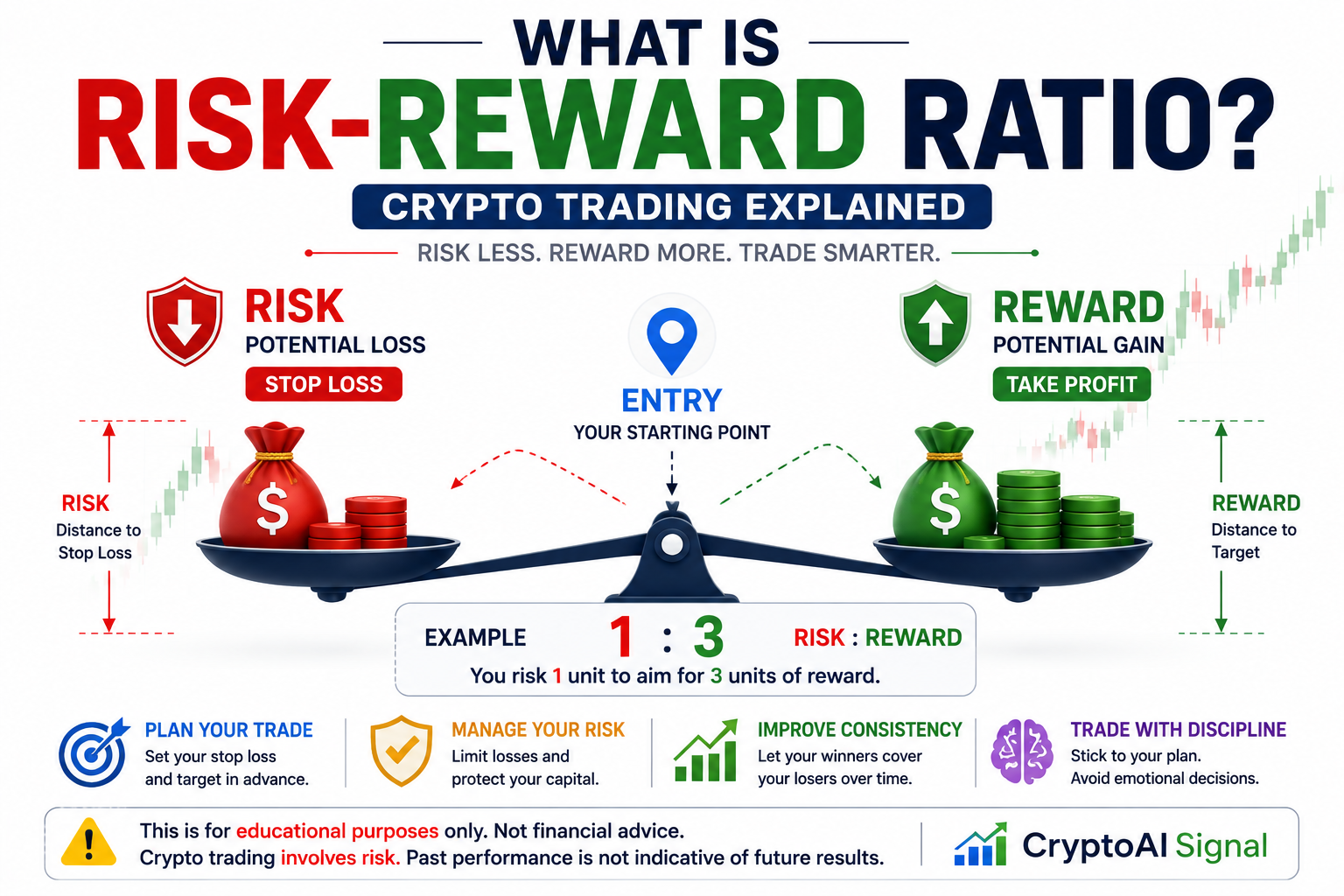
For example, if you risk $10 to make $30, your risk-reward ratio is 1:3. This means your possible reward is three times larger than your possible loss.
A better ratio means each winning trade can cover several losing trades. But the ratio alone does not tell you if a trade will be profitable. You also need to think about how often your trades reach their target. We will explain this later in the article.
What Is the Risk-Reward Ratio?
The risk-reward ratio measures the relationship between two distances on a price chart:
Risk is the distance from your entry price to your stop loss.
Reward is the distance from your entry price to your target (take-profit) price.
We usually write it as risk : reward.
A ratio of 1:2 means you risk 1 unit to aim for 2 units of profit. A ratio of 1:3 means you risk 1 unit to aim for 3 units. The higher the second number, the more reward you are aiming for compared to your risk.
Two important terms to know:
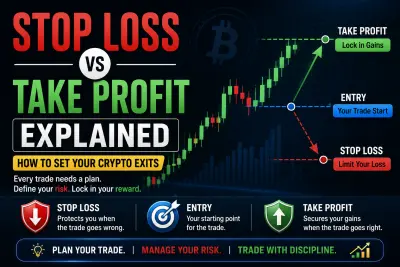
Stop loss is the price where you plan to exit a losing trade to limit your loss.
Take-profit target is the price where you plan to exit a winning trade to lock in your gain.
The risk-reward ratio only makes sense when you decide both of these levels before you enter the trade.
Why the Risk-Reward Ratio Matters
The risk-reward ratio helps you in a few practical ways.
First, it forces you to plan the trade before you enter. You have to choose your stop loss and target in advance. This reduces emotional decisions later.
Second, it lets you compare different trades fairly. A trade with a 1:3 ratio gives you more reward for the same risk than a trade with a 1:1 ratio.
Third, it connects directly to long-term results. If your reward is larger than your risk, you do not need to win every trade to stay profitable over time. A few strong winners can balance several small losers.
The ratio does not remove risk. Crypto trading always carries the chance of loss. But a clear risk-reward plan gives you a structured way to manage that risk instead of guessing.
![IMAGE 1 [A10].png](/uploads/webp/2c4bd81e86dd215cb9c945fa05679087.webp)
How to Calculate the Risk-Reward Ratio
The calculation uses three prices: your entry, your stop loss, and your target.
For a long trade (a trade that profits when price goes up), the formula is:
Risk = Entry Price − Stop Loss Price
Reward = Target Price − Entry Price
Risk-Reward Ratio = Risk : Reward
You then simplify the two numbers into a clean ratio.
You can use dollar amounts or percentages. The ratio stays the same either way, because it measures the relationship between the two distances, not the total size of the trade.
A Hypothetical Risk-Reward Example
Let's look at a simple example. These numbers are hypothetical and are only used to explain the math. They do not represent any real trade or result.
Imagine a long trade on a coin:
Entry price: $100
Stop loss: $90
Target price: $130
Now we calculate:
Risk = $100 − $90 = $10 per coin
Reward = $130 − $100 = $30 per coin
Ratio = 10 : 30 = 1 : 3
So this trade has a risk-reward ratio of 1:3. You are risking $10 to aim for $30.
We can also read this in percentages:
The stop loss is 10% below the entry.
The target is 30% above the entry.
10% risk to 30% reward is still 1:3.
This shows an important point. The risk-reward ratio is based on price levels, not on your position size or leverage. Leverage can make your gains and losses larger in your account, but it does not change the ratio between the risk and the reward.
Risk-Reward Ratio and Win Rate
Here is the part many beginners miss. A good risk-reward ratio alone does not make a strategy profitable. You also need to know your win rate.
Your win rate is the percentage of your trades that reach their target instead of hitting the stop loss.
The reason both numbers matter is simple. A higher reward-to-risk ratio lowers the win rate you need just to break even.
The break-even win rate is the win rate at which your winners and losers cancel out, before fees. You can calculate it like this:
Break-even win rate = 1 ÷ (1 + reward-to-risk)
Here are some common examples:
Risk-Reward Ratio Break-even Win Rate 1:1 50% 1:2 33.3% 1:3 25% 1:4 20%
![IMAGE 2 [A10].png](/uploads/webp/a634196d7e0a34e9d746acea871ca73d.webp)
This table shows why traders care about the ratio. With a 1:3 ratio, you only need to win about 1 out of every 4 trades to break even. With a 1:1 ratio, you need to win half of your trades just to stay level.
But be careful. A very high ratio often comes with a lower win rate, because larger targets are harder to reach. The goal is to find a balance that fits your strategy and the real market, not to chase the highest ratio on paper.
Risk-Reward in Structured Trade Setups
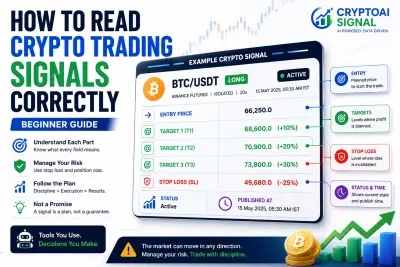
Structured trade setups make the risk-reward ratio easier to see, because they list the entry price, stop loss, and target levels clearly.
For example, structured signals, including those published by CryptoAI Signal, present a defined entry price, a stop loss, and one or more target levels. This lets you calculate the risk-reward ratio yourself before you decide to act.
Some setups use more than one target. In that case, the risk-reward ratio is different for each target. A nearby first target has a smaller reward compared to the risk. A further target has a larger reward. Many traders handle this by taking partial profit at the first target and holding part of the position for higher targets.
It also helps to know the difference between a maximum stop loss and your own exit. A published stop loss shows the lowest planned level for the setup. Your actual exit, position size, and how you manage the trade are still your own decisions. Because of this, two traders can use the same signal and still get different results.
Remember that a trading signal is a decision-support tool. It is not a guaranteed prediction. The risk-reward ratio helps you judge a setup, but it cannot remove market risk.
Common Mistakes to Avoid
Traders often reduce the value of the risk-reward ratio by making these mistakes:
Moving the stop loss lower after entry. This makes your risk bigger and quietly turns a good ratio into a bad one.
Setting targets just to make the ratio look good. A target must match real chart levels, not only your wished-for reward.
Ignoring the win rate. A 1:5 ratio is useless if the target almost never gets hit.
Closing winners too early. Cutting a trade far before the target reduces your real reward and breaks your plan.
Not calculating the ratio before entering. If you check it after entering, it is too late to change the plan calmly.
Forgetting fees and funding costs. On perpetual futures, fees and funding can slightly change your real result, especially on trades held for a long time.
Limitations of the Risk-Reward Ratio
The risk-reward ratio is useful, but it has clear limits.
It only measures planned levels. It does not know the real chance of each outcome. That is why you must combine it with win rate and market context.
It also assumes your stop loss and target are realistic. A tight stop can be hit by normal price movement, and an unrealistic target may never be reached. In fast markets, your stop loss may also fill at a slightly worse price than planned, which is called slippage.
Finally, the ratio does not guarantee anything. It is a planning tool, not a promise. Good risk-reward planning improves your process, but every crypto trade still carries the risk of loss.
Practical Checklist
Before you enter a trade, you can use this simple checklist:
Have I chosen my entry price?
Have I set a clear stop loss based on the chart, not on hope?
Have I set a realistic target based on real price levels?
Have I calculated the risk-reward ratio?
Does the ratio make sense for my win rate?
Have I decided my position size and how much I am willing to risk?
Do I have a plan for partial targets, if the setup uses them?
If you can answer yes to these questions, your trade is based on a plan, not on emotion.
Conclusion
The risk-reward ratio is one of the most useful tools in crypto trading. It compares what you risk to what you aim to gain, and it pushes you to plan every trade in advance.
But it works best when you use it with two other ideas: a realistic win rate and proper position sizing. A strong ratio, a sensible win rate, and controlled risk together form the base of a disciplined trading process.
No ratio can remove market risk or promise profit. What it can do is help you trade with structure, patience, and clear thinking, which matters far more over the long term than any single trade.
Frequently Asked Questions
What is a good risk-reward ratio in crypto trading?
Many traders aim for at least 1:2 or 1:3, meaning the reward is two or three times the risk. But there is no single perfect number. The right ratio depends on your strategy and your win rate. A lower ratio can still work if your win rate is high, and a high ratio can fail if the target rarely gets hit.
Is the risk-reward ratio the same as win rate?
No. The risk-reward ratio compares the size of your possible loss to your possible gain. The win rate is how often your trades reach their target. You need both to judge if a strategy can be profitable over time.
Does leverage change the risk-reward ratio?
No. The ratio is based on price levels: entry, stop loss, and target. Leverage changes how large your gains and losses are in your account, but it does not change the relationship between risk and reward. However, higher leverage increases the risk of liquidation, which is a separate danger.
How do I calculate risk-reward for a long trade?
Subtract the stop loss price from the entry price to find your risk. Subtract the entry price from the target price to find your reward. Then write the two numbers as a ratio and simplify. For example, $10 risk and $30 reward is a 1:3 ratio.
Can a good risk-reward ratio guarantee profit?
No. A good ratio improves your planning, but it cannot predict the market or guarantee any result. Every crypto trade carries risk, and outcomes also depend on your win rate, execution, fees, and market conditions.