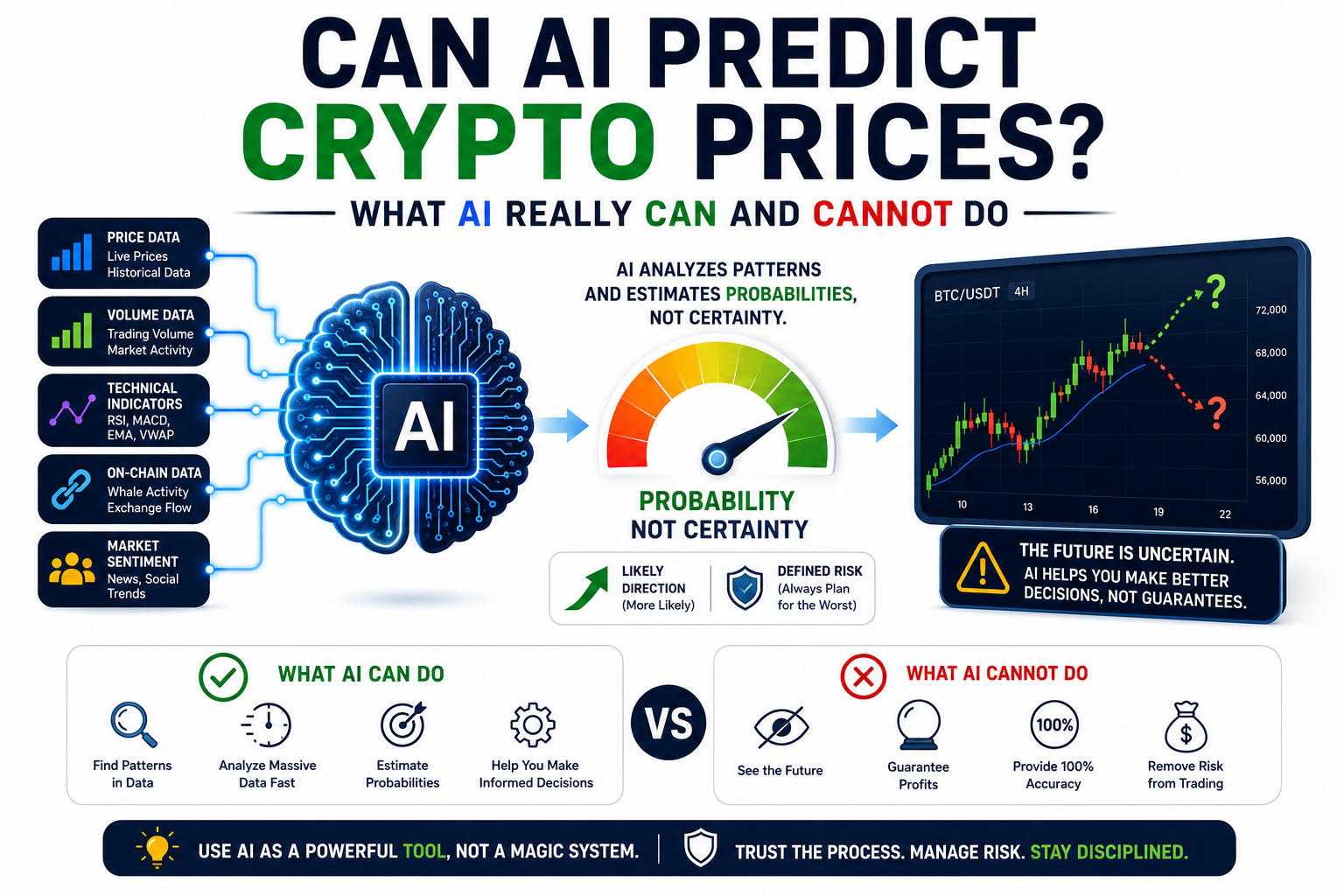
Quick Answer
Can AI predict crypto prices? The honest answer is no — not with certainty. No tool, human or machine, can know the exact future price of Bitcoin, Ethereum, or any altcoin.
But this short answer hides a more useful truth. AI cannot see the future, but it can read large amounts of market data, find patterns, and estimate probabilities much faster than a person. The real value of AI in crypto is not magic prediction. It is faster and more consistent analysis.
This article explains what AI can and cannot do in crypto markets, why perfect prediction is impossible, and how to judge AI crypto tools in an honest way.
What "Prediction" Really Means in Crypto
The word "prediction" causes a lot of confusion. Many people think prediction means knowing the future. In real markets, this kind of certainty does not exist.
In trading, a better word is "probability." A good analysis does not say "the price will go up." It says "based on the data, an upward move is more likely than a downward move — but it is not guaranteed."
This difference matters. A system that promises certain predictions is making a claim it cannot support. A system that works with probabilities is being honest about how markets actually behave.
What AI Actually Does in Crypto Markets
AI does not have special knowledge of the future. What it has is speed and scale. It can process far more information than a human in far less time.
Here is what AI can realistically do:
Read large amounts of price and volume data quickly.
Find repeating patterns in historical market behaviour.
Track many coins at the same time.
Apply the same rules again and again without getting tired or emotional.
Estimate the probability of different outcomes based on past data.
![IMAGE 1 [A14].png](/uploads/webp/5574d1255c54e9445b0bcbad736c7b59.webp)
In simple terms, AI turns raw market data into a structured, probability-based view. It does not remove risk. It helps organise information so a trader can make a more informed decision.
Why No AI Can Predict Crypto Prices With Certainty
Crypto markets are some of the hardest markets to predict. There are clear reasons for this.
Extreme volatility
Crypto prices can move sharply in minutes. A coin can rise or fall by double digits in a single day. This level of movement makes precise prediction very difficult.
Sudden news and events
Prices react to news that no model can see in advance. A regulation change, an exchange problem, a hack, or a single social media post can move the market instantly. These are often called "black swan" events — rare shocks that no historical data can predict.
Human behaviour
Markets are driven by people. Fear, greed, and hype do not follow fixed rules. AI can measure the results of human behaviour, but it cannot fully predict it.
The market reacts to itself
When many traders use similar tools, their actions change the market. A pattern that worked in the past may stop working once too many people rely on it. Markets are not fixed systems — they adapt over time.
Data limits and overfitting
AI learns from past data. But the past does not always repeat. Sometimes a model looks very accurate on old data but fails on new data. This problem is called "overfitting." The model memorised the past instead of understanding it.
![IMAGE 2 [A14].png](/uploads/webp/1895f7f41741dbfca1937c6e4eba6841.webp)
Because of these factors, any claim of guaranteed or near-perfect crypto price prediction should be treated as a warning sign, not a selling point.
Prediction vs Probability: The Key Difference
This is the most important idea in the whole article.
A prediction says: "The price will reach a fixed level." This is a promise about the future.
A probability-based approach says: "Based on current data, this setup has a reasonable chance of moving in this direction, and here is the level where the idea is proven wrong."
The second approach is realistic. It accepts that the trade can fail, and it plans for that failure in advance. This is why serious traders focus on risk management, not on perfect prediction.
![IMAGE 3 [A14].png](/uploads/webp/bdef4003f59cbf8e4379e31f9a420535.webp)
Where AI Genuinely Helps
AI is not useless just because it cannot predict the future. Used correctly, it offers real advantages.
Speed: it scans the market far faster than any human.
Coverage: it can watch hundreds of coins at once.
Consistency: it applies the same rules every time, without emotion.
Filtering: it can reduce a huge market down to a short list of setups worth studying.
Discipline: it can flag clear entry and exit levels, which supports better risk control.
The goal of good AI analysis is not to remove risk. It is to make analysis faster, more consistent, and easier to act on.
Common Myths About AI Crypto Prediction
Several myths cause traders to lose money. It helps to know them.
Myth 1: "AI can guarantee profits." No system can guarantee profit. Every trade carries risk.
Myth 2: "AI is always right." AI is only as good as its data and design. It makes mistakes, especially in new market conditions.
Myth 3: "AI removes the need to think." AI is a support tool. The final decision, and the risk, still belong to the trader.
Myth 4: "High accuracy in the past means high accuracy in the future." Past results do not guarantee future results. This is true for humans and machines.
How to Judge AI Crypto Tools Honestly
If you are looking at an AI crypto tool or signal service, judge it with clear questions.
Does it promise guaranteed profit or 100% accuracy? If yes, be careful.
Does it explain its risk levels, not just its targets?
Can you see past results, including losing trades, not only wins?
Does it clearly separate education from financial advice?
Is the method described in an honest, understandable way?
A trustworthy tool talks openly about risk and limitations. A weak tool hides them behind big promises.
![IMAGE 4 [A14].png](/uploads/webp/a28cfc1a73d5e0dd3445e58ed4c0e903.webp)
How CryptoAI Signal Approaches This
CryptoAI Signal is an AI-assisted crypto signal platform. It is built around this same honest idea: structured analysis, not guaranteed prediction.
Instead of promising a fixed future price, each signal is presented as a structured setup with clearly defined levels — an entry price, staged targets, and a maximum stop-loss level. This turns a market idea into a plan with defined risk, rather than a vague forecast.
The platform focuses on Binance Futures perpetual markets and publishes structured setups across free and premium tiers. It does not claim to know the future. When no setup meets its filtering standards, it can simply state that no signal qualifies that day.
This matters because it reflects how markets really work. The point is not to predict prices perfectly. The point is to give traders a structured, risk-defined starting point they can evaluate for themselves.
Risk Considerations You Should Never Ignore
AI analysis does not remove market risk. A few points are worth repeating.
Every trade can fail, even a well-analysed one.
On futures markets, leverage increases both potential gains and potential losses.
A stop-loss level is based on the asset price. Depending on leverage and market conditions, a position may still be liquidated before that level is reached.
No signal, AI or human, should be followed blindly.
Always use your own risk management and never risk money you cannot afford to lose.
Conclusion
So, can AI predict crypto prices? Not with certainty — and any tool that claims otherwise is not being honest. What AI can do is process data quickly, find patterns, and estimate probabilities, which helps traders make more informed and disciplined decisions.
The smartest way to use AI in crypto is to treat it as a support tool, not a crystal ball. Focus on probabilities, defined risk, and clear planning. When AI is used this way — to build structured, risk-defined setups instead of magic predictions — it becomes genuinely useful, without pretending to do the impossible.
Frequently Asked Questions
Can AI predict crypto prices accurately?
No tool can predict crypto prices with certainty. AI can estimate probabilities based on data, but crypto markets are affected by sudden news and human behaviour that no model can fully predict.
Is AI useful for crypto trading at all?
Yes. AI is useful for fast data analysis, pattern detection, and consistent filtering across many coins. It supports better decisions, but it does not remove risk or guarantee profit.
Why can't AI guarantee profit in crypto?
Markets change, react to unexpected events, and adapt to widely used strategies. Because the future is uncertain, no system can guarantee profit. Every trade carries real risk.
What is the difference between prediction and probability?
Prediction claims to know the future price. Probability estimates the chance of an outcome while accepting it may not happen. Serious trading is built on probability and risk management, not perfect prediction.
Should I trust an AI tool that promises 100% accuracy?
No. A promise of 100% accuracy or guaranteed profit is a strong warning sign. Honest tools explain their risks, show both wins and losses, and never guarantee results.