Introduction
Computers now make many trading decisions in crypto and other markets. But not all trading systems think the same way. Two main approaches are used: rule-based trading and machine learning trading.
A rule-based system follows fixed instructions written by a human. A machine learning system studies past data and builds its own decision logic. Both can work in crypto markets, and both have real strengths and real weaknesses.
This article compares the two from a technical point of view. You will learn how each one works, how they differ, where each performs well, and where each can fail. This will help you understand any automated or AI-based trading tool, including crypto trading signal services.
What Is Rule-Based Trading?
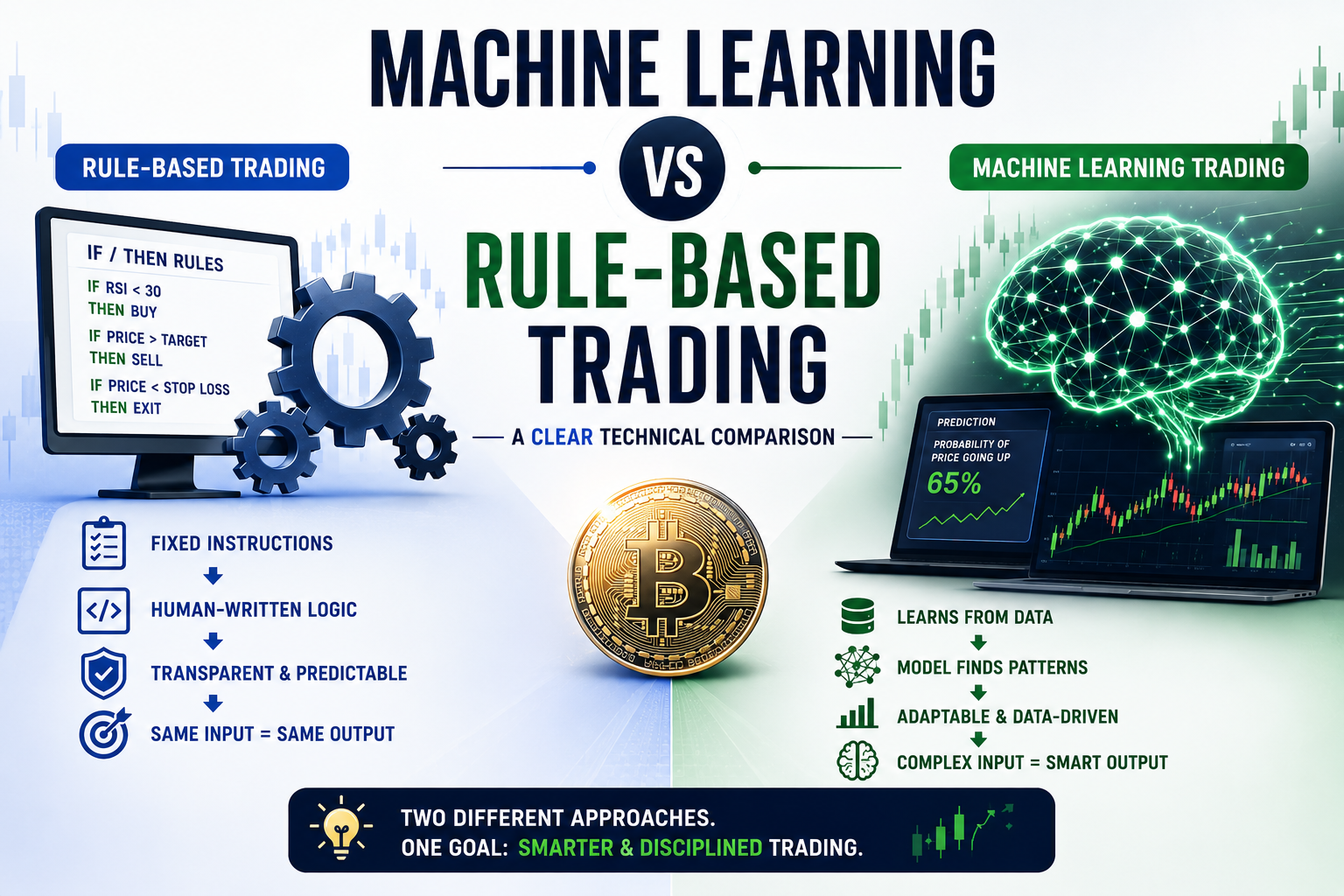
Rule-based trading uses a set of fixed conditions to decide when to buy or sell. A human designs these conditions in advance, and the system only does what the rules allow.
A simple set of rules might look like this:
If the RSI falls below 30, open a long position.
If the price reaches the target, close the trade with profit.
If the price hits the stop loss, close the trade to limit loss.
RSI (Relative Strength Index) is a common indicator that measures whether an asset may be overbought or oversold.
Because a person writes every rule, the logic is fully visible. You can read the rules and know exactly why a trade happened. For this reason, rule-based systems are often called transparent or "white box" systems.
Rule-based trading is also known as systematic trading or classic algorithmic trading. Most traditional technical strategies — moving average crossovers, breakout systems, or fixed RSI levels — are rule-based.
What Is Machine Learning Trading?
Machine learning (ML) trading uses models that learn from historical data instead of following fixed human rules. The developer does not tell the system exactly what to do. Instead, the system is given data and learns patterns on its own.
There are three common types of machine learning used in trading:
Supervised learning: The model learns from labeled examples. For example, it may learn to estimate whether the next price move is more likely to be up or down.
Unsupervised learning: The model groups similar market conditions together without labels.
Reinforcement learning: The model learns by trial and error and improves its actions based on rewards and penalties.
The main idea is that the model builds its own decision logic from data. This logic can capture complex, non-linear relationships that are hard to write as simple rules. But the same logic is harder to read and explain. This is why ML systems are often called "black box" systems.
How Each Approach Works
The two approaches follow very different workflows.
Rule-based workflow:
A human selects indicators and defines exact conditions.
The strategy is tested on historical data (backtesting).
The system is deployed to live markets.
It checks the conditions on new price data.
When a condition is met, it acts exactly as written.
Machine learning workflow:
Large amounts of data are collected and cleaned.
The developer selects features (the inputs the model will study).
The model is trained on part of the data.
It is tested on unseen data to check if it learned real patterns.
Once deployed, it produces predictions or probabilities, and the system acts on them.
The key difference is simple. In rule-based trading, humans define the logic. In machine learning trading, the model builds the logic from data.
![IMAGE 1 [A15].png](/uploads/webp/cefe24e708858595a66b08749f6d5955.webp)
Key Technical Differences
Both approaches can automate trading, but they differ in important ways.
Decision Logic
Rule-based systems use fixed, human-written logic. The same input always gives the same output. Machine learning systems use learned logic that can be complex and non-linear.
Transparency and Interpretability
Rule-based systems are easy to read. You can see every condition. Machine learning models, especially deep models, are harder to interpret. It can be difficult to explain exactly why the model made a decision.
Adaptability
Rule-based systems are static. They do not change unless a human updates them. Machine learning systems can adapt to new patterns if they are retrained on fresh data. However, adaptation is not automatic or guaranteed.
Data Requirements
Rule-based systems can work with limited data. Machine learning systems usually need large amounts of clean, high-quality data to learn well. Poor data leads to poor results.
Overfitting Risk
Overfitting happens when a system fits past data too closely and then fails on new data. Both approaches can overfit, but the risk is often higher and harder to detect in machine learning, because the models are more complex.
Maintenance and Complexity
Rule-based systems are simpler to build, test, and debug. Machine learning systems need more skill, more computing power, and ongoing monitoring.
Here is a simple comparison:
Factor Rule-Based Trading Machine Learning Trading Decision logic Fixed, human-written Learned from data Transparency High (white box) Often low (black box) Adaptability Low, manual updates Higher, needs retraining Data needed Lower High Overfitting risk Present Present and harder to spot Complexity Lower Higher
![IMAGE 2 [A15].png](/uploads/webp/66d09eeb92f25034226f4cfe901d8dbd.webp)
Strengths and Limitations of Rule-Based Trading
Strengths:
The logic is transparent and easy to understand.
It is simple to backtest and debug.
Behavior is predictable and consistent.
It is cheaper to build and run.
Limitations:
It is rigid and cannot adapt on its own.
It may miss complex patterns that simple rules cannot capture.
It needs manual updates when market conditions change.
Strengths and Limitations of Machine Learning Trading
Strengths:
It can find complex, non-linear patterns.
It can study many inputs at the same time.
It can adapt when retrained on new data.
Limitations:
It needs large amounts of good-quality data.
It carries a high risk of overfitting.
Its decisions are hard to interpret.
It is expensive and needs constant monitoring.
It can fail quietly when the market behaves differently from the training data.
Which Approach Is Better?
There is no single winner. The better approach depends on the goal, the data, the resources, and the market.
Rule-based trading is a strong choice when clarity, simplicity, and robust logic matter most. Machine learning is useful when you need to study complex, multi-factor patterns and you have good data and careful testing.
In real markets, many strong systems do not choose only one method. They combine both.
Hybrid Systems
A hybrid system uses both approaches together. For example, a machine learning model might generate or filter trade ideas, while fixed rules handle risk management and trade execution.
This design tries to take the strengths of each method. The ML part looks for patterns, and the rule-based part keeps the system controlled and predictable. Many professional trading systems work this way.
![IMAGE 3 [ A15].png](/uploads/webp/9d6883274a94aa2b2154f7b5aafb30c7.webp)
How This Applies to Crypto Trading Signals
Crypto markets are open 24 hours a day and can move very fast. Because of this, many crypto tools use automation.
Crypto trading signal services may use rule-based filters, machine learning models, or a mix of both to select trade setups. The method behind a signal is less important than how the signal is structured and how honestly its results are reported.
CryptoAI Signal is an AI-assisted signal platform that publishes structured trade setups with a defined entry price, target levels, and a stop-loss level. This structure lets a user see the exact plan of each signal instead of a vague prediction.
It is important to remember one point. No matter which method is used, a trading signal is a decision-support tool, not a guaranteed prediction. Automated systems can be wrong, and all trading carries risk. In crypto futures, if leverage is used, a position may even be liquidated before the stop-loss level is reached, depending on market conditions. Good risk management always stays your responsibility.
Common Mistakes and Misconceptions
Believing machine learning always beats rules. More complexity does not always mean better results.
Thinking ML can predict the future reliably. Models estimate probabilities; they do not know what will happen.
Ignoring overfitting. A system that looks perfect on past data may fail on live data.
Forgetting risk management. No method removes the need for stop losses and position control.
Conclusion
Rule-based trading and machine learning trading are two different tools, not two levels of the same tool. Rule-based systems are transparent, simple, and predictable but rigid. Machine learning systems are flexible and powerful but complex, data-hungry, and harder to trust blindly.
Neither method removes risk, and neither guarantees profit. Understanding how each one works helps you evaluate any automated or AI-based trading system with clear eyes — including crypto trading signal services. The smartest question is often not "which is better," but "which fits this problem," and sometimes the answer is a careful mix of both.
Frequently Asked Questions
Is machine learning better than rule-based trading?
Not always. Machine learning can find complex patterns, but it needs good data and careful testing. Rule-based systems are simpler and more transparent. The better choice depends on the goal and the situation.
Can rule-based trading use indicators like RSI and moving averages?
Yes. Most traditional rule-based strategies are built on indicators such as RSI, moving averages, and breakouts, using fixed conditions written by a trader.
Does machine learning guarantee profits in trading?
No. Machine learning models estimate probabilities based on past data. They can be wrong, especially when market conditions change. No trading method can guarantee profit.
What is overfitting in trading models?
Overfitting happens when a model fits past data too closely and then performs poorly on new data. It is a common risk in both rule-based and machine learning systems.
Do crypto signal services use AI or fixed rules?
It varies. Some use fixed rules, some use machine learning, and some use both. What matters most is how clearly each signal is structured and how honestly its results are reported.