Quick Answer
Crypto trading signals can be worth it, but not for every trader and not in every situation.
A trading signal is a structured trade idea. It usually includes an entry price, a stop loss, one or more target levels, and a trade direction. A good signal saves you research time and gives you a clear plan. A weak or unclear signal can cost you money and teach you nothing.
So the honest answer is this: signals are worth it only when they are transparent, when you fully understand the risk, and when you still make your own final decision. They are not worth it if you follow them blindly or expect guaranteed profit.
The rest of this article explains when signals help, when they hurt, what you actually pay for, and how to test a signal service before you trust it with real money.
![IMAGE 1 [A19].png](/uploads/webp/d0d92f16a2e7ec272c050497a5c2f562.webp)
What "Worth It" Really Means for Trading Signals
Before you decide, it helps to define "worth it" clearly. Many traders judge a signal service by one lucky trade. That is the wrong measure.
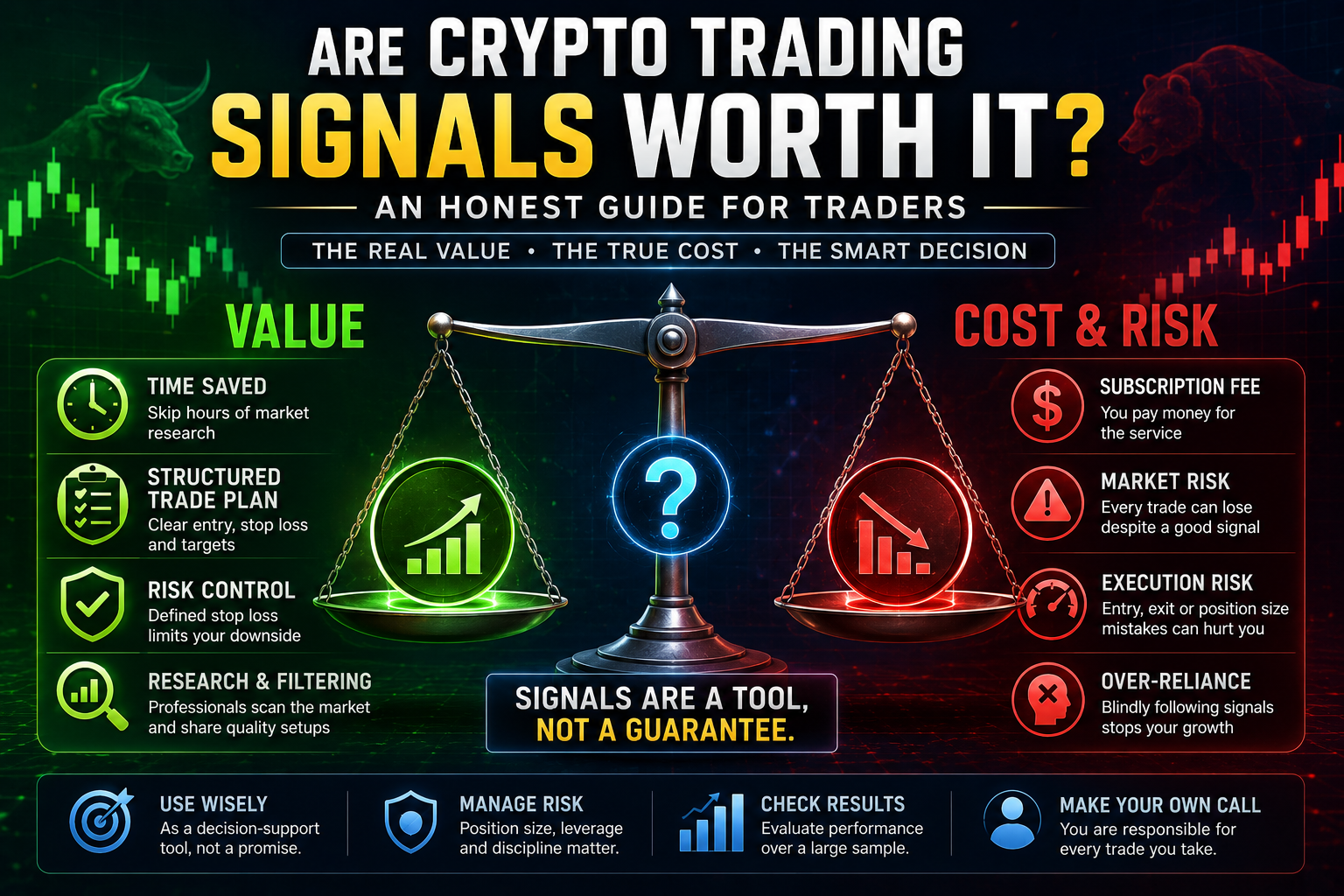
A signal service is worth it when its total value is higher than its total cost, measured over many trades — not one win and not one loss.
Value is more than profit. It also includes:
Time saved on market research
A clear, structured trade plan instead of guesswork
Better risk control through defined stop-loss levels
Learning how a proper trade setup looks
Cost is also more than the subscription price. It includes:
The money you risk on each trade
The risk of depending too much on another person's decisions
The risk of following low-quality signals
When you look at both sides honestly, "worth it" becomes a fair question you can answer with evidence, not emotion.
What Crypto Trading Signals Can and Cannot Do
Signals are useful, but they are often misunderstood. Being clear about their real role protects you from disappointment.
A crypto trading signal can:
Give you a ready-made trade idea with defined levels
Save time you would spend on chart analysis
Add discipline by setting a stop loss and targets in advance
Help beginners see how experienced setups are built
A crypto trading signal cannot:
Predict the future with certainty
Remove market risk
Guarantee profit on any single trade
Manage your position size or emotions for you
This is the most important idea in the whole article: a trading signal is a decision-support tool, not a promise. The market decides the outcome, not the signal. Any service that claims certain profit is making a claim it cannot honestly support.
What You Are Really Paying For
When you pay for premium signals, you are not buying guaranteed wins. You are paying for research, filtering, and structure.
A serious signal provider studies many coins, applies its own analysis method, and then shares only the setups that pass its filters. You are paying for that filtering work and for a clear plan you can act on quickly.
You are also paying for consistency. A good service gives you setups in the same clear format every time, so you always know the entry, the stop loss, and the targets before you enter a trade.
What you are not paying for is a magic result. If a provider sells you a "no-loss" promise, they are selling something that does not exist in real trading.
The Real Costs and Risks of Using Signals
Signals carry costs that go beyond the monthly fee. You must understand these before you decide if the service is worth it.
Market risk. Every trade can lose. A stop loss limits the loss, but it does not remove it.
Execution risk. A signal gives a plan, but you still have to enter and exit correctly. Slow action, wrong position size, or emotional decisions can turn a good setup into a loss.
Leverage and liquidation risk. Many crypto signals are built for futures markets. If you use high leverage, your position can be liquidated before the stop-loss price is even reached. A published stop loss is based on the asset price. It does not control your leverage, and it cannot promise protection from liquidation.
Over-reliance risk. If you copy every signal without understanding it, you never learn to trade. That makes you dependent and fragile.
A signal is only worth it when you accept these risks with open eyes and manage them with proper position sizing.
![IMAGE 2 [A19].png](/uploads/webp/54024d5f7098521fe2cc19d651389389.webp)
When Crypto Trading Signals Are Worth It
Signals make sense for some traders and some goals. They are usually worth it when:
You are still learning and want to see well-structured setups
You do not have time to analyse the market every day
You want a clear plan with a fixed stop loss and defined targets
You use signals as one input, and still make your own final choice
The provider is transparent and shows both wins and losses
In these cases, signals act like a research assistant. They do part of the work, but you stay in control.
When Crypto Trading Signals Are Not Worth It
Signals are a waste of money in other situations. They are usually not worth it when:
You expect guaranteed profit or a "no-loss" system
You follow every signal blindly, with no risk management
You use very high leverage and ignore liquidation risk
The provider hides losing trades or shows only winners
You cannot verify any of the past results
In these cases, the problem is not the signal itself. The problem is how it is being used, or a provider that is not honest. Both destroy any value the signal could have offered.
How to Test if a Signal Service Is Worth It
You do not have to guess. You can test a signal service in a calm, structured way before you pay or before you risk real money.
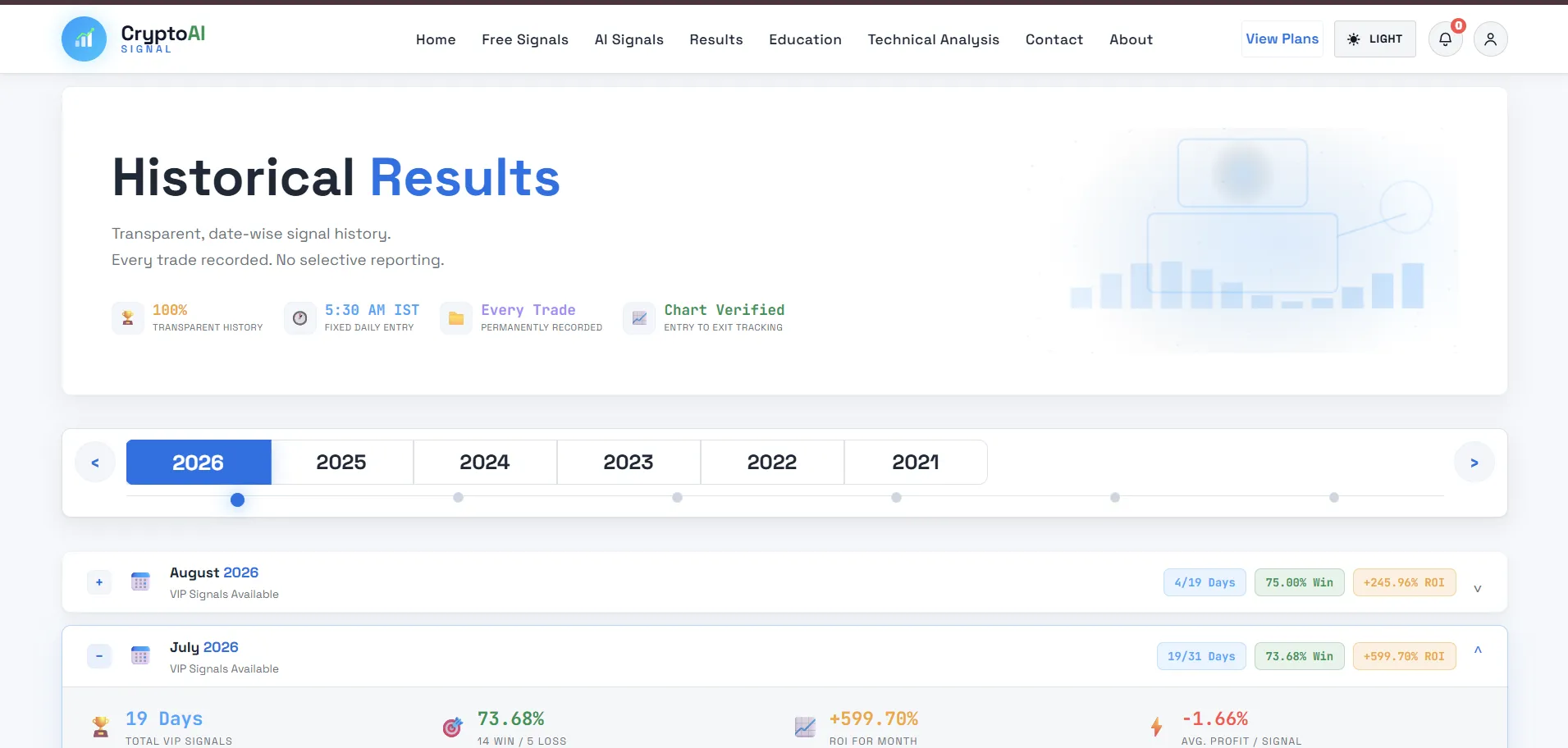
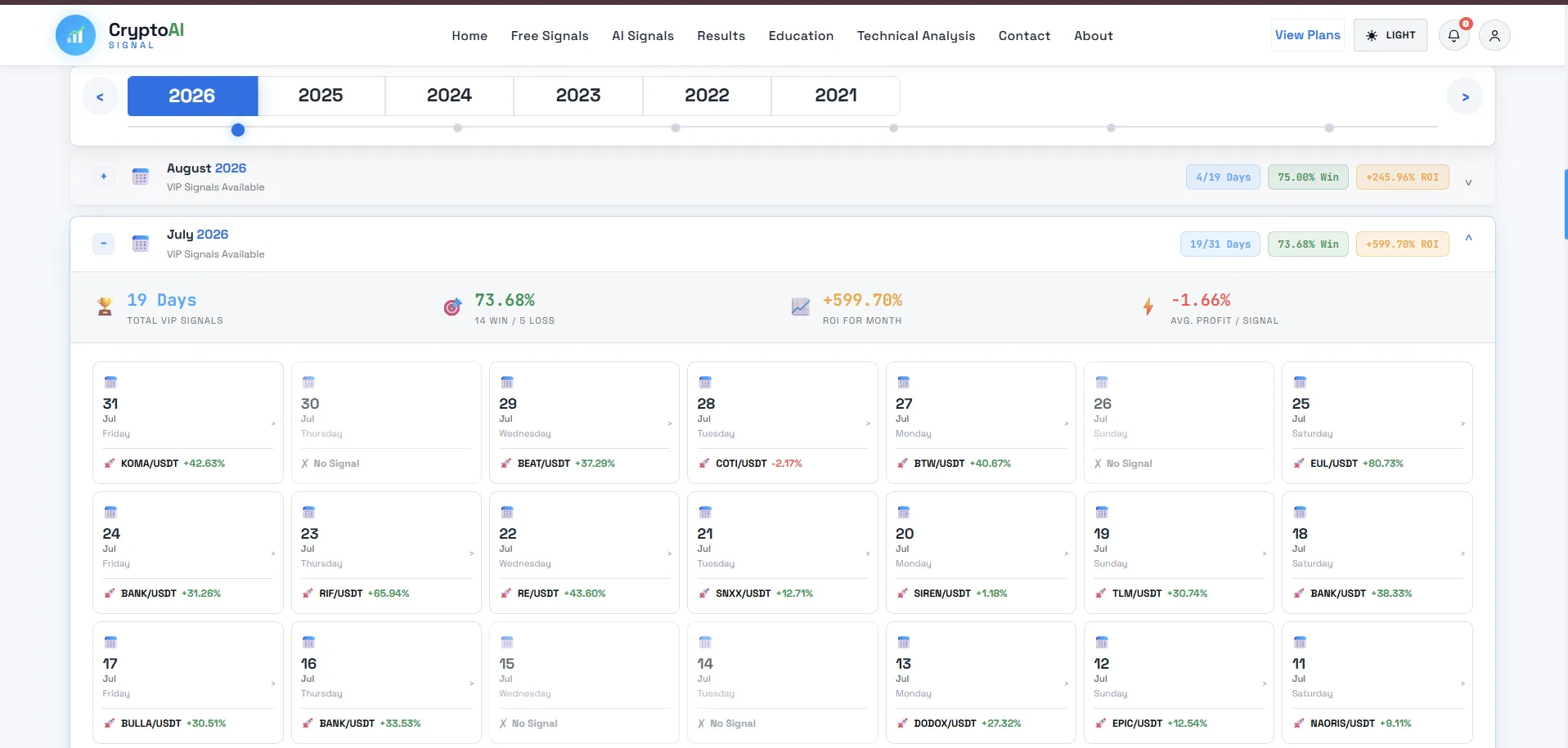
Check for transparency. A trustworthy provider shows a full record, including losing trades, not only the best results. Selective history is a warning sign.
Look for clear, defined levels. Every signal should include an entry, a stop loss, and target levels. Vague "buy now" messages are not real signals.
Start by watching, not trading. Follow the free or public signals first. Track them on paper for a few weeks before you commit money.
Test with small size. When you do go live, use a small position that you can afford to lose while you judge the service.
Judge over many trades. One win proves nothing. Look at how the setups perform across a larger sample.
This method costs you time, not money, and it protects you from paying for a service that cannot back up its claims.
![IMAGE 3 [A19].png](/uploads/webp/10f46b141bb24ed4d0396e7ff0475e9d.webp)
Common Mistakes That Make Signals a Waste of Money
Even a good signal can fail in the wrong hands. These are the mistakes that most often turn signals into losses:
Blind copying. Following signals without understanding the setup or the risk.
Wrong position size. Risking too much on a single trade, so one loss hurts badly.
Chasing entries. Entering far above the given entry price and breaking the plan.
Ignoring the stop loss. Moving or removing the stop loss when the trade goes against you.
Over-leveraging. Using high leverage that causes liquidation before the plan can work.
No tracking. Never recording results, so you cannot tell if the service is actually worth it.
Fix these habits first. Often the signal was fine — the execution was the real problem.
Where CryptoAI Signal Fits (And Its Limits)
If you are comparing providers, it is fair to see how a specific service fits this honest framework. CryptoAI Signal is one example of a structured, transparency-focused approach.
CryptoAI Signal publishes long-only signals for Binance Futures perpetual markets. Each signal is shared in a fixed format with an entry price, three target levels (Target 1 at +10%, Target 2 at +20%, Target 3 at +30%), and a maximum stop loss at −25%. When no setup meets the criteria, a "No Signal Today" message is published instead of a forced trade. There are three access levels: Top 16 Free Public, Top 6 VIP Premium, and Top 3 Elite Premium.
The free public tier matters most for the "worth it" question. It lets you watch real signals and judge the method before you pay anything. That is exactly the kind of low-risk test described earlier in this article.
It is just as important to be clear about the limits:
The signals are long-only, so they aim for upward moves and do not guide short trades or down-market strategies.
The published target and stop-loss figures are price levels, not guaranteed returns. They describe the plan, not your result.
Because these are futures markets, your own leverage choice can cause liquidation before the stop-loss price is reached. That risk stays with you.
You should still check the public record yourself and start small, rather than trust any claim on faith.
Read honestly, none of this is a sales promise. It is a structure you can evaluate — and evaluating it yourself is the whole point.
A Simple "Worth It" Checklist
Before you pay for any crypto signal service, run through this quick checklist:
Does the provider show a full record, including losses?
Does every signal have a clear entry, stop loss, and targets?
Can you test it for free or on paper first?
Do you understand the risk, including leverage and liquidation?
Will you still make your own final decision?
Are you judging results over many trades, not one?
If you can answer "yes" to most of these, a signal service may be worth it for you. If you answer "no" to several, wait and keep testing before you spend money.
Conclusion
Are crypto trading signals worth it? They can be — but only under honest conditions.
Signals are worth it when they are transparent, clearly structured, and used as support for your own decisions, with proper risk control. They are not worth it when you expect guaranteed profit, follow them blindly, or use a provider that hides its losses.
The smart approach is simple: treat signals as a tool, not a promise. Test any service for free first, start small, manage your risk, and judge it over many trades. If a service passes that test, it can genuinely add value. If it cannot, no subscription price is low enough to make it worth it.
Frequently Asked Questions
Are crypto trading signals worth paying for?
They can be, if the provider is transparent and the signals are clearly structured with an entry, stop loss, and targets. Paid signals are worth it only when they save you time and improve your discipline. They are not worth it if you expect guaranteed profit or follow them without your own risk management.
Do crypto trading signals guarantee profit?
No. A trading signal is a decision-support tool, not a prediction. The market decides the result. Any provider that promises guaranteed profit or a no-loss system is making a claim that cannot be supported in real trading.
Are free crypto signals better than paid ones?
Not automatically. Free signals are useful for testing a provider and learning how setups look. Paid signals may offer more selective filtering. The better choice is the one that is transparent and fits your risk tolerance, whether it is free or paid.
How do I know if a signal provider is trustworthy?
Look for a full public record that includes losing trades, clear and defined trade levels, and the ability to test the service before paying. A provider that shows only winning trades or hides its history should be treated with caution.
Can I lose money even with a good signal?
Yes. Every trade carries risk. A stop loss limits a loss but does not remove it. On futures markets, high leverage can even cause liquidation before the stop-loss price is reached. Good signals reduce guesswork, but they never remove market risk.