Introduction
A crypto trading signal can look simple at first. You see a coin, a direction, an entry price, and a few target levels. It seems easy to follow.
But reading a signal correctly is very different from just looking at it. Many new traders lose money not because the signal was wrong, but because they read it in the wrong way. They confuse a price level with a promise. They mix up market movement with their own result.
This guide explains how to read crypto trading signals correctly. You will learn what each part of a signal means, what a signal does not tell you, and the mistakes that cause the most confusion. The goal is to help you treat a signal as a decision-support tool, not as a guaranteed prediction.
What a Crypto Trading Signal Really Is
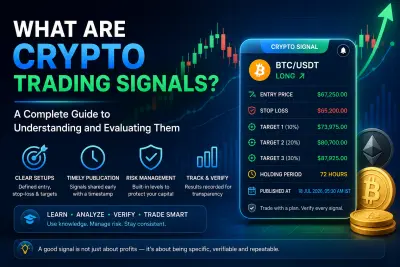
A crypto trading signal is a structured trade idea based on market analysis. It usually includes a trading pair, a direction, an entry price, one or more target levels, and a stop loss.
The key word here is idea. A signal is a plan, not a promise. The market can always move in a different way than expected. So the correct way to read a signal is to see it as information you can study and decide on, not as a fixed outcome.
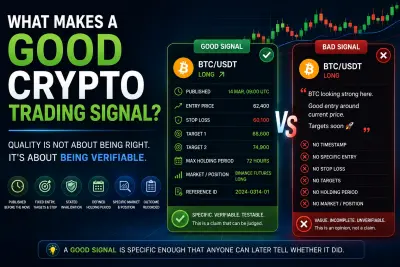
A good signal gives you clear numbers. A clear signal is easier to evaluate, follow, and check later. But even the clearest signal still carries risk, because no one can control how the market will move.
![IMAGE 1 [ A6 ].png](/uploads/webp/384df9640ea13607d1452482fc9bdd4f.webp)
[IMAGE 1 — INSERT HERE] Image type: Diagram / infographic Purpose: Show that a trading signal is a structured trade idea, not a guaranteed result. Visual concept: A simple labeled card showing the parts of a signal (pair, direction, entry, targets, stop loss) with a small note that reads "a plan, not a promise." Alt text: Diagram of a crypto trading signal showing pair, direction, entry price, targets, and stop loss.
The Main Parts of a Trading Signal
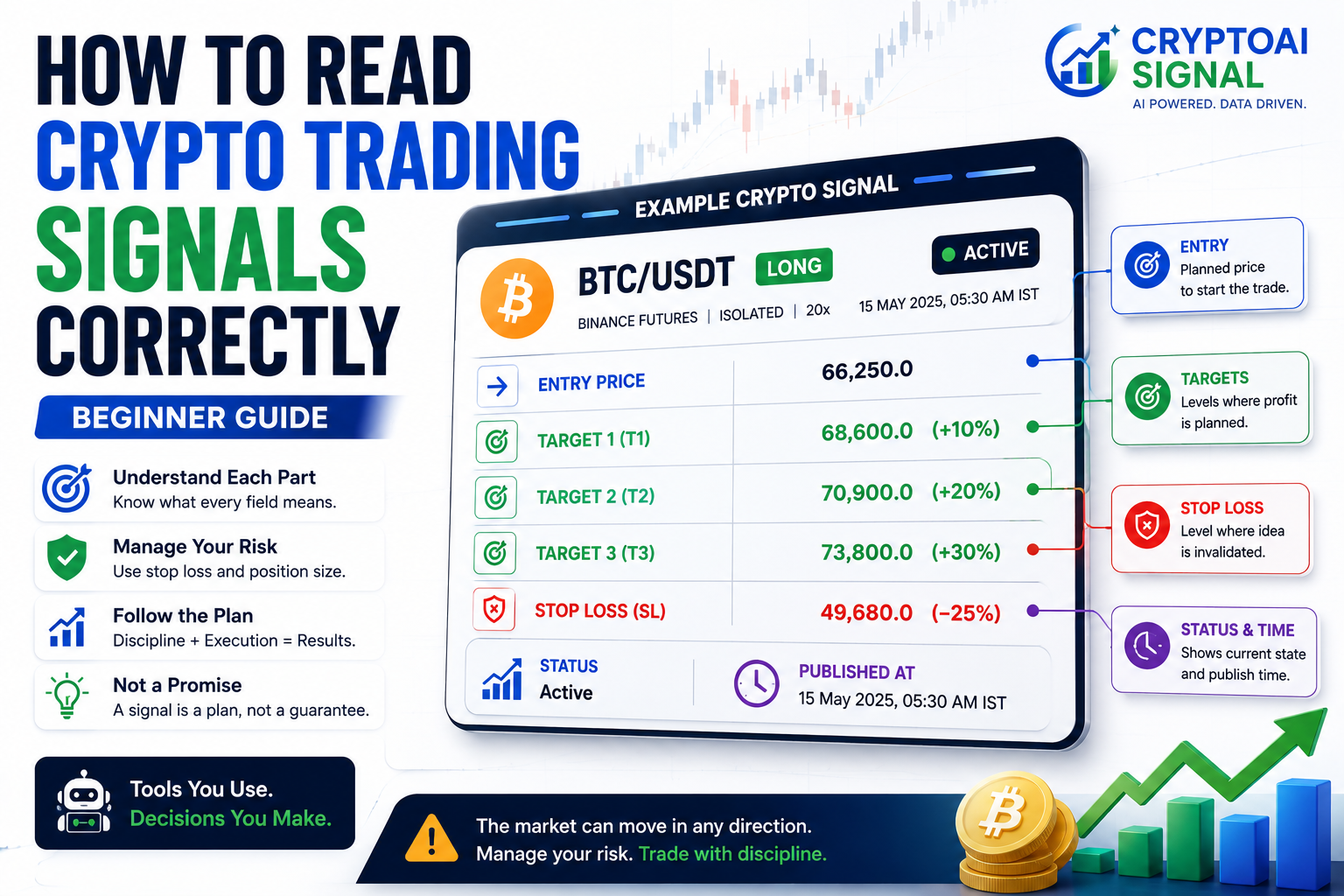
Most crypto trading signals are built from the same basic parts. When you can name each part, reading a signal becomes much easier.
The main parts are:
Trading pair — the coin and the currency it trades against, such as BTC/USDT.
Direction — whether the idea expects the price to go up or down.
Entry price — the price level where the trade idea is planned to start.
Target levels — the price levels where taking profit is planned.
Stop loss — the price level where the idea is treated as wrong or invalid.
Status — the current state of the signal, such as active or completed.
Timing — when the signal was published.
On CryptoAI Signal, signals are published for Binance Futures perpetual markets and are long-only. This means every published trade idea expects the price to move up. When no strong setup is found, the platform publishes "No Signal Today" instead of forcing a weak idea.
How to Read Each Part Correctly
Knowing the parts is not enough. You also need to read each one with the correct meaning.
Trading Pair
The trading pair tells you which asset the idea is about. BTC/USDT means the idea is about Bitcoin priced in USDT. Always confirm you are looking at the correct market before you do anything.
Direction
Direction tells you what the idea expects. A long signal expects the price to rise. Some services also publish short signals, which expect the price to fall. Reading direction correctly means you know which way the plan is pointing before you study the numbers.
Entry Price
The entry price is the planned level to start the trade. Read this as a target zone, not a fixed point. The market may never reach it, or it may pass it quickly. When you actually place an order, your real fill price can be slightly different because of slippage and market speed.
Target Levels
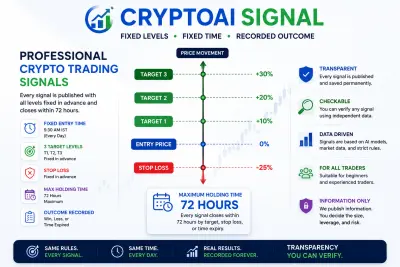
Target levels are where taking profit is planned. On CryptoAI Signal, published targets are set as price moves of about +10% (Target 1), +20% (Target 2), and +30% (Target 3) from the entry.
Read these targets as movements in the asset price, not as your personal profit. Your real result depends on how much you traded, your entry, and your fees.
Stop Loss
The stop loss is the price level where the idea is treated as invalid. On CryptoAI Signal, the published maximum stop loss is around −25% from entry.
Reading the stop loss correctly is very important. A published stop loss is based on the underlying asset price. It does not guarantee that you will avoid a larger loss or a liquidation, because that depends on how you execute the trade.
![IMAGE 2 [A6].png](/uploads/webp/e0dce39ac941dcf8bb1f942c40d7b784.webp)
How to Read Signal Status Labels Correctly
Status labels are one of the most misread parts of any signal. A status label describes what happened to the price, not what happened to you.
On CryptoAI Signal, common status labels include:
Full Profit — the price reached the published target level.
Partial Profit — the price reached one of the earlier target levels.
Stop Loss Hit — the price reached the published stop loss level.
Read these carefully. "Full Profit" means the market price touched the published target. It does not mean every user made that exact profit. Two people can follow the same signal and get different results, because their position size, entry, leverage, and fees are different.
You may also see a term like Maximum Pump. This is a measurement of how far the price moved at its highest point. It is a market-price measurement, not a guaranteed or realized profit. Never read it as money you were sure to make.
What a Trading Signal Does Not Tell You
Reading a signal correctly also means knowing what is not inside it. A signal gives you a plan, but it does not manage the trade for you.
A standard signal usually does not include:
Position size — how much money you should put into the trade.
Leverage — how much borrowed size you use. On CryptoAI Signal, leverage is your own execution choice and is not part of the published signal. You can trade with leverage on futures, or with no leverage at all.
Your fees and slippage — small costs that change your real result.
Your exit decision — whether you take profit early, hold, or move your stop.
These missing parts are exactly why two traders can follow the same signal and end with very different outcomes. The signal is the shared idea. The execution is personal.
![IMAGE 3 [A6].png](/uploads/webp/95c79fc3cb609394f04dfaf8093bed28.webp)
Common Mistakes When Reading Signals
Most reading mistakes are simple, but they cause real losses. Here are the most common ones.
Reading a target as guaranteed profit. A target is a planned level, not a promise. The price may never reach it.
Ignoring the stop loss. The stop loss is the risk side of the plan. Skipping it removes the whole safety idea of the signal.
Confusing price movement with personal return. A +20% price move is not the same as a +20% return for you, especially with leverage or a different entry.
Chasing a missed entry. If the price already passed the entry, entering late changes the whole risk and reward of the plan.
Using very high leverage. High leverage can cause a liquidation before the price even reaches the published stop loss. The signal cannot protect you from that.
Following without understanding. If you cannot explain why a signal makes sense, you cannot manage it when the market moves.
How to Verify a Signal Before You Act
Reading a signal correctly includes checking it. A few quick checks can save you from acting on a weak or unclear idea.
Check that all parts are clear. A good signal states the pair, direction, entry, targets, and stop loss without confusion.
Confirm the direction and market. Make sure you are looking at the correct pair and the correct side.
Compare the reward and the risk. Look at the distance to the targets versus the distance to the stop loss.
Check the timing. An old signal may no longer match current market conditions.
Look at the past record. A trustworthy service shows both winning and losing signals, not only the good ones.
Honest signal services do not hide losing trades. If a provider only shows perfect results, that is a warning sign, not proof of quality.
A Simple Signal-Reading Checklist
Use this short checklist every time you read a new signal:
Do I know the pair and the direction?
Is the entry price a level, not a promise?
Do I understand each target as a price move, not my profit?
Do I know the stop loss level and accept that risk?
Have I decided my own position size and leverage?
Do I understand that status labels describe price, not my result?
Can I explain the trade idea in one simple sentence?
If you can answer all of these, you are reading the signal correctly.
![IMAGE 4 [A6].png](/uploads/webp/a4d2713b8cb5b9c064eded7b5aeed4b1.webp)
Conclusion
Reading a crypto trading signal correctly is a skill, and it is one you can learn quickly. The main idea is simple: a signal is a structured trade plan, not a guarantee. Each part has a clear meaning, and each part carries its own risk.
Read the entry as a planned level. Read the targets as price moves, not personal profit. Respect the stop loss, and remember that your own position size and leverage decide your real outcome. Always treat status labels as a record of price, not a record of your result.
When you read signals this way, you make calmer and more informed decisions. The signal gives you the idea. You stay responsible for the execution and the risk.
Frequently Asked Questions
Is a crypto trading signal a guaranteed prediction?
No. A signal is a decision-support tool based on market analysis. It shows a plan with clear levels, but the market can always move in a different direction.
Does "Full Profit" mean I made a full profit?
No. A "Full Profit" label means the market price reached the published target level. Your personal result depends on your entry, position size, leverage, and fees.
Is leverage part of the signal?
No. On CryptoAI Signal, leverage is your own execution choice. The published signal gives price levels, and you decide how to trade them.
Does a published stop loss protect me from liquidation?
Not fully. A stop loss is based on the underlying asset price. If you use high leverage, you could face a liquidation before the price reaches the published stop loss.
What should I check before acting on a signal?
Check that all parts are clear, confirm the pair and direction, compare risk and reward, check the timing, and review the provider's past record, including losing trades.