Quick Answer
AI-generated crypto trading signals come from automated systems that scan market data, price action, and indicators across many trading pairs at once. Human-generated signals come from a trader or analyst who reads charts and market context manually and makes a discretionary call. The core difference is not accuracy — it is how the signal is produced, how fast it is produced, and how consistently it is produced.
What Are Crypto Trading Signals?
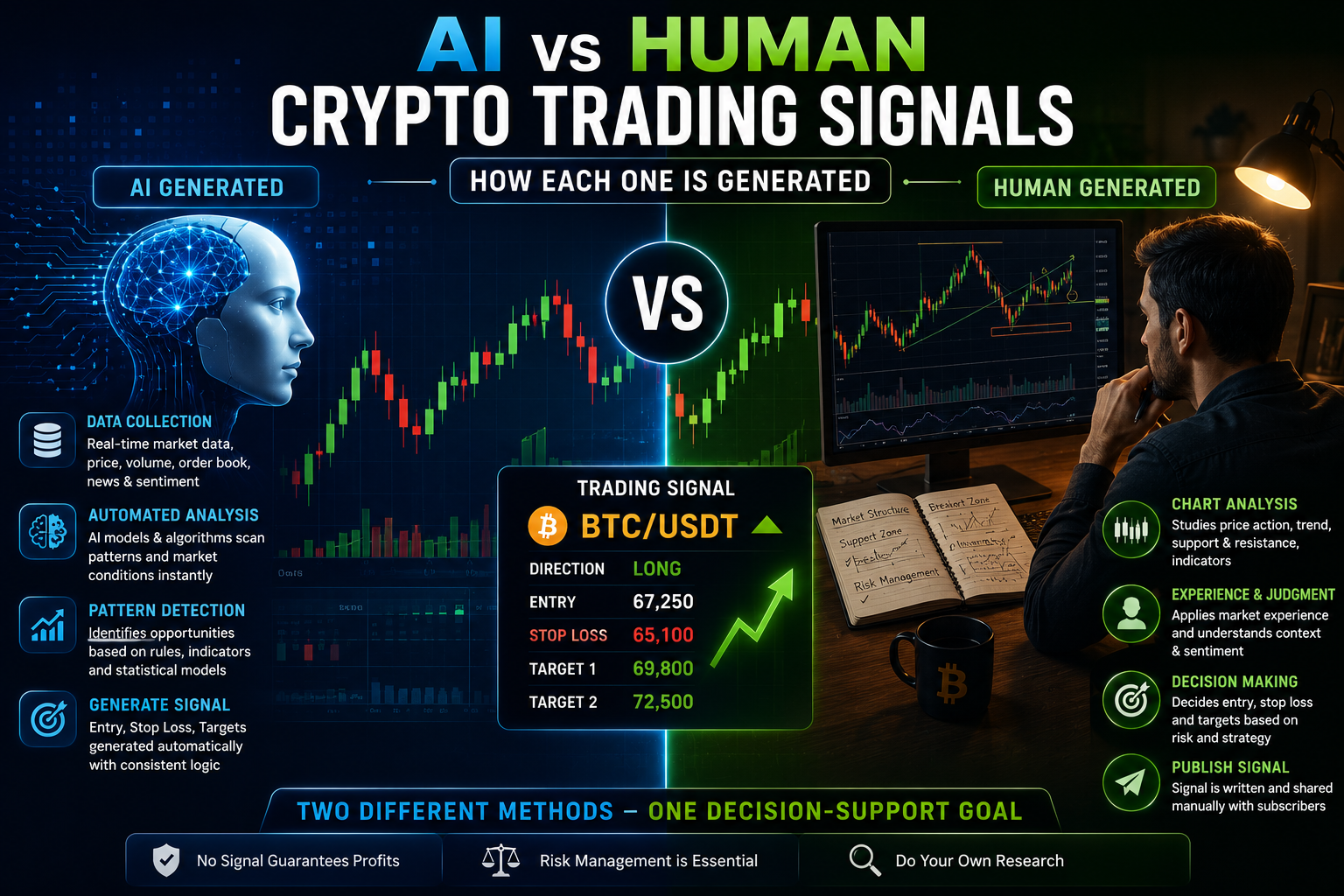
A crypto trading signal is a structured trade idea. It usually includes a trading pair, a direction (long or short), an entry price, a stop loss, and one or more target levels. Some signals also include a suggested holding time or market context.
A signal is a decision-support tool. It is not a guaranteed prediction of what the market will do. Every signal, whether it comes from a person or from software, still carries market risk.
There are two main ways a signal can be produced: by a human analyst using manual research, or by an automated system using algorithms and data models. Many platforms today use a mix of both.
How Human-Generated Crypto Trading Signals Are Created
A human-generated signal usually comes from a trader who has spent years studying price charts and market behavior. The process typically looks like this:
The analyst reviews price charts using tools such as moving averages, RSI, support and resistance levels, or volume patterns.
The analyst applies personal experience to judge whether a pattern is likely to repeat.
News, market sentiment, and broader events are factored in through personal judgment rather than a fixed formula.
The final entry, stop loss, and target levels are set based on the analyst's own risk approach.
The signal is written up and shared manually with subscribers or followers.
This process depends heavily on the individual. Two analysts looking at the same chart can reach different conclusions, because human interpretation is not a fixed process. It can also be slow, since one person can only actively track a limited number of markets at a time.
How AI-Generated Crypto Trading Signals Are Created
An AI-generated signal comes from software that processes market data using defined rules or statistical models. The general process looks like this:
The system continuously collects data such as price, trading volume, and order book activity across many trading pairs.
A model or rule-based algorithm scans this data for patterns that match predefined criteria.
Before being used live, this type of model or rule set is usually tested against historical data, a process known as backtesting.
When market conditions match the model's criteria, the system generates a signal automatically.
Some platforms publish this output directly, while others add a review step before the signal is shared publicly.
Because the process is automated, an AI system can monitor far more markets at the same time than a single human analyst can. It also applies the same logic every time, which removes emotional decision-making from the process. However, the output is still shaped by how the model was built and what data it was trained or configured on.
![IMAGE 1 [A16].png](/uploads/webp/40123128e48f797338a6e6d70ded882c.webp)
Key Differences Between AI and Human Signal Generation
Factor Human-Generated Signals AI-Generated Signals Speed Slower, based on manual chart review Near-instant, based on automated data processing Market coverage Limited to what one person can actively track Can scan many trading pairs at the same time Emotional bias Present — fear, overconfidence, and fatigue can affect decisions Not directly present, though the model's design can still carry bias Consistency Can vary between analysts and over time Applies the same logic every time, unless the model is changed Adaptability Can react quickly to unusual, one-off events Needs retraining or rule updates to handle new patterns Explainability The analyst can usually explain the exact reasoning Can be harder to explain in detail, especially with complex models Testing Rarely tested formally before publishing Can be backtested against historical data before going live
Neither column is automatically "better." Each method has a different trade-off between speed, scale, and contextual judgment.
Strengths and Limitations of Human-Generated Signals
Strengths:
Analysts can apply context that is hard to code, such as reading tone in breaking news.
Reasoning is usually easy to explain in plain language.
Experienced traders can adjust quickly when something unusual happens in the market.
Limitations:
Emotion, fatigue, and overconfidence can affect decision quality.
One analyst can only track a limited number of markets closely.
Output quality can vary from one signal to the next.
Strengths and Limitations of AI-Generated Signals
Strengths:
Can process large amounts of market data quickly and continuously.
Applies the same rules or model logic consistently, without fatigue.
Can be backtested against historical data before it is used live.
Limitations:
Output quality depends entirely on the quality and relevance of the underlying data.
A model may struggle with situations it was not designed or trained to handle, such as a sudden regulatory announcement.
Some models are harder to fully explain, which is sometimes called a "black box" problem.
Past performance in backtesting does not guarantee future results in live markets.
![IMAGE 2 [A16].png](/uploads/webp/fb5aebd7d93c816dd9be91612a7c2801.webp)
Common Misconceptions About AI Trading Signals
"AI signals are always more accurate." Accuracy depends on data quality, model design, and current market conditions. Being automated does not automatically make a signal more reliable.
"AI removes all risk." AI can remove emotional bias from the generation process, but it cannot remove market risk. Prices can still move against any signal.
"AI signals never need human oversight." Many platforms still include a human review step to catch unusual situations that a model was not built to handle.
"More data always means a better signal." Data volume matters less than data quality and relevance. A model fed with noisy or irrelevant data can still produce weak signals.
How to Evaluate a Crypto Signal Regardless of Its Source
Whether a signal is generated by a human analyst, an AI system, or a mix of both, the same evaluation questions apply:
Does it clearly state the entry price, stop loss, and target levels?
Is a historical track record available, and does it show losing trades as well as winning ones?
Does the provider explain, even briefly, how the signal was generated?
Is it clear that the signal is a decision-support tool and not a guaranteed outcome?
Can the price levels in the signal be checked against real exchange data after the fact?
A signal that avoids these details, or only shows selected winning trades, is harder to evaluate honestly.
![IMAGE 3 [A16].png](/uploads/webp/77180bfa59cf7b39b581149c20a28849.webp)
Where CryptoAI Signal Fits Into This Comparison
CryptoAI Signal is built as an AI-powered platform that produces structured crypto trade setups with defined entry prices, stop losses, and take-profit targets. The comparison in this article is not just theoretical — it is the same framework a reader can use to evaluate CryptoAI Signal itself, or any other signal provider.
The platform offers free public signals as well as premium tiers, which gives a new user a way to review the signal format and track record before deciding whether a paid tier fits their trading approach. As with any signal source, users should apply their own risk management and should not treat any signal as a guaranteed result.
Conclusion
AI and human analysts generate crypto trading signals in fundamentally different ways. AI systems process data faster and at a larger scale, while human analysts bring contextual judgment that is harder to automate. Neither approach removes market risk, and neither is automatically more accurate than the other. The generation method matters less than transparency: clear entry and exit levels, an honest track record, and a clear explanation of risk. Traders who understand how a signal was created are better placed to judge whether it fits their own strategy.
Frequently Asked Questions
Are AI crypto signals more accurate than human signals?
Accuracy depends on data quality, market conditions, and how well the model or analyst adapts to changing conditions. Being AI-generated does not by itself make a signal more accurate, and neither method guarantees a specific outcome.
Can AI trading signals fully replace human judgment?
AI can process more data at a faster pace, but many platforms still use human review to catch context that a model was not built to interpret, such as an unexpected news event.
Is it common to combine AI and human analysis?
Yes. A hybrid approach, where an algorithm does the initial data scanning and a human reviews the result, is used by many signal providers to balance speed with contextual judgment.
How can I check if a crypto signal is trustworthy, whether it is AI or human generated?
Look for a transparent track record that includes both winning and losing trades, clearly stated entry, stop loss, and target levels, and an honest explanation that the signal is not a guaranteed prediction.