Quick Answer
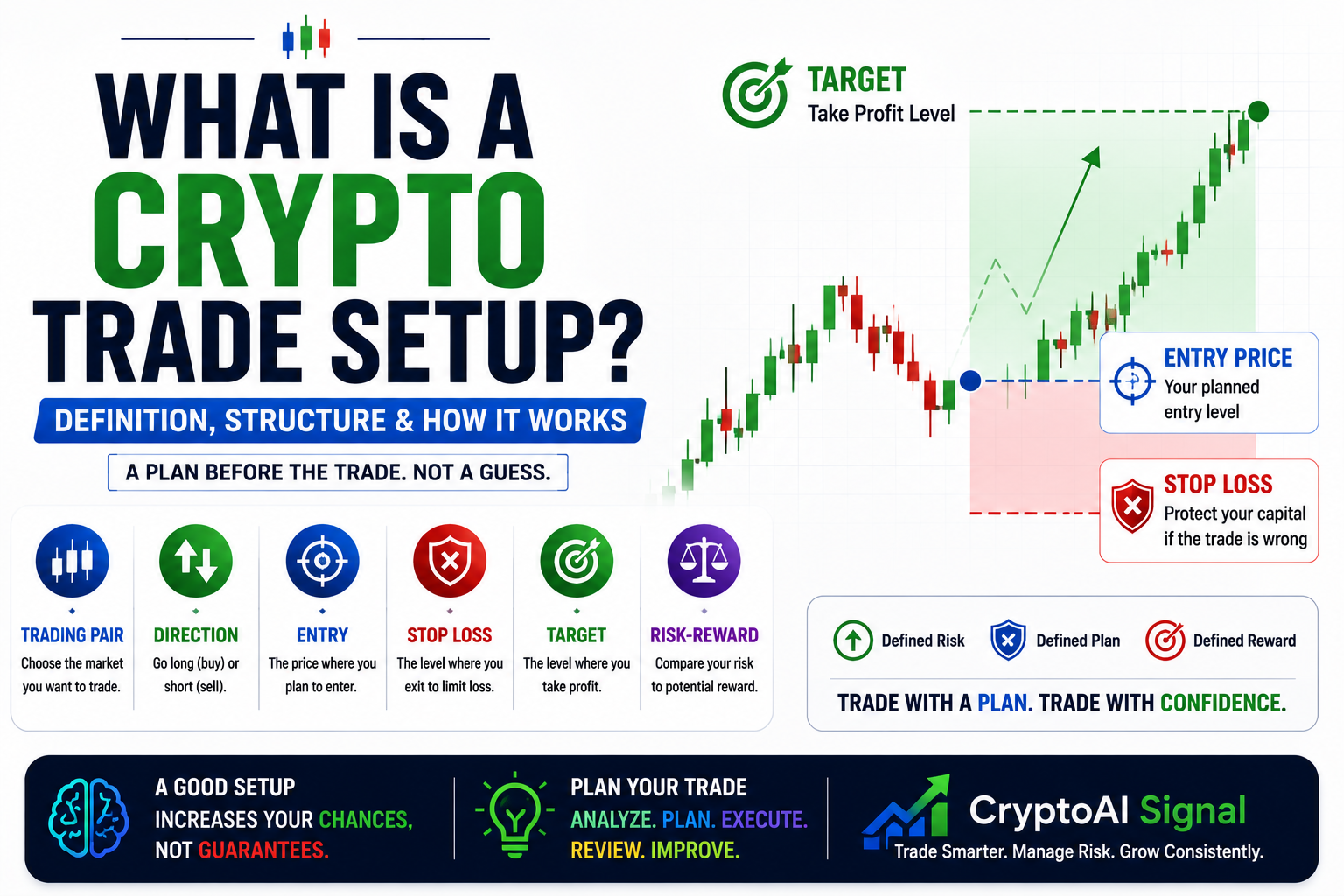
A crypto trade setup is a structured trading plan built before you enter a trade. It defines the trading pair, direction, entry price, stop loss, and target level, along with the reasoning behind each level. A trade setup turns a general market idea into a clear plan with defined risk and defined reward, instead of a guess.
What Is a Crypto Trade Setup?
A crypto trade setup is a plan that a trader builds before opening a position in the market. It is based on market analysis, not on emotion or a random guess. A proper setup answers four basic questions: What is being traded? In which direction? Where is the entry? Where are the exit points, on both the profit side and the loss side?
A trade setup is not the same as a market opinion. Saying "Bitcoin will go up" is an opinion, not a setup. A setup adds structure to that opinion. It sets an entry price, a stop loss to limit the loss if the market moves the wrong way, and a target that defines where the trade could be closed for a profit.
Because a trade setup is written down before the trade, it forces the trader to think through the trade in advance, instead of reacting to price movement in real time.
![IMAGE 1 [A11].png](/uploads/webp/5950a371b37ecf0c62f1b5cb6981018b.webp)
Why a Trade Setup Matters
A clear trade setup helps in several ways:
It reduces emotional decision-making, because the entry, stop loss, and target are already defined before the trade starts.
It defines risk in advance, so the trader knows the maximum acceptable loss before entering.
It makes trades easier to review later, since each trade can be checked against its original plan.
It makes a trading approach repeatable, because the same structure can be applied to future trades and improved over time.
Without a setup, a trader is often reacting to price after it has already moved, which usually leads to poor entries and unclear exits.
Core Components of a Trade Setup
A complete crypto trade setup usually includes the following parts.
Trading Pair and Direction
This identifies exactly what is being traded, such as BTC/USDT, and whether the trade is a long position (expecting the price to rise) or a short position (expecting the price to fall).
Entry Price
The entry price is the level at which the trader plans to open the position. It is usually chosen based on a specific technical reason, such as a support level, a breakout point, or a pullback zone, rather than a random price.
Stop Loss
The stop loss is the price level where the trade idea is considered wrong. If the market reaches this level, the position is closed to limit further loss. The stop loss should be based on market structure, such as a level below recent support in a long trade, not on how much money the trader is willing to lose.
Target or Take-Profit Level
The target is the price level where the trader plans to close the trade for a profit. Targets are often based on nearby resistance, previous price highs, or a measured price move.
Risk-Reward Ratio
The risk-reward ratio compares how much is being risked (the distance from entry to stop loss) to how much could be gained (the distance from entry to target). A setup with a poor risk-reward ratio is generally considered weaker, even if it has a high chance of working.
Timeframe and Holding Period
This defines whether the setup is short-term (a few hours), medium-term (a few days), or longer-term (weeks), which affects how the setup is analyzed and managed.
How a Crypto Trade Setup Is Constructed
Building a trade setup is a step-by-step process, not a single decision.
Step 1: Start With Market Analysis
Before choosing any price levels, a trader studies the overall market structure. This includes identifying the current trend, key support and resistance zones, and any relevant patterns in price or volume.
Step 2: Identify a Potential Entry Zone
Based on the analysis, the trader looks for a price area that offers a reasonable entry, such as a breakout of a resistance level, a pullback to support, or a confirmed reversal signal.
Step 3: Define the Stop Loss First
Before deciding on a target, the trader defines the point at which the trade idea would be invalidated. This becomes the stop loss. Defining the stop loss early helps prevent the trader from adjusting it later just to avoid taking a loss.
Step 4: Define a Realistic Target
The target is set using visible market levels, such as the next resistance zone in a long trade, rather than an arbitrary percentage. A target should be a level the price can realistically reach based on current market conditions.
Step 5: Calculate the Risk-Reward Ratio
Once the entry, stop loss, and target are known, the trader calculates the risk-reward ratio. If the potential reward is too small compared to the risk, the setup may not be worth taking, even if the trader is confident about the direction.
Step 6: Confirm the Setup With Additional Factors
Many traders add confirmation, such as trading volume, momentum indicators, or confluence with another timeframe, before finalizing the setup. Confirmation does not guarantee the trade will work, but it can reduce low-quality entries.
Step 7: Document the Setup Before Execution
The final step is writing down the complete setup, including entry, stop loss, target, and the reason for the trade. This makes it possible to review the trade later and compare the result with the original plan.
![IMAGE 2 [A11] A.png](/uploads/webp/7e61362cdbd5c6892d113093a9f77d9d.webp)
The following is a hypothetical example used only to illustrate the structure of a trade setup. It is not a real trade recommendation and does not represent actual market data.
Trading Pair: ETH/USDT
Direction: Long
Entry Price: $3,200
Stop Loss: $3,040
Target: $3,520
In this example, the risk is the distance from entry to stop loss: $3,200 minus $3,040, which equals $160. The potential reward is the distance from entry to target: $3,520 minus $3,200, which equals $320. Comparing reward to risk gives a risk-reward ratio of approximately 1:2, meaning the potential gain is about twice the amount being risked.
This example shows the structure of a setup, not a guarantee of the outcome. Real market conditions can move against the plan at any point.
![IMAGE 2 [A11] B.png](/uploads/webp/0872c8cb2986da8ed25fe1b3eed652ea.webp)
Common Types of Trade Setups
Crypto traders commonly use a few recognizable setup types.
Breakout Setup
The trader enters after the price moves beyond a key resistance or support level, expecting the move to continue in that direction.
Pullback or Retracement Setup
The trader waits for the price to pull back to a support or resistance level within an existing trend before entering, instead of chasing the initial move.
Trend-Continuation Setup
The trader enters in the direction of an established trend, expecting the trend to continue after a brief pause.
Reversal Setup
The trader looks for signs that a trend is ending, such as a break of structure, and enters in the opposite direction of the previous trend.
Each type carries different risk characteristics, and no single type works in every market condition.
![IMAGE 3 [A11].png](/uploads/webp/98b654dd9019c7f1a8d97811aaee7d53.webp)
Trade Setup vs. Trading Signal
A trade setup and a trading signal are related but not identical.
A trade setup is the analytical process described above: studying the market, defining an entry, a stop loss, and a target, and confirming the idea before acting on it. Building a setup takes time, market knowledge, and consistent analysis.
A trading signal is the finished result of that process, shared in a ready-to-use format. Signal providers, including CryptoAI Signal, build the setup internally and publish the completed structure, such as the entry price, stop loss, and profit targets, so that a trader can review a finished setup instead of building one from scratch. A signal should still be treated as a decision-support tool, not a guaranteed outcome, and traders benefit from understanding how a setup is built even when they use signals from a provider.
Common Mistakes When Building a Trade Setup
Entering a trade without a defined stop loss, which removes any limit on potential loss.
Moving the stop loss further away after entering the trade, instead of accepting the original invalidation point.
Chasing an entry after most of a price move has already happened.
Ignoring the risk-reward ratio and taking trades where the potential loss is larger than the potential gain.
Building a setup based on hope or a strong personal opinion instead of visible market structure.
Using high leverage without understanding that leverage increases risk and can lead to liquidation before the planned stop loss is even reached.
Risk Management in Trade Setup Construction
Risk management is part of building the setup, not a separate step added afterward.
Position sizing determines how much capital is used for a single trade, so that a stop loss being hit does not cause excessive damage to the overall account. Many traders risk only a small, fixed percentage of their capital on any single setup.
Leverage is a separate decision from the setup itself. A stop loss is based on the price of the underlying asset, but leverage affects how much of a price move a trader's position can absorb. Depending on the leverage used and position conditions, a leveraged position can be liquidated before the price reaches the planned stop loss level. Understanding this difference is an important part of managing risk around any trade setup.
Practical Checklist Before Using a Trade Setup
Before acting on a trade setup, it helps to check the following:
Is the trading pair and direction clearly defined?
Is the entry price based on a specific technical reason?
Is the stop loss placed at a logical invalidation point, not just an arbitrary distance?
Is the target based on a realistic market level?
Is the risk-reward ratio acceptable before entering?
Has the setup been confirmed with any additional factors, if used?
Is the position size appropriate for the amount of capital being risked?
Has the setup been written down for later review?
Frequently Asked Questions
Is a crypto trade setup the same as a trading signal?
No. A trade setup is the process of analyzing the market and building entry, stop loss, and target levels. A trading signal is the finished setup shared by a provider in a ready-to-use format.
Do I need technical analysis to build a trade setup?
Most trade setups rely on some form of technical analysis, such as support and resistance, trend structure, or volume, to justify the entry, stop loss, and target levels.
What is considered a good risk-reward ratio?
There is no fixed number that works for every trader, but many traders look for setups where the potential reward is at least equal to, or greater than, the amount being risked.
Can a trade setup guarantee a profitable trade?
No. A trade setup organizes risk and improves decision-making, but it cannot guarantee a result. The market can move against any setup, which is why the stop loss is a required part of the structure, not an optional one.
Conclusion
A crypto trade setup is a structured plan, not a prediction. It combines market analysis with clearly defined entry, stop loss, and target levels, so that risk is known before a trade begins. Learning to construct a setup step by step, rather than reacting to price in the moment, is one of the more practical skills a crypto trader can build over time.