A crypto trading signal is a claim about the future, published at a specific moment. That makes it one of the few things in crypto you can actually test after the fact.
Verification means taking a signal that has already been published and checking it against what price actually did. It needs no access to anyone's system, no subscription and no special tools — only the published record and an independent price chart.
This guide is provider-agnostic. The method works on paid services, free Telegram groups and individual analysts alike, and it is worth running before you pay anyone anything.
![how to verfy [ Artical 3] image 1.png](/uploads/webp/693bd50033c51813eef148fb3776cd5e.webp)
Contents
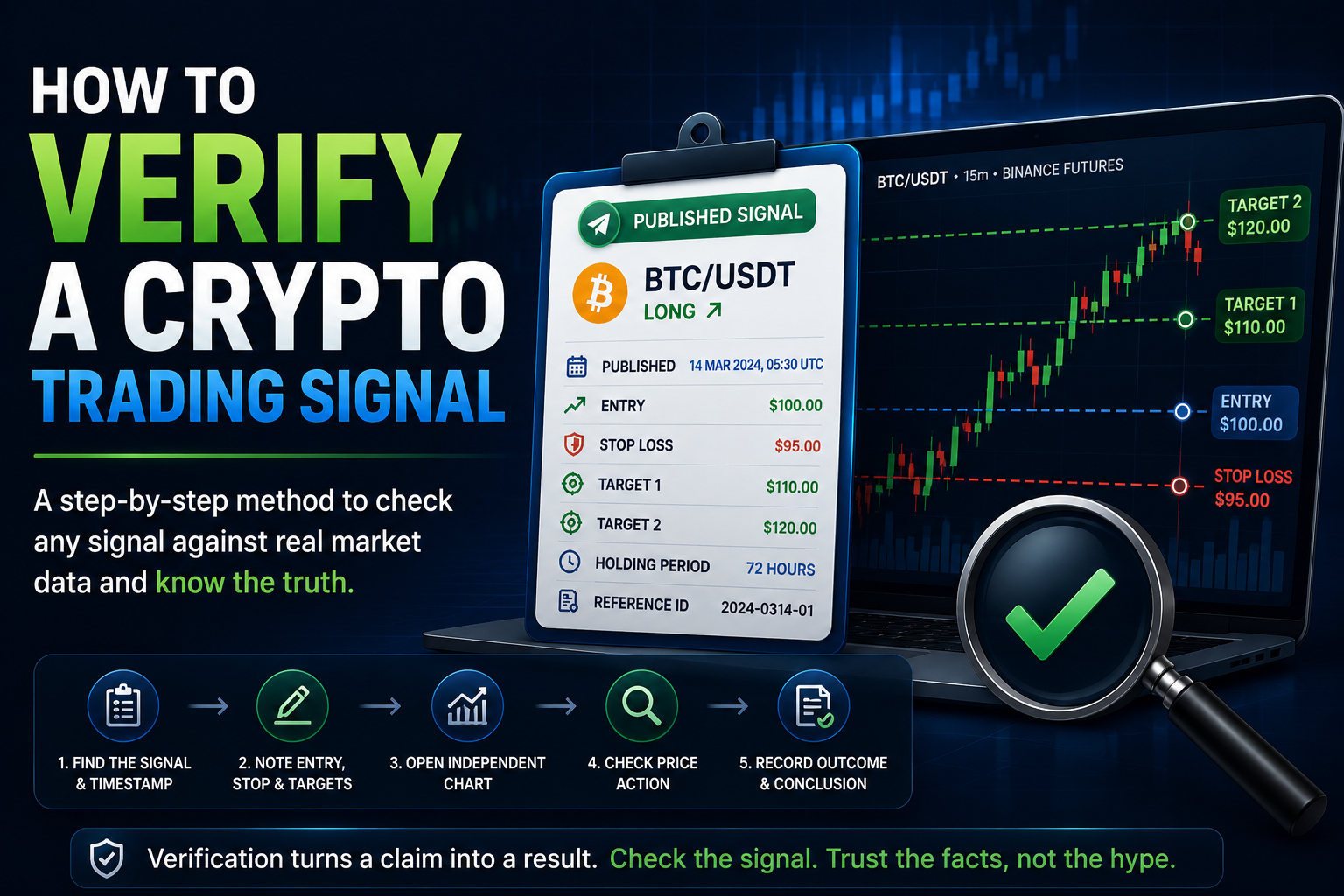
The verification method
The method below works on any provider's signals, including free ones. Run it before you pay for anything.
Start with the publication timestamp
Find the time the signal was published, not the time the trade was supposed to start. These are different, and the difference is the entire integrity check.
A signal published at 05:00 for an entry at 05:30 is a prediction. A signal published at 09:00 describing an entry at 05:30 is a description of something that already happened. Both can appear identical in a screenshot.
If a provider does not publish a verifiable timestamp, stop here. Nothing further can be checked, and no amount of impressive-looking history changes that.
Record the published entry level
Write down the exact entry price as it was published. Not the current price, not a range someone described afterwards.
If the entry level is restated later, or given as a wide zone that would have been touched at some point regardless, the signal cannot be tested against a single point in time.
Record the published stop-loss
The stop must have been published with the signal, before the trade began.
A stop level that first appears while a trade is running is not a stop. It is a description of what happened. This is the most common way a record is quietly improved after the fact, and it is invisible unless you check the original publication.
Record the published targets
List every target level and the state each one reached. Partial outcomes are outcomes — a signal that reached its first target and then reversed is a complete record, not an incomplete one.
Be careful with any figure describing the best price reached after a signal concluded. That number describes the market, not the signal.
Check the holding time
A signal needs a defined end. Without one, a position can be held indefinitely until it eventually looks better, and no result is ever recorded.
Note what the stated holding period was and whether the record respects it.
Read the trade record and its status
A complete record contains the publication timestamp, entry, stop, targets, holding period, final status, and — for any signal closed by time rather than by reaching a level — the closing timestamp and closing price.
That last field matters more than it appears. A signal marked as closed at expiry with no recorded closing price cannot be verified at all. There is nothing to compare the chart against.
Read status labels precisely. Across the industry, terms like "full profit" or "partial profit" describe price reaching a published level, not any user's result. Nobody's position size, entry fill or exit was specified by the provider. A record of price behaviour is a legitimate thing to publish, but it is not a record of anyone's returns, and the two are easy to confuse.
A signal record describes what price did. It does not describe what any trader earned. Position size, leverage, fills and exits are decisions the reader makes, and their outcome will differ from the record.
Open an independent chart and compare
Use any third-party charting platform. Load the same trading pair, on the same exchange and market type, for the same date and time.
Third-party matters. A chart supplied by the provider being tested is not independent evidence.
Compare what price actually did against what was published in advance. That comparison is the whole exercise.
The verification framework
What to record Where to find it What it proves Publication timestamp The original published signal, not a later summary That the claim existed before the move, or that it did not Entry level as published The original signal What the position was measured from Stop level as published The original signal That a failure point was defined in advance Target levels as published The original signal What outcome was claimed, and at which stages Stated holding period The original signal That the signal had a defined end Recorded status The provider's archive What the provider says happened Closing timestamp and price The archive, for time-expired signals only That a time-closed outcome can be checked at all Price history for that pair and period An independent charting platform What actually happened, from a source the provider does not control
Repeat across several signals, including unfavourable ones
One verified signal proves almost nothing. Anyone can produce one good example.
Choose signals yourself rather than accepting a curated set, and deliberately include periods when the market fell. If unfavourable records are missing, hard to find, or quietly absent from the archive, that absence is the finding.
A complete worked example
The steps above are easier to follow once you have seen them applied end to end. The signal below is generic and invented for illustration; the method is the same whatever the source.
Step 1 — the published record
Say a provider has published a signal in this form. The prices, times and reference below are placeholders, not real market data — substitute the details from the actual signal you are checking.
Published: day 1, 09:00 UTC Pair: ETH/USDT · futures · long Entry: E Stop-loss: S (below E) Target 1: T1 · Target 2: T2 (both above E) Maximum holding period: 72 hours Reference: a permanent signal ID Status: Target 1 reached
Step 2 — what to write down
The publication time. The entry, stop and both targets as published. The point at which the holding period expires — day 4, 09:00 UTC in this case. And the claimed outcome: first target reached.
Step 3 — open an independent chart
Load the same pair and market type on a third-party charting platform. Set the timezone to UTC so it matches the publication timestamp; a timezone mismatch will make every comparison that follows wrong. Choose a candle interval short enough to see intraday movement — one hour usually works — and move to the publication date.
Step 4 — the questions the chart answers
Where was price at the moment of publication? If it was already at or beyond T1, the signal was published after the move it describes and nothing else matters.
Did price reach E after publication? If the entry was never touched, the signal was never actually live, whatever the record says about its outcome.
Which came first — T1 or S? This is the only question that determines the result. If price touched the stop before the first target, the record is wrong regardless of where price went afterwards.
Did all of it happen inside the stated holding period? An outcome recorded after the period expired is not a valid outcome under the signal's own rules.
Step 5 — the conclusion
If price was near E at publication, traded down to E within a few hours, and rose to T1 before ever touching S, all inside 72 hours, the record is accurate. That is one verified signal.
The whole check takes about five minutes once you have done it twice. What takes longer, and matters more, is doing it across enough signals for the result to mean anything.
Complete and incomplete records
Verification is only possible when the record contains enough to verify. Most of the difficulty in practice comes from records that are missing a field rather than records that are wrong.
A complete record contains:
The publication timestamp, distinct from the entry time
The entry price as a single number
The stop-loss level, published with the signal
Every target level
The stated holding period
A permanent identifier that does not change
The final status
For a signal that ended by running out of time: the closing timestamp and the closing price
An incomplete record is missing at least one of those, and the consequences differ:
Missing field What becomes impossible Publication timestamp Everything — the claim cannot be placed in time Entry as a single price Establishing whether the signal was ever live Stop-loss Knowing whether the outcome was a loss Holding period Knowing whether the outcome arrived within the signal's own rules Permanent identifier Finding the same signal again to re-check it Closing price on a time-expired signal Any verification of that signal at all
That last one is worth stressing. A signal marked as closed at expiry with no recorded closing price cannot be checked in any way. There is nothing to compare the chart against, and the outcome rests entirely on the provider's word.
Doing this at scale
One verified signal proves very little. The exercise only becomes informative across a sample, and the way you pick that sample matters more than its size.
Choose the signals yourself. A curated list of examples proves nothing about the record it was drawn from.
Deliberately include difficult periods. Pick a week when the market fell sharply and check what was published then. If those signals are hard to find, or missing, that absence is the finding.
Check the oldest signals available. Records tend to be tidiest where they are most visible. The early entries are where gaps show.
Ten signals is usually enough to see a pattern. Not enough to judge a strategy, but enough to establish whether the record is being kept honestly, which is the question this method answers.
What verification cannot tell you
Verification confirms that a record is accurate. It does not tell you whether the record is good.
Judging quality requires separate concepts: how outcomes are defined, how large the sample is, over what market conditions, and how the relationship between the stop and the targets affects what a given hit rate is worth.
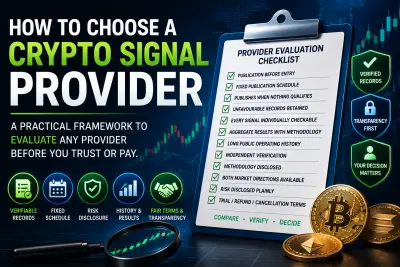
Accuracy and quality are different questions. This guide answers the first. The second belongs to judging the service as a whole, which is covered in how to choose a crypto signal provider.
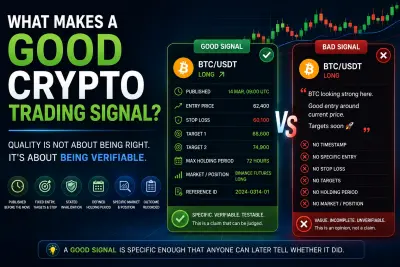
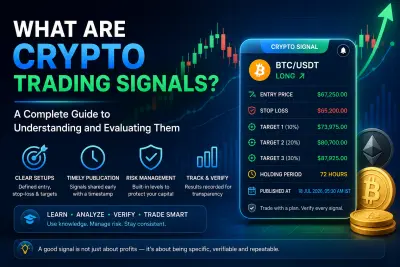
If any of the fields discussed here are unfamiliar, what are crypto trading signals explains each one.
Frequently Asked Questions
How do I verify a crypto trading signal?
Find the publication timestamp, write down the entry, stop-loss and target levels exactly as published, then open the same trading pair on an independent charting platform for that date and time. Compare what price actually did against what was published beforehand.
How do I check whether a signal was published before the move?
Compare the publication timestamp against the chart. If price had already reached the signal's target range at the moment of publication, the signal describes a completed move rather than predicting one. Without a verifiable timestamp, this cannot be established at all.
What charting platform should I use to verify signals?
Any third-party platform showing historical price data for the correct pair and market type will work. What matters is that it is not supplied by the provider being tested — a chart from the provider is not independent evidence. Set the timezone to UTC so timestamps align.
Can I verify signals from a Telegram group?
Partly. Telegram shows a message timestamp, which is useful, but messages can be edited or deleted afterwards. Check whether an edit marker is present and whether old signals — particularly unfavourable ones — are still findable months later.
How many signals should I verify?
Around ten is usually enough to see whether a record is kept honestly. Choose them yourself rather than accepting a curated set, include periods when the market fell, and check the oldest available entries, since those are where gaps tend to show.
What if a signal has no closing price recorded?
Then it cannot be verified. A signal marked as closed at expiry with no recorded closing price gives you nothing to compare the chart against, and the outcome rests entirely on the provider's word. Treat the missing field as the finding.
Does verification tell me if a provider is profitable?
No. Verification confirms that a record is accurate — that the levels were published when claimed and that price did what the record says. Whether the overall record is any good is a separate question requiring sample size, outcome definitions and market conditions.
About the author
Vikas Chauhan is the founder of CryptoAI Signal. He is a crypto market researcher and algorithmic trading systems developer, working on the development of AI-assisted crypto signal systems, crypto market research, and transparent signal documentation.
Find him on X, LinkedIn, Telegram and Binance Square.
Last updated: [publication date]. Reviewed on publication and on material change to the subject matter.
Risk disclaimer
This article is educational. It is not financial, investment, legal or tax advice, and it does not recommend any signal provider, trading strategy or asset — including any operated by the publisher.
Cryptocurrency markets are volatile and trading them carries substantial risk, including the total loss of the capital committed. Past behaviour of any market or any published record does not indicate future results.
Futures and margin trading carry additional risk. The published stop-loss is based on the underlying asset price. It does not guarantee protection from liquidation. Depending on leverage, a user's position may be liquidated before the published stop-loss level is reached.
Every decision described in this article — whether to trade, what size, what leverage, and whether to act on any signal — belongs to the reader. Do your own research.