This guide explains what crypto trading signals are, how they are produced, what a published signal contains, and what signals cannot do. It ends with a short introduction to judging signal quality, verifying a published signal, and choosing a provider — each of which has its own detailed guide. This article is educational. It is not financial advice, and it does not recommend any provider, including the one publishing it.
Contents
Quick Answer
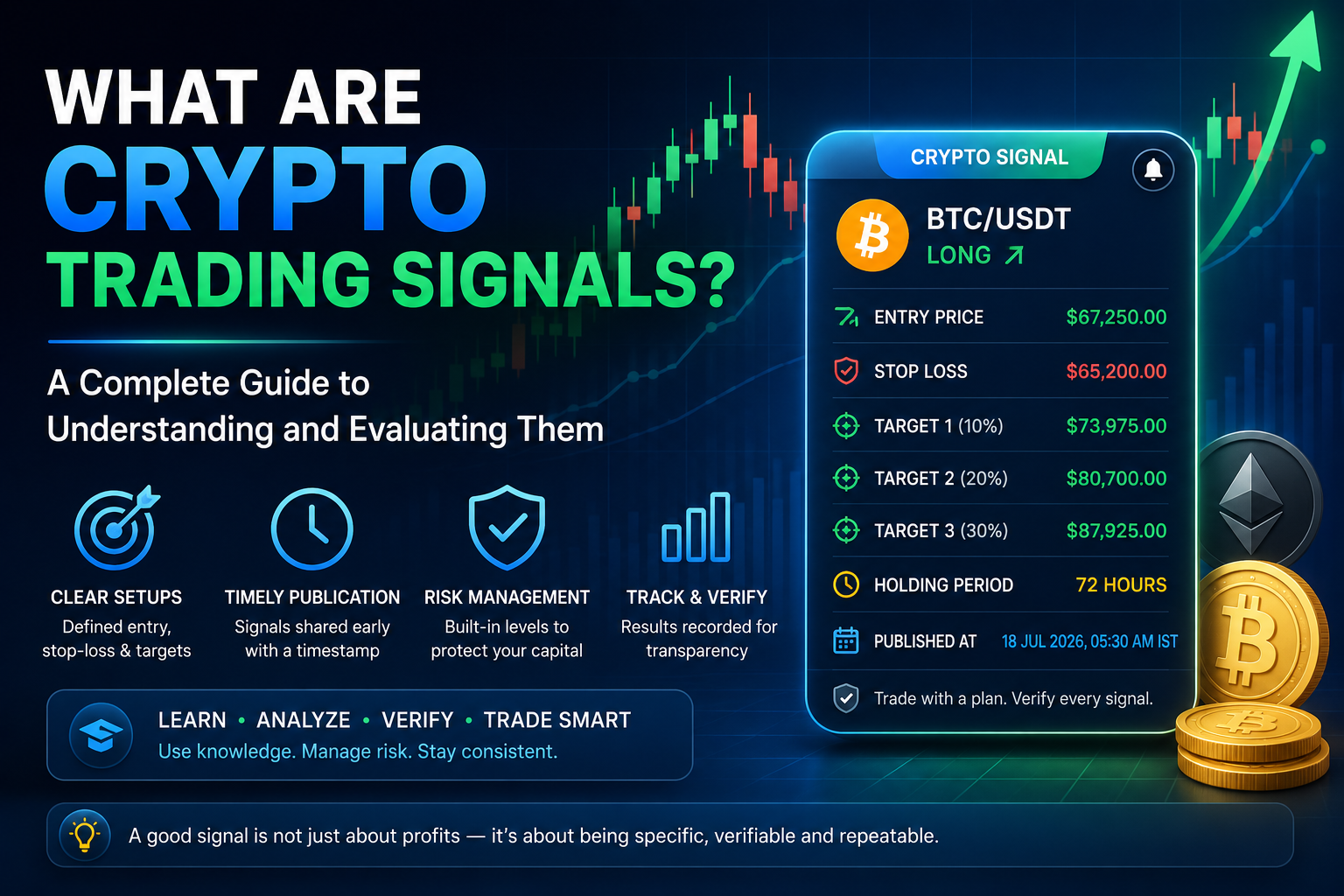
Crypto trading signals are published trade suggestions for cryptocurrency markets. Each one names an asset and a direction, and states the price at which the position begins, the level at which the idea is considered wrong, and the levels it is expected to reach. A time limit is usually attached.
Signals are produced by individual analysts, communities, platforms and automated systems, and delivered through messaging channels, apps and web dashboards. They vary enormously in quality, and almost nothing on the surface of a signal indicates which kind you are looking at.
What separates a useful signal from an unusable one is not whether it works. It is whether it was specific enough, and published early enough, that anyone can tell afterwards whether it worked. That single idea runs through the rest of this guide — first as a way to judge a signal, then as a method for verifying a published record, and finally as a framework for evaluating any provider.
![ANATOMY Trade Signal [ IMAGE 1 ].png](/uploads/webp/6f75edcb26437d6c67c02f5d40206591.webp)
What Is a Crypto Signal?
A crypto signal is a published suggestion to take a specific position in a cryptocurrency, stated with enough detail to be acted on and checked afterwards. At minimum it names an asset and a direction. In practice, a useful one also states the price levels at which the position begins, ends badly, and ends well.
That last part is what separates a signal from everything else people publish about crypto markets. A signal commits to numbers.
A signal is not market analysis
Market analysis explains a view. It describes what is happening, why it might matter, and what could follow. It can be thoughtful, well-argued and genuinely useful, and it can also be right in spirit while being impossible to score.
A signal takes the same underlying view and commits it to specifics: this pair, this direction, from this price, invalid below this one. Those numbers turn an opinion into something that can be checked by anyone with a chart.
The difference is not intelligence or effort. Analysis and signals are frequently produced by the same people from the same work. The difference is accountability. Analysis can be discussed. A signal can be scored.
A signal is not a price alert
A price alert reports that a condition has been met — a coin crossed a level, an indicator entered a certain range, volume spiked. It is a notification about the present.
Alerts propose nothing. They do not suggest a position, they do not say where the idea would be wrong, and they carry no view about what happens next. Two traders receiving the identical alert can reasonably act in opposite directions.
A signal is a proposal. It says what to do, and — in any version worth following — where that proposal fails. This is why an alert cannot be verified in any meaningful sense while a signal can: there is nothing in an alert to be right or wrong about.
Screeners, indicator tools and exchange notifications all produce alerts. Some platforms present alert output under the word "signals," which is worth being aware of when comparing services.
What Are Crypto Signals?
Crypto signals, in the plural, are less a category of object than a category of service. Thousands are published every day, by very different kinds of publisher, through very different channels, funded in very different ways.
Understanding that landscape matters more than the definition does. Two signals with identical fields can be produced by an automated screener with no human involvement and by an analyst who spent an hour on the chart — and nothing on the surface of either one tells you which.
Where crypto signals come from
Four kinds of producer account for almost everything published:
Individual analysts publishing their own trade ideas, usually on social platforms or private channels.
Communities and groups where signals are contributed by one or several members, often alongside discussion.
Platforms and screeners that scan large numbers of assets for technical conditions and surface whatever matches.
Automated and algorithmic systems that generate signals from rules or models without a person deciding each one.
These categories overlap constantly. A platform may employ analysts; a group may run a screener and post its output. Knowing which one you are actually following is more useful than knowing the label it uses.
How signals reach you
Delivery is not a detail. It shapes what you can check later.
Messaging channels such as Telegram and Discord are the most common route. They are fast and easy to join, and they are also editable — a message can be deleted or changed after the fact, and the record is only as reliable as the platform's edit history.
Web dashboards, mobile apps, email and API feeds all place the record somewhere more permanent, though permanence depends entirely on the provider's own policy rather than the channel.
The practical question is simple: if a signal from three months ago turned out badly, would you still be able to find it?
Free signals and paid signals
Free signals are not a lesser version of paid ones. They are a different arrangement, and it is worth understanding what funds them.
Common models include referral or affiliate arrangements with exchanges, where the provider earns a share of the trading fees generated by users who sign up through their link; free tiers that exist to convert a portion of users to a paid plan; sponsorship or advertising; and services where the audience itself is the product being monetised elsewhere.
None of these is improper, and most established services use one or more of them openly. But each creates an incentive, and incentives shape output in predictable directions. A provider earning a share of trading fees benefits from more trading, which is not automatically the same thing as better signals. A free tier designed as a funnel has a reason to make the paid tier look necessary.
The useful habit is not suspicion. It is simply asking how a service earns money, and then noticing whether the answer would push it toward publishing more, or toward publishing better.
Paid services carry their own version of the same question. A subscription aligns the provider with retention, which usually rewards consistency — but it also means the provider is paid whether the signals work or not.
Screener output and published calls
A screener scans a universe of assets and returns those currently matching a set of conditions. Its output is a list of what is true right now, and it changes as conditions change.
A published call is different in one specific way: it is fixed at a moment in time. It exists as a record afterwards whether or not the conditions still hold.
Some platforms present screener output under the heading "signals," which is a legitimate use of the word. The distinction worth holding on to is not which one is better — it is that only one of them leaves behind something that can be checked later against a specific timestamp.
What Is a Crypto Trading Signal?
A crypto trading signal is a crypto signal that describes a complete position. Not just which asset and which direction, but where the position begins, where the idea is wrong, where it would be right, and how long it stays valid.
The test is practical: could someone act on this without asking the publisher a single follow-up question? If not, it is a view rather than a trading signal.
Direction
Every trading signal states whether it expects the asset to rise or fall — a long position or a short one.
On spot markets, a long position simply means owning the asset. On futures markets, direction determines what a price move does to a position that may be considerably larger than the money behind it.
Entry
The entry is the price at which the idea begins. It is what everything else is measured against.
An entry stated as a single number can be checked later against a chart. An entry given as a broad zone usually cannot, because a wide enough zone will have been touched at some point regardless of what the market did next.
Where the idea is wrong
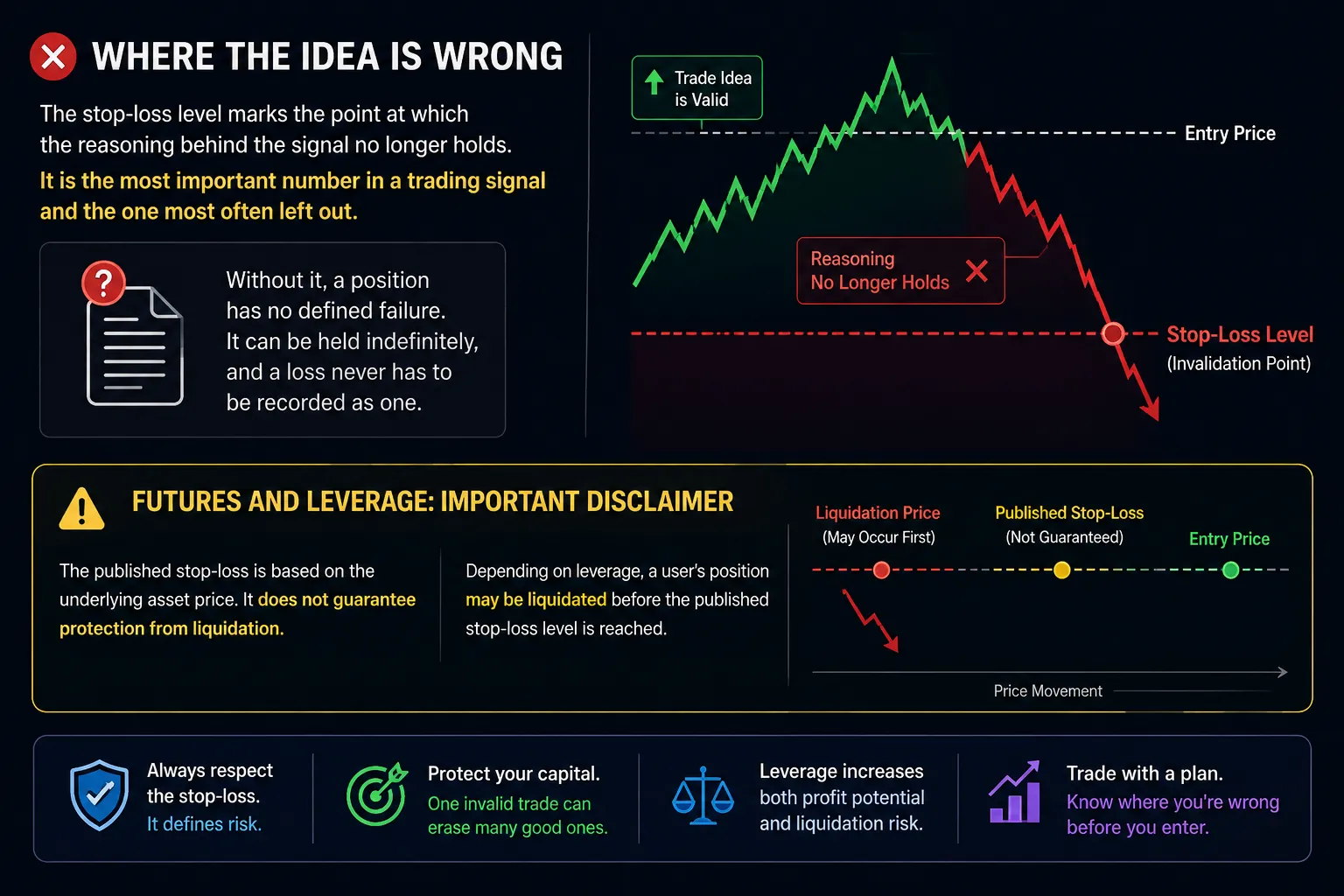
The stop-loss level marks the point at which the reasoning behind the signal no longer holds. It is the most important number in a trading signal and the one most often left out.
Without it, a position has no defined failure. It can be held indefinitely, and a loss never has to be recorded as one.
Futures and leverage: The published stop-loss is based on the underlying asset price. It does not guarantee protection from liquidation. Depending on leverage, a user's position may be liquidated before the published stop-loss level is reached.
Where the idea would be right
Target levels state where the signal expects the move to reach. Many signals publish more than one, describing successive stages of the same idea rather than alternatives.
Targets state where price is expected to go. They do not state what any particular person should do when it gets there — that decision belongs to whoever is holding the position.
How long it stays valid
A trading signal covers a period, not a permanent view. Some state this explicitly as a maximum holding time; others leave it implied by the timeframe being analysed.
An idea with no end date cannot produce a result. It simply remains open until it eventually looks better or is forgotten, which is the same thing as never being scored at all.
What Are Crypto Trading Signals?
In the plural, crypto trading signals describe an ongoing activity rather than a set of objects. Signals arrive, decisions get made, positions resolve, and a record accumulates behind them.
Most explanations stop at the definition. The part that determines whether following signals works for a particular person is what that activity actually involves week to week.
How signals get executed
Following a signal manually means reading it and placing the orders yourself. It is slower, and the delay between publication and entry matters — but it leaves every decision intact. You can take a signal, skip it, size it differently, or decide the setup no longer looks the same by the time you see it.
Automated execution connects a service to an exchange account, usually through an API key, so positions open without you. It removes the delay and removes hesitation, which is sometimes the point. It also removes the ability to decline an individual signal, and it means an account can accumulate positions while nobody is watching.
Neither approach is better in general. They suit different people, different account sizes, and different amounts of available attention.
One distinction is worth holding on to, because the vocabulary invites confusion: this is about how a signal is executed, not how it was produced. A signal written by a person can be executed automatically, and a signal generated by an algorithm can be entered by hand. How signals are produced is covered further on.
What a signal service actually provides
A signal service provides published opinions with levels attached, usually on some kind of schedule, and — in the better cases — a record of what happened to them afterwards.
That is the whole product. It is worth being precise about what sits outside it: the decision to take any given trade, the position size, the leverage, the exchange account, the execution, and every consequence that follows.
A signal service transfers information. It does not transfer responsibility, and it cannot transfer judgement.
This matters for a reason beyond risk. Following signals without understanding why each one was published produces a year of outcomes rather than a year of learning — and the reader who understands the reasoning is also the only one equipped to notice when a service stops making sense.
Why Crypto Trading Signals Matter
Crypto markets do not close. Thousands of assets trade continuously across dozens of venues, and any of them can make its most significant move of the month while you are asleep.
That is the practical problem signals exist to address. Everything else people claim about them follows from it, or is decoration.
Coverage beyond your own attention
No individual can watch a market that never stops. Following signals is one way of extending coverage past the hours you are actually at a screen and past the handful of assets you know well.
This is a coverage benefit, not an accuracy benefit. A signal reaches you about a setup you would never have seen. Whether that setup was worth seeing is a separate question, and the rest of this guide is largely about how to answer it.
Structure instead of impulse
A signal published with entry, invalidation and target levels forces the difficult decisions to be made in advance, when nothing is at stake emotionally. The point at which a position is wrong is decided before it is losing money, which is the only time that decision can be made clearly.
Worth being honest about where this benefit comes from: it comes from the levels existing, not from someone else supplying them. A trader who writes down the same three numbers before entering their own trade gets the identical benefit. Signals make that discipline convenient; they do not create it.
Seeing setups resolve, repeatedly
Watching published levels play out — including the ones that fail — is a reasonable way to develop pattern recognition, particularly for someone early enough that they do not yet know what a setup looks like before it works.
This benefit depends entirely on engaging with the reasoning rather than only the outcome. It is available to anyone following signals attentively, and it is the one benefit that compounds.
What signals do not solve
They do not remove risk, they do not replace understanding, and they do not make a market predictable. A signal is one input into a decision that remains yours, taken with your money, in conditions nobody controls.
Anyone describing signals as a solution to the difficulty of trading is describing something other than what they are.
How Crypto Trading Signals Work
Every trading signal passes through the same six stages, whether it was written by a person in ten minutes or produced by a system in ten milliseconds. Understanding the sequence is what makes the rest of this guide usable, because almost everything that can go wrong with a signal goes wrong at a specific stage.
![How Crypto Trading Signals Work [ IMAGE 2 ].png](/uploads/webp/4341461916c8ffde87a0d9fe179c6898.webp)
Market analysis
Something has to be examined before anything can be published. In practice that means price and volume data, chart structure such as support and resistance levels, and indicators derived from price — moving averages, RSI, MACD and similar tools that summarise momentum or trend.
Some approaches add on-chain data, order book depth, funding rates, or sentiment measures. What is analysed varies enormously between providers. That it is disclosed at all varies too.
Signal generation
Analysis produces candidates. Generation is the step where a candidate becomes a signal — where something crosses whatever threshold the producer uses and is judged worth publishing.
This is the least visible stage in the entire process and the one where providers differ most. Some apply fixed rules; some rely on a person's judgement; many combine both. Almost none describe the step in detail, which is why the sections later in this guide focus on what can be checked afterwards rather than on what happened here.
Publication
Publication is the moment a claim stops being flexible.
Before it, the idea can be adjusted, abandoned or quietly dropped. After it, the levels are on the record, attached to a time. That timestamp is what makes everything downstream verifiable — it fixes exactly what was claimed and exactly when, which is the only way anyone can later tell a forecast apart from a description of something that already happened.
This is the single most important stage in the lifecycle, and it is the one most often left ambiguous.
Entry
The signal specifies a price at which the position begins. Some providers publish shortly before that price is expected to be relevant; others publish at a fixed scheduled time; others publish continuously as conditions appear.
The gap between publication and entry matters. A short, predictable gap makes a signal easy to check. A long or variable one makes it harder to establish what was known at the moment of publication.
Trade management
Once live, a signal is simply a set of levels waiting to be reached or not reached. Price moves toward a target, toward the stop, or sideways until the holding period expires.
What happens to the signal at this stage is a matter of record. What happens to any individual position is a matter of execution, and belongs to whoever holds it.
Recorded outcome
Every signal eventually ends: a target is reached, the stop is reached, or time runs out. That conclusion is what turns a published claim into a record.
A signal that never formally concludes never produces a result. It stays open, indefinitely, and cannot be counted as anything. This is why a defined ending matters more than it appears — without one, the sixth stage never happens, and the first five leave nothing behind.
Types of Crypto Trading Signals
Signals get labelled in several different ways, and the labels stack rather than compete. The same signal can be a futures signal, a swing signal and an algorithmically generated signal at once.
Three questions separate them: which market it trades, how long it is meant to last, and what produced it.
![Types of Crypto Trading Signals [ IMAGE 3 ].png](/uploads/webp/342767b6c0ea720d7ae1850427d07370.webp)
By market: spot, margin and futures
A spot signal concerns buying or selling the asset itself. You own what you buy. The position cannot be liquidated, the maximum loss is what the asset falls to, and there are no ongoing holding costs beyond trading fees.
A margin signal concerns a position opened with borrowed funds, secured against assets you already hold. You still own the underlying asset, but the borrowed portion carries interest and creates a liquidation level: if the collateral falls far enough, the exchange closes the position to recover the loan.
A futures signal concerns a contract whose value tracks the asset without owning it. Most crypto futures signals refer to perpetual contracts, which have no expiry date and carry a periodic funding payment between long and short holders. Futures allow leverage, meaning exposure larger than the money committed — which magnifies both directions of a move.
Short signals appear almost exclusively on margin and futures. A plain spot position cannot be sold short; profiting from a fall requires borrowing the asset or holding a derivative contract.
Futures and leverage: The published stop-loss is based on the underlying asset price. It does not guarantee protection from liquidation. Depending on leverage, a user's position may be liquidated before the published stop-loss level is reached.
By time horizon: scalping, intraday, swing and position
Scalping signals target small moves over minutes to a couple of hours. They are the least tolerant of delay: a signal read twenty minutes after publication may describe a move that has already finished. They require the most attention, and fees and spreads consume a larger share of a small target.
Intraday signals open and close within a single session, usually a few hours. They demand less constant attention than scalping but still assume you are available during the relevant window.
Swing signals run for days, sometimes weeks. They tolerate a slower reaction, which makes them workable for someone who checks charts twice a day rather than continuously. The trade-off is exposure: a position held across several days sits through weekend gaps, overnight moves and news the market has not priced yet.
Position signals run for weeks or months and take the widest view. They demand the least ongoing attention and the most patience, and they carry the largest exposure to structural change — a regulatory decision or a shift in market conditions has time to arrive while the position is open. A long horizon also makes a defined end point matter more, not less: without one, a position signal can remain unresolved indefinitely and never produce a recorded outcome.
Time horizon is the axis that most determines whether a signal service fits a particular life, and it is the one people consider least before subscribing.
By how they are produced: manual, rule-based and AI-assisted
Manual signals are decided by a person. That allows context a rule cannot capture — an unusual news event, a market behaving strangely — and it introduces the person's mood, fatigue and biases along with it. Consistency varies.
Rule-based signals, also described as algorithmic, apply fixed conditions to data. The two terms are used interchangeably across the industry, and the distinction that actually matters is not whether rules exist but whether they are executed by a person or automatically by a system. Either way, the same conditions always produce the same output, which makes the approach consistent and testable against historical data. The limitation mirrors manual's strength: a rule set is blind to anything it was not built to see.
AI-assisted signals describe systems that adapt how they weigh inputs as new data arrives, rather than following fixed conditions. This can handle more variables than a rule set, and it makes the reasoning harder to inspect. A signal may arrive with no simple explanation behind it, and neither the reader nor sometimes the operator can reconstruct exactly why it was produced.
Two things are worth saying plainly. First, auditability is a genuine consideration here, not a technicality — a system whose output cannot be explained can still be evaluated on its published record, which is why the record matters more, not less. Second, "AI-generated" has no agreed technical definition in this industry and is applied to very different technologies, some sophisticated and some conventional. The label is not evidence of quality, and readers should evaluate published records rather than marketing terminology.
Signal classification matrix
Axis Category What it means Key characteristic Main limitation Market Spot Buying or selling the asset itself You own the asset; no liquidation Capital committed in full; no short selling Market Margin Position opened with borrowed funds against collateral You own the asset; borrowing carries interest Collateral can be liquidated; interest accrues while open Market Futures Contract tracking the asset without owning it Leverage available; perpetuals carry funding payments Liquidation can occur before a published stop is reached Time horizon Scalping Minutes to a few hours Highest attention; smallest targets Almost no tolerance for delay; fees weigh heavily Time horizon Intraday Opened and closed within one session Defined daily end point Requires availability during the session Time horizon Swing Days to a few weeks Tolerates slower reaction Overnight and weekend exposure Time horizon Position Weeks to months Least ongoing attention Longest exposure to structural change; needs a defined end Production Manual A person decides each signal Can weigh context a rule misses Consistency varies with judgement and fatigue Production Rule-based / algorithmic Fixed conditions applied to data Consistent and testable against history Blind to anything it was not built to see Production AI-assisted Weighting adapts as data arrives Handles more variables Reasoning is harder to inspect or explain
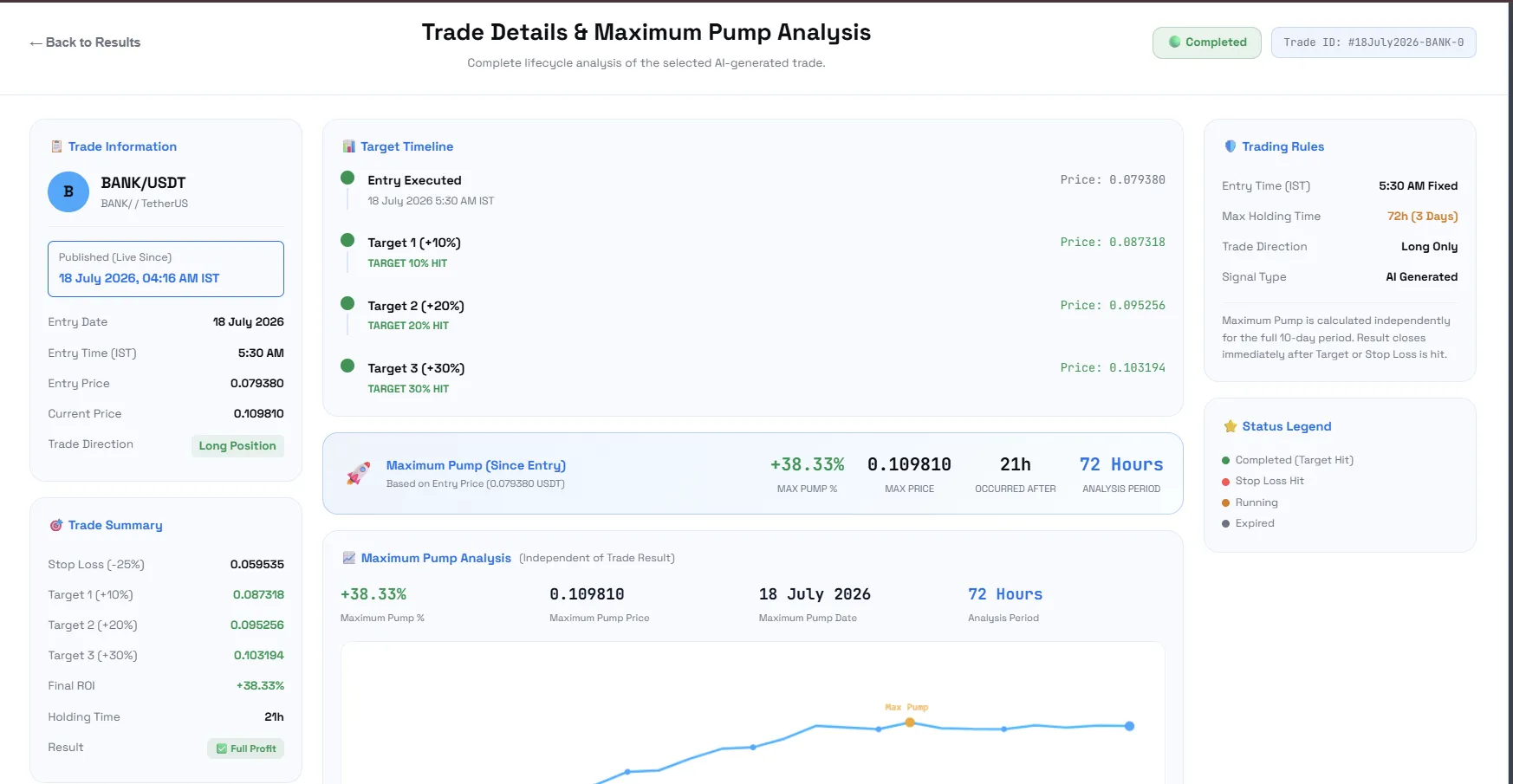
Anatomy of a Crypto Trading Signal
Earlier sections covered what a trading signal is. This one covers what you actually see when one arrives, field by field.
Published signals vary in presentation, but the fields divide cleanly into two groups: those describing the trade, and those turning it into a record.
Fields that describe the trade
These state the position itself: the trading pair, the market it trades on, the position type, the entry price, the stop-loss level, the target levels, and the holding period.
Their meaning was covered in the earlier section on what makes a signal a trading signal. The practical points worth adding here are about format rather than concept.
The trading pair should name both the asset and what it is priced against — a pair quoted in a stablecoin behaves differently from the same asset quoted in Bitcoin. The market field should distinguish spot from futures, since identical levels carry very different risk on each. And levels should be single prices rather than ranges, for the reason a chart makes obvious: a range wide enough will have been touched at some point regardless.
Fields that make it a record
The second group is what separates a published signal from a message.
The publication timestamp states when the claim was made. Without it, a signal cannot be placed in time at all.
The trade identifier gives the signal a permanent reference that does not change as the position develops, so a specific entry can be pointed to and found again.
The status states where the signal currently stands — still open, concluded at a target, concluded at the stop, or concluded by time. Status labels vary between providers and are worth reading literally rather than assuming.
Closing data applies to any signal that ends by running out of time rather than reaching a level. Such a signal needs a closing timestamp and a closing price, because without them there is nothing recorded to compare against.
Most providers publish the first group. Considerably fewer publish the second.
Signal field reference
Field What it states Format to expect Why it matters Trading pair The asset and what it is priced against Two tickers, e.g. asset/quote currency The same asset behaves differently quoted against a stablecoin than against Bitcoin Market type Spot, margin or futures A single named market Identical levels carry very different risk on each Position type Long or short One word Determines what a price move does to the position Entry price Where the position begins A single price, not a wide range Everything else is measured against it Stop-loss level Where the idea is considered wrong A single price Without it, a loss never has to be recorded Target levels Where the move is expected to reach One or more prices States expectation; does not prescribe an exit Holding period How long the signal remains valid A duration or an end time Forces a result; without one nothing concludes Publication timestamp When the claim was made public Date and time The only thing that separates a forecast from a description Trade identifier A permanent reference for this signal A code that does not change Lets a specific entry be found again later Status Where the signal currently stands Open, or a stated conclusion Read literally; labels vary between providers Closing timestamp and price Where a time-expired signal ended Date, time and price Without them, a time-closed signal cannot be checked at all
Limitations of Crypto Trading Signals
Every limitation below is structural. None of them is a flaw in a particular provider, and none is solved by choosing a better one.
No signal guarantees an outcome
A trading signal is a probabilistic claim about an uncertain market. Even carefully constructed signals fail regularly, and a provider whose signals never failed would be describing something other than a market.
This is worth internalising early, because it reframes what a losing signal means. A loss is not automatically evidence of a bad signal or a dishonest provider. It is the expected cost of participating at all. What distinguishes providers is not whether losses occur but whether they are recorded.
Volatility and gaps
Crypto markets move fast and continuously, and price does not always pass through every level on its way somewhere else.
A stop level can be jumped rather than touched, particularly during sudden moves, exchange outages or major news. A position can end up closing meaningfully below the level that was published, through nothing anyone did wrong.
Liquidity and slippage
A signal assumes you can transact at roughly the published price. On heavily traded pairs that assumption usually holds. On thinly traded ones it can fail badly.
Where order books are shallow, an order fills across several price levels, and the average price achieved differs from the price expected. The same signal followed by many people at once makes this worse. Low-liquidity assets are also where the largest published percentage moves tend to appear, which is not a coincidence.
Leverage and liquidation
Futures and leverage: The published stop-loss is based on the underlying asset price. It does not guarantee protection from liquidation. Depending on leverage, a user's position may be liquidated before the published stop-loss level is reached.
The mechanism is worth understanding rather than taking on faith. Leverage sets how far price can move against a position before the exchange closes it to protect the borrowed funds. Higher leverage means a shorter distance.
If a published stop sits further away than that distance, the position is closed by the exchange before the stop is ever reached. The signal's risk management is intact; the position's is not. This is a decision made by whoever chooses the leverage, and it is not something a signal can protect against.
Several signals in the same direction are one bet
This limitation is the least discussed and among the most consequential.
Crypto assets move together. Most altcoins are strongly correlated with Bitcoin and with each other, particularly during sharp moves. Ten long positions across ten different tokens are therefore not ten independent bets. They are approximately one bet on market direction, taken ten times over.
That has a specific consequence: when a set of same-direction signals works, most of them work together, and when it fails, most of them fail together. A day of signals is closer to a single position than a diversified portfolio, and it should be sized with that in mind.
Every approach depends on conditions
Any method for producing signals works better in some market conditions than others. A trend-following approach performs differently in a sustained rally than in a choppy sideways market; a mean-reversion approach reverses that pattern.
This is why the period a record covers matters as much as its length. A record spanning a single rising market has not yet been tested against anything else — not because the provider did anything wrong, but because the market has not yet asked the question.
Common Mistakes While Using Trading Signals
The limitations in the previous section belong to the market. The ones below belong to the reader — which is the good news, because these are the only ones anyone can do something about.
Acting on a signal that has already moved. A signal is tied to a specific entry price. Once price has travelled well past it, the setup you are entering is not the setup that was published: the distance to the stop has changed, and so has the distance to the targets. The published levels no longer describe your position. A signal seen late is often a signal to skip.
Leaving the stop in your head. A stop-loss that has not been placed as an order on the exchange is an intention, not a stop. Intentions tend not to survive the moment they are needed, which is precisely when the position is losing money.
Choosing leverage that liquidates before the stop. As covered above, leverage determines how far price can move against a position before the exchange closes it. Set high enough, the position is closed before the published stop is ever reached — so the signal's risk plan never gets the chance to apply.
Following a signal you do not understand. If you cannot say why a setup was published, you also cannot tell when it stops making sense. Understanding the reasoning is what lets you decline an individual signal, and declining is the main advantage manual execution has.
Taking every signal that arrives. A published set is not a to-do list. Position count is not diversification, fees accumulate on every entry, and attention thins across simultaneous positions. Choosing which signals to act on is part of using signals, not a failure to use them properly.
Judging Signals and Providers: a Short Introduction
Everything above describes what crypto trading signals are. What follows is a short introduction to the harder question — whether any particular signal, record or provider is worth your attention. Each of these subjects has its own guide.
Is this individual signal complete enough to act on?
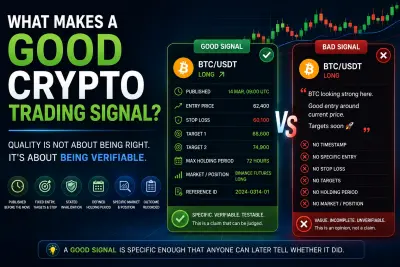
Quality here does not mean the signal will work. It means the signal is specific enough that anyone can later tell whether it did. A signal published before the move it describes, with levels fixed in advance, a stated invalidation point, a defined holding period and a named market, can be judged after the fact. One without those things was never really a claim.
Read next: What Makes a Good Crypto Trading Signal?
Did this published signal do what its record says?
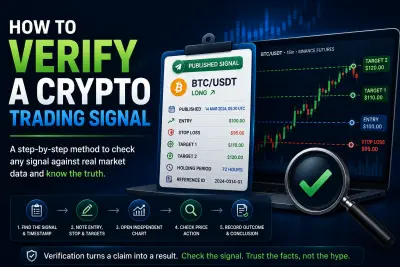
A signal is a claim about the future, published at a specific moment, which makes it one of the few things in crypto you can actually test. The method uses only the published record and an independent price chart: find the publication timestamp, note the levels as published, then compare against what price actually did. No access to anyone's system is required.
Read next: How to Verify a Crypto Trading Signal
Is this provider worth relying on?
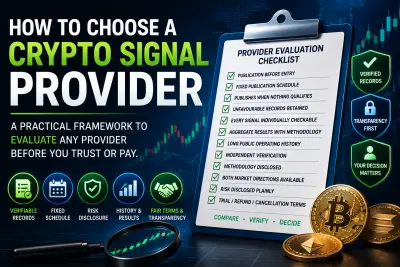
Verifying one signal tells you whether one record is accurate. Judging a service is a different question: are the rules sound, is the record complete, and is anything being quietly withheld? That is answered by a set of criteria you can apply to any provider — free groups and paid subscriptions alike — before committing anything.
Read next: How to Choose a Crypto Signal Provider
Where CryptoAI Signal Fits
CryptoAI Signal publishes signals under the rules described in this guide. Levels are fixed before publication, each signal carries a publication timestamp and a permanent identifier, a maximum holding period applies, and records are retained in every state rather than edited or removed. The platform publishes every day — either trading signals or a record showing that no setup qualified.
The public record begins with this launch. There is no long operating history yet, and no record spanning multiple market conditions. Those are stated limitations, not oversights, and the only thing that resolves them is time.
The platform records price behaviour against published levels. It does not instruct execution, recommend leverage, or claim any user outcome. Status labels describe price reaching a published level, not any reader's result.
Full details are on the What Is CryptoAI Signal? page. The evaluation criteria in this cluster are meant to be applied there as readily as anywhere else.
Where to Go From Here
This guide covered what crypto trading signals are, how they are produced, what a published signal contains, and what they cannot do.
The most useful next step is not more reading. It is picking one provider you already follow, opening their published record, and checking three or four past signals against a chart yourself. Twenty minutes of that will teach you more about that provider than anything written about them, including anything they have written about themselves.
If you want the method first, start with how to verify a crypto trading signal.
Frequently Asked Questions
What is a crypto trading signal?
A crypto trading signal is a published suggestion to take a specific position in a cryptocurrency, stated with enough detail to act on and check later. It names the asset and direction, and usually the entry price, the level at which the idea is wrong, and the target levels.
How do crypto trading signals work?
A signal passes through six stages: something is analysed, a candidate becomes a signal, it is published with a timestamp, the position begins at the stated entry, price moves toward the levels, and an outcome is recorded. The publication stage is what makes everything afterwards checkable.
What information does a crypto trading signal include?
Two groups of fields. The first describes the trade: trading pair, market, position type, entry, stop-loss, targets and holding period. The second turns it into a record: publication timestamp, a permanent identifier, current status, and closing details for signals that end by running out of time.
What is the difference between spot and futures signals?
A spot signal concerns buying the asset itself, so you own it and the position cannot be liquidated. A futures signal concerns a contract tracking the asset, which allows leverage and carries liquidation risk. Identical published levels represent very different risk on each.
What is the difference between long and short signals?
A long signal expects the price to rise; a short signal expects it to fall. Short positions generally require futures or a margin-enabled market, because a plain spot holding cannot be sold short. Direction is an attribute of a signal rather than a separate category of one.
Are AI crypto signals better than manual signals?
There is no evidence that the label predicts quality. "AI-generated" has no agreed technical definition in this industry and is applied to very different systems, some sophisticated and some conventional. Judge any provider on its published record rather than on the technology it names.
Are crypto trading signals worth it?
That depends on what you expect them to do. They can extend coverage of a market that never closes and impose structure on decisions. They do not remove risk, guarantee outcomes or replace understanding, and following them without understanding the reasoning produces outcomes rather than learning.
Are Telegram crypto signal groups safe?
Messaging channels are fast but editable, so a record there is only as reliable as the platform's edit history. The relevant question is not the channel but whether past signals — including unfavourable ones — remain findable months later, and whether each carries a verifiable publication time.
Are free crypto signals reliable?
Free signals are not inherently better or worse than paid ones. What differs is the funding model behind them: referral arrangements, conversion funnels, sponsorship or audience monetisation. None is improper, but each creates an incentive, and it is worth asking whether it rewards publishing more signals or better ones.
About the author
Vikas Chauhan is the founder of CryptoAI Signal. He is a crypto market researcher and algorithmic trading systems developer, working on the development of AI-assisted crypto signal systems, crypto market research, and transparent signal documentation.
Find him on = Telegram and Binance Square.
Last updated: [publication date]. Reviewed on publication and on material change to the subject matter.
Risk disclaimer
This article is educational. It is not financial, investment, legal or tax advice, and it does not recommend any signal provider, trading strategy or asset — including any operated by the publisher.
Cryptocurrency markets are volatile and trading them carries substantial risk, including the total loss of the capital committed. Past behaviour of any market or any published record does not indicate future results.
Futures and margin trading carry additional risk. Positions are opened with borrowed exposure and can be closed by the exchange before a published stop-loss level is reached. The published stop-loss is based on the underlying asset price. It does not guarantee protection from liquidation. Depending on leverage, a user's position may be liquidated before the published stop-loss level is reached.
Every decision described in this article — whether to trade, what size, what leverage, and whether to act on any signal — belongs to the reader. Do your own research.