Choosing a crypto signal provider is a different question from judging any single signal they publish. A provider can produce one convincing signal and still keep a record that cannot be checked, or publish clear levels and quietly delete the ones that failed.
What follows is a set of criteria you can apply to any provider — free Telegram groups, paid subscriptions, apps and platforms alike. Each one exists because it detects a specific way records get flattered.
Nothing here ranks providers or recommends one. The criteria are the useful part; the judgement stays yours.
![Signal Provider [ Artical 4 ] Image 1.png](/uploads/webp/8a4a11b34df42128c29f8e4b0383b69e.webp)
Contents
How the signals are constructed
Are entry, stop and targets defined before publication?
A signal published with only a direction and a coin can be described afterwards in whatever way suits the outcome. Levels fixed in advance remove that freedom. This is the single cheapest thing to check and the most common thing to be missing.
Is the publication schedule fixed?
A provider that publishes at unpredictable times can choose when to publish — which in practice means choosing to publish after a move has begun. A fixed schedule, announced in advance, removes the option.
Does the provider publish on days when it has nothing to say?
This is the criterion almost nobody meets, and the one that reveals most. Screeners always surface something. Groups always post. A provider willing to publicly record that nothing qualified today is making a costly, checkable statement — and costly statements are the only kind that carry information. Ask what happens on a quiet day, then go and look at a quiet week.
The record
Are unfavourable records retained?
Look specifically for the losses. If they are hard to find, buried, or absent from periods when the market clearly fell, the absence is the finding. A record containing only good outcomes is not a record of a strategy; it is a record of an editing policy.
Is every signal individually checkable?
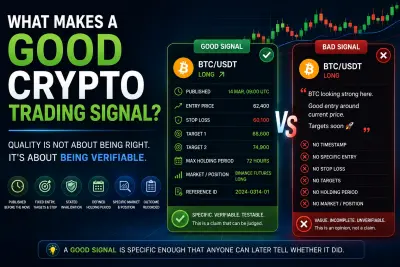
Each entry should carry a publication timestamp, its published levels, a final status, and a permanent identifier that does not change. Without those, you can read the record but you cannot test it.
Is an aggregate record published, with a stated method and sample?
A headline percentage means nothing on its own. Ask three questions of any figure: over what period, across how many signals, and how is a favourable outcome defined? A provider claiming a high rate without stating a definition has told you nothing you can check. A provider publishing no aggregate figure at all has also told you nothing — that is a gap, not a virtue, and it should be counted as one.
How long is the public operating history?
A record spanning several market conditions is worth more than a longer record from a single rising market. Length alone is not quality, but a very short history simply has not been tested yet, and no amount of methodology compensates for that.
Is anything verified independently?
Almost no provider in this category submits to third-party verification. A self-published record can still be honest — most are — but it remains self-published, and you should hold it at that weight rather than treating it as audited.
What is disclosed
Is the methodology disclosed at any level?
Nobody should expect a provider to publish proprietary logic. But there is a large space between full disclosure and none: which data categories are used, what timeframes are analysed, whether the process is rule-based, discretionary or adaptive. A provider that will not describe its approach in even general terms is asking for trust it has not offered evidence for.
Are both market directions available?
A provider publishing only long positions is making a directional assumption on your behalf, whether or not it says so. That is a legitimate design choice, but it means the results will look strong in rising markets and weak in falling ones, and several long positions held at once are not several independent bets — they are one bet on market direction, sized larger.
Is risk disclosed plainly?
For anything involving futures, the disclosure must be specific rather than decorative. In particular, a published stop-loss level is based on the underlying asset price. It does not guarantee protection from liquidation. Depending on the leverage chosen, a position may be liquidated before the published stop-loss level is reached. A provider that publishes futures levels without saying this has left out the part that matters most to a new trader.
The business behind the service
What are the trial, refund and cancellation terms?
These should be findable without contacting anyone. Terms that are vague, absent, or only disclosed after payment tell you how the business expects disputes to go.
Look also at what a free tier actually lets you test. A free tier that shows a sample rather than a complete published set lets you evaluate the marketing, not the method.
The evaluation framework
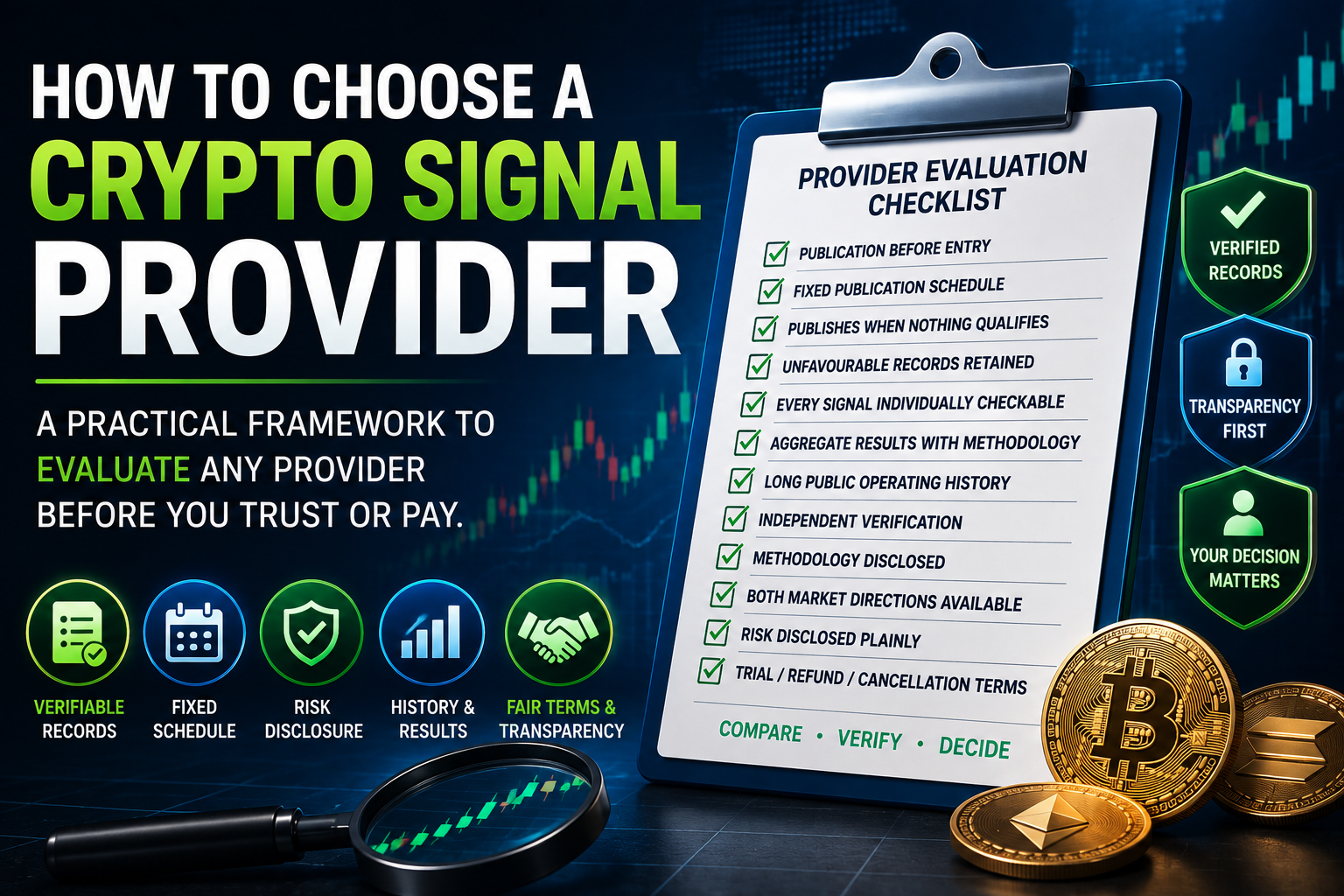
Criterion What it detects How to check Your assessment Levels defined before publication Outcomes described after the fact Open several past signals and confirm entry, stop and targets appear in the original Fixed publication schedule Publishing only after a move has begun Compare publication times across a week Publishes when nothing qualifies A system that must always find something Look for quiet days in the archive Unfavourable records retained Selective record keeping Search the archive for a period when the market fell Every signal individually checkable Records that can be read but not tested Confirm each entry has a timestamp, levels, status and a permanent identifier Aggregate figure with method and sample Headline percentages that cannot be verified If a figure is claimed, look for the period, the sample size and the definition of a favourable outcome Length and breadth of public history A record tested in only one market condition Check the earliest published signal and what conditions the record spans Independent verification Self-published records treated as audited Look for third-party confirmation; assume none unless stated Methodology disclosed at some level Trust requested without any description offered Look for data categories, timeframes, and whether the process is rule-based or adaptive Both market directions available A directional assumption made on your behalf Check whether short signals are ever published Risk disclosed plainly Decorative disclaimers Look for specific statements on leverage and liquidation, not general warnings Trial, refund and cancellation terms Terms disclosed only after payment Find them before paying; note if you cannot
A checklist pass is not an endorsement
These twelve criteria are necessary, not sufficient. A provider can meet every one of them and still produce results that do not suit you, or that do not work in the market conditions ahead.
What the criteria do is narrow the field to providers whose claims can be checked at all. That is the useful first cut. Everything after it — whether a given record is any good, whether the approach fits your circumstances, whether you should be trading futures in the first place — is a judgement no checklist makes for you.
Red flags
The criteria above describe what to look for. These are the patterns worth treating as warnings in their own right.
A headline accuracy figure with no method attached.
A percentage means nothing without a stated period, a sample size and a definition of what counts as a favourable outcome. A figure offered without those three is not a claim you can check.
Signals posted only after a move has begun.
Compare a handful of publication times against a chart. If the pattern is consistent, the record is a description rather than a forecast.
Screenshots instead of a record. A curated set of images proves nothing about what else was published in the same period.
Missing losses. If a market fell sharply and the archive shows nothing from that week, the absence is the finding.
Guaranteed returns, or any language implying certainty. Markets do not offer this, so anyone offering it is describing something other than trading.
Terms that only appear after payment. Refund and cancellation conditions should be findable before you commit anything.
Levels that change during a trade. A stop-loss that first appears while a position is running is not a stop-loss. This is the most common way a record is improved after the fact.
Advice to use high leverage. A provider is not in a position to know your account size or risk tolerance, and any specific leverage recommendation ignores both.
Pricing considerations
Price is the criterion people weigh first and the one that tells you least.
A subscription cost is easy to compare and reveals nothing about whether the signals are any good. Free services are not automatically worse — they are funded differently, usually through exchange referral arrangements, conversion to a paid tier, or sponsorship, and each of those creates its own incentive.
The questions worth asking about price are structural rather than numerical:
What does the payment actually buy?
In almost every case: published opinions with levels attached, on some kind of schedule, and in better cases a record of what happened to them. It does not buy the decision to trade, the position size, the leverage, the execution, or any of the consequences.
Is the cost proportionate to your account?
A subscription that represents a meaningful share of your trading capital changes your behaviour — it creates pressure to trade in order to justify the expense, which is the opposite of what a signal service should encourage.
What are the exit terms?
Whether you can cancel, when the next charge falls, and whether any refund exists. Terms that are vague or only disclosed after payment tell you how the business expects disputes to go.
Does the free tier let you test the method or only the marketing?
A free tier showing a curated sample demonstrates presentation. One showing the complete published set demonstrates the method.
Questions to ask before you commit
Everything above becomes useful at one moment: when you are deciding whether to rely on a particular provider. This is that checklist, and nothing in it is new — it is the criteria above reduced to questions you can answer in an afternoon.
Apply it to paid services and free ones alike. A free group costs nothing to join and can still cost a great deal to follow.
Everything above becomes useful at one moment: when you are deciding whether to rely on a particular provider. This is that checklist. Nothing here is new — it is the previous three sections reduced to questions you can answer in an afternoon.
Apply it to paid services and free ones alike. A free group costs nothing to join and can still cost a great deal to follow.
About the signals themselves
Are entry, stop-loss and target levels published as numbers, before the trade begins?
Does each signal state its market, position type and trading pair?
Is there a defined holding period, or can a position stay open indefinitely?
Does each signal name the level at which its own idea has failed?
About the record
Does every published signal carry a timestamp showing when it was published?
Are losing and unfavourable outcomes still visible in the archive?
Can you open a chart and check a past signal yourself, without asking anyone?
If an aggregate figure is claimed, is the period stated, the sample size stated, and the definition of a favourable outcome stated?
How long has the provider been publishing publicly, and across what kinds of market?
About the provider
Is the approach described at any level — what is analysed, on what timeframes, whether the process is rule-based or discretionary?
Are both market directions available, or is a directional assumption being made for you?
Is risk disclosed plainly, including what leverage does to a published stop level?
Are trial, refund and cancellation terms findable before you pay rather than after?
What to test before committing anything
If a free tier or trial exists, use it to test the method rather than the marketing.
That means watching signals arrive in real time for a few weeks, checking a handful against charts yourself, and seeing what the provider does on a bad week. A free tier that shows a curated sample rather than what actually gets published lets you evaluate the presentation and nothing else.
You are allowed to not decide yet
Nothing forces this decision today. Following a provider without money involved, for a month, answers more of these questions than any amount of reading — including this article.
If a provider makes waiting feel expensive, that is itself an answer. Nothing about a legitimate signal service becomes unavailable because you took four weeks to check it.
Where this fits
Judging a provider is the third of three related skills, and it works best on top of the other two.
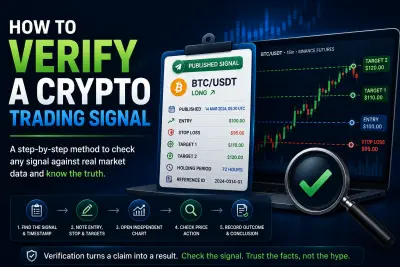
If you want to check a specific past signal against chart history first, the method is set out in how to verify a crypto trading signal — several criteria above depend on being able to do that.
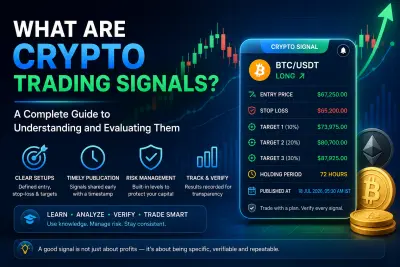
If any of the underlying terminology is unfamiliar, what are crypto trading signals covers what a signal contains and how one is produced.
Frequently Asked Questions
How do I choose a crypto signal provider?
Apply a fixed set of criteria rather than judging by presentation. Check whether levels are published in advance, whether unfavourable outcomes remain visible, whether individual signals can be verified against a chart, how long the public record runs, and whether risk and refund terms are disclosed before payment.
What should a trustworthy signal provider publish?
Levels fixed before publication, a verifiable timestamp on every signal, a permanent identifier, a recorded outcome for each one including unfavourable results, and plain risk disclosure. Providers publishing an aggregate figure should also state the period, the sample size and the definition behind it.
How should I interpret a provider's accuracy or win-rate claim?
Treat any figure as incomplete until the provider states the period it covers, the number of signals behind it, and what counts as a favourable outcome. A rate calculated on a short target with a distant stop reads very differently from the same rate on the reverse structure. Without those details, the number is not comparable to any other provider's.
What should I check before paying for a crypto signal service?
Whether levels are published in advance, whether losing outcomes remain visible, whether you can verify past signals yourself, how long the public record runs and across what market conditions, whether risk is disclosed plainly, and whether refund and cancellation terms are findable before payment.
What does a paid crypto signal membership actually buy?
Published opinions with levels attached, usually on a schedule, and in better cases a record of what happened to them. It does not buy the decision to trade, the position size, the leverage, the execution or the consequences. A signal service transfers information, not responsibility.
Should beginners pay for crypto signals?
Paying is not required to start learning from signals, since many providers publish freely and the same evaluation applies to both. A beginner gains more from following a provider without money at stake for several weeks, checking past signals independently, than from subscribing early.
Can I test a crypto signal service without paying?
Often, through a free tier or trial. Use it to test the method rather than the presentation: watch signals arrive in real time, check several against charts yourself, and see what the provider does during a poor week. A curated sample only demonstrates marketing.
Are free crypto signal groups legitimate?
Some are, and the same criteria apply to them as to paid services. Free does not mean lower standards are acceptable — a free group costs nothing to join and can still cost a great deal to follow. Check the record, not the price.
About the author
Vikas Chauhan is the founder of CryptoAI Signal. He is a crypto market researcher and algorithmic trading systems developer, working on the development of AI-assisted crypto signal systems, crypto market research, and transparent signal documentation.
CryptoAI Signal is itself a crypto signal service. The criteria in this guide are meant to be applied to it as readily as to anyone else — details of how it publishes are on the What Is CryptoAI Signal? page.
Find him on X, LinkedIn, Telegram and Binance Square.
Last updated: [publication date]. Reviewed on publication and on material change to the subject matter.
Risk disclaimer
This article is educational. It is not financial, investment, legal or tax advice, and it does not recommend any signal provider, trading strategy or asset — including any operated by the publisher.
Cryptocurrency markets are volatile and trading them carries substantial risk, including the total loss of the capital committed. Past behaviour of any market or any published record does not indicate future results.
Futures and margin trading carry additional risk. The published stop-loss is based on the underlying asset price. It does not guarantee protection from liquidation. Depending on leverage, a user's position may be liquidated before the published stop-loss level is reached.
Every decision described in this article — whether to trade, what size, what leverage, and whether to act on any signal — belongs to the reader. Do your own research.