A crypto trading signal is a published suggestion to take a specific position in a cryptocurrency. It normally states the asset, the direction, the price where the position starts, the level where the idea is considered wrong, and the levels it is expected to reach.
Some are worth acting on. Many are not. This guide explains how to tell the difference before you commit anything — and, just as importantly, what "good" actually means here.
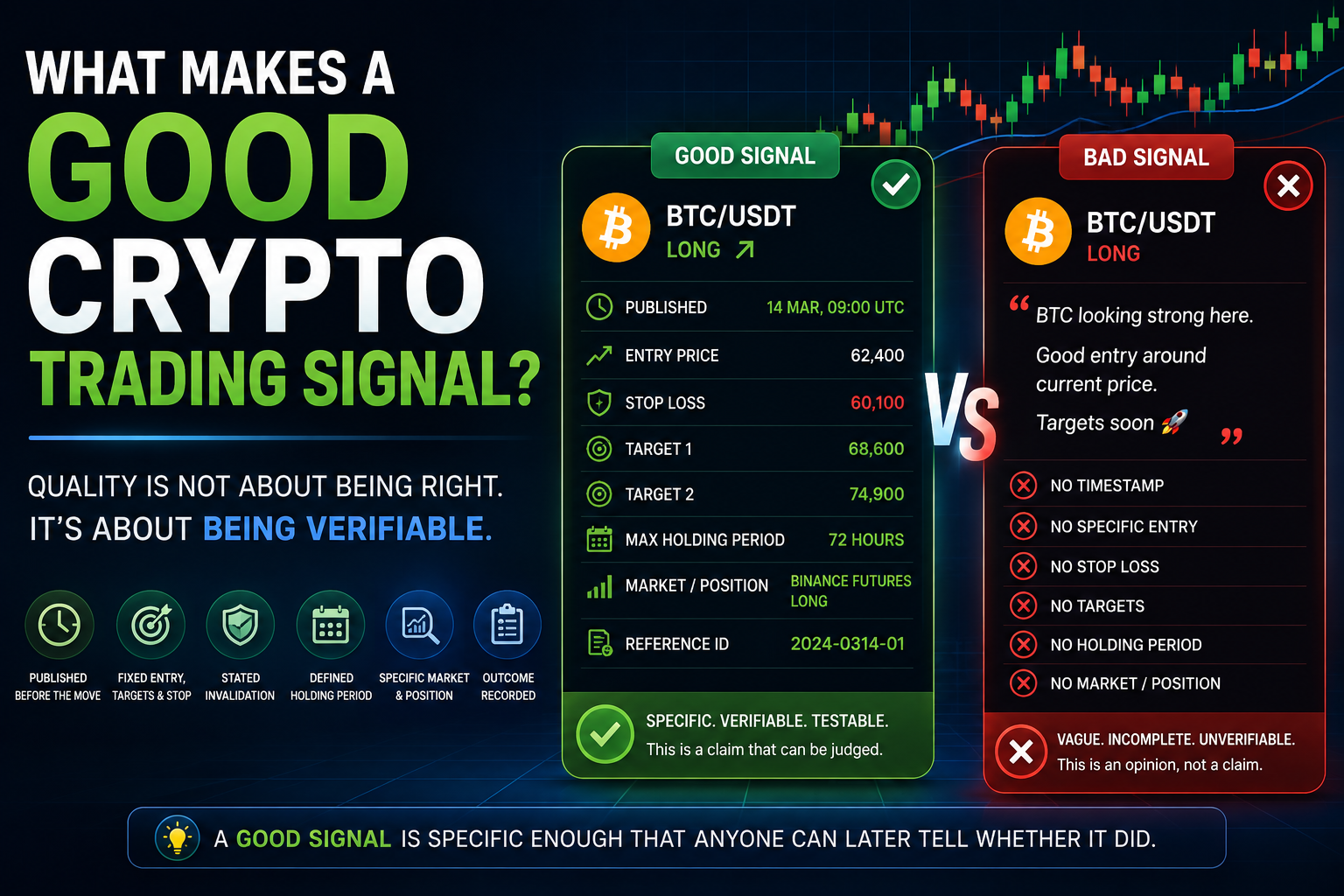
Quality here does not mean the signal will work. It means the signal is specific enough that anyone can later tell whether it did.
A signal that cannot be judged after the fact was never really a claim. It was an opinion with a coin attached.
![Highe Quality Signal [ Image ] Artical 2.png](/uploads/webp/31eb0f694bdeda11b9e6dc5bc066e8f7.webp)
Contents
The six attributes of a usable signal
It was published before the move it describes
The most important attribute is also the simplest. A signal is a claim about what happens next. Published after a move has begun, it is a description of what already happened, wearing the same clothes.
This single attribute separates a forecast from a screenshot, and it is the one most often missing.
Its levels were fixed in advance
Entry, stop and targets should be stated at publication, as numbers.
Vague levels are what make weak records look strong. An entry given as a wide zone will have been touched at some point almost regardless of what happened; a target described as "the next resistance" can be relocated once the outcome is known. Fixed numbers remove that flexibility, which is exactly why they are sometimes avoided.
It states where it is wrong
A quality signal names the point at which its own idea has failed.
Without a stated invalidation level there is no such thing as a losing outcome — a position can simply be held until it recovers or is quietly forgotten. The invalidation level is what makes a loss a recorded event rather than an ongoing situation.
It has a defined holding period
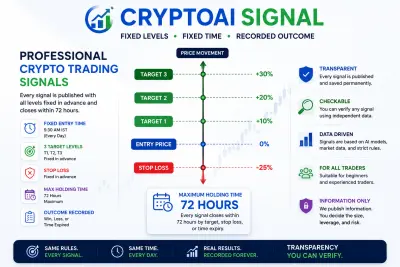
An open-ended idea never has to conclude. A stated maximum duration forces a result, whatever that result is.
This is a quiet but powerful attribute: it converts every signal into something with a beginning and an end, which is the minimum condition for a record to mean anything.
It states the market and the position type
Spot or futures. Long or short. Which trading pair, on which exchange.
These are not details. The same idea carries entirely different risk on spot than on a leveraged futures contract, and a signal that leaves it unstated has left out the part that determines what can go wrong.
Its outcome will be recorded either way
The final attribute is not visible in the signal itself, but it is decided before the signal is published: will the result be recorded whether or not it is flattering?
A signal published into a system that only preserves good outcomes is not a claim at all. Whether that system exists is a question about the provider rather than the signal.
A worked comparison
The difference between a usable signal and an unusable one is easier to see side by side than to describe. Both examples below are generic and invented purely for illustration.
Signal A
Published 14 March, 09:00 UTC BTC/USDT · Binance futures · Long Entry 62,400 Stop-loss 60,100 Target 1 68,600 · Target 2 74,900 Maximum holding period: 72 hours Reference: 2024-0314-01
Signal B
BTC looking strong here. Good entry around current price. Targets soon 🚀
Signal A can be checked by anyone. The timestamp fixes when the claim was made. The levels are single numbers, so there is no ambiguity about whether they were reached. The holding period guarantees the signal concludes. The reference means it can be found again later.
Signal B cannot be checked at all. "Around current price" changes minute by minute. "Targets soon" names no level and no time. There is no point at which Signal B can be said to have failed, which means there is no point at which it can be said to have succeeded either.
This is the whole distinction. Signal A is a claim. Signal B is a mood.
Note what the comparison does not show: whether either idea was correct. Signal A may well have hit its stop. That is a normal outcome and it does not make Signal A a poor signal — it makes it a signal whose result is knowable.
The most common quality problems
Six attributes are listed above. In practice, four failures account for most poor signals:
No timestamp. The single most common gap, and the one that makes everything else unverifiable.
Entry given as a wide range. A zone spanning several percent will almost always be touched at some point, which means the signal can be described as entered whatever the market did.
No stop-loss. Without a stated invalidation level, a losing idea never has to be recorded as one.
No end date. An open position can be held until it eventually looks better. A signal that never concludes never produces a result.
Any one of these is enough to make a signal unusable as evidence, however reasonable the underlying idea might be.
What signal quality does not tell you
A high-quality signal can still lose money. A poorly specified signal can still be followed by a price move in the expected direction.
Quality, as used here, is about whether the claim is specific enough to be judged — not about whether it turns out to be right. These are separate questions and they are easy to blur, particularly when looking at a single example.
That is also why the six attributes are checked before acting rather than afterwards. Once the outcome is known, judgement about the signal itself becomes much harder to make honestly.
What to do next
Judging a signal in front of you is the first of three related skills. The second is testing a signal that has already been published, against what price actually did. The third is judging the provider behind it.
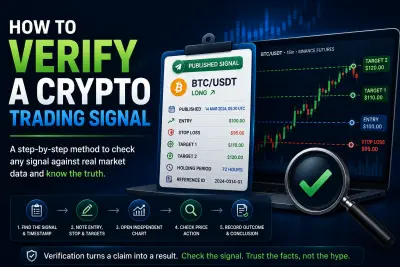
If you have a specific past signal you want to check, that method is set out in how to verify a crypto trading signal.
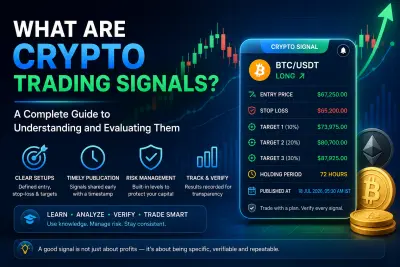
If you are still building the underlying picture — what signals are, where they come from, what each field means — start with what are crypto trading signals.
Frequently Asked Questions
What makes a crypto trading signal good?
A good signal is specific enough to be judged afterwards. It carries a publication timestamp, an entry price stated as a number, a stop-loss level fixed in advance, target levels, a defined holding period, and a stated market and position type. Whether it turns out profitable is a separate question.
Does a good signal mean a profitable signal?
No. Quality describes how clearly a claim is stated, not whether it proves correct. A well-specified signal can still reach its stop-loss, and that is a normal outcome rather than evidence of a poor signal. Signals that cannot be judged either way are the real problem.
Why does the publication timestamp matter so much?
It is the only thing separating a forecast from a description of something that already happened. A signal published before a move is a prediction; the same text published afterwards is a report. Without a verifiable timestamp, the two are indistinguishable.
Is a signal without a stop-loss ever acceptable?
For evaluation purposes, no. A signal with no stated invalidation level has no defined failure, which means a losing idea can be held indefinitely and never recorded as a loss. That makes the signal unusable as evidence, whatever its underlying reasoning.
What if a signal gives an entry range instead of a single price?
Treat a wide range as a weakness. A zone spanning several percent will usually be touched at some point regardless of what the market did next, so the signal can be described as entered in almost any scenario. A narrow range is workable; a broad one is not testable.
About the author
Vikas Chauhan is the founder of CryptoAI Signal. He is a crypto market researcher and algorithmic trading systems developer, working on the development of AI-assisted crypto signal systems, crypto market research, and transparent signal documentation.
Find him on = X, LinkedIn, Telegram and Binance Square.
Last updated: [publication date]. Reviewed on publication and on material change to the subject matter.
Risk disclaimer
This article is educational. It is not financial, investment, legal or tax advice, and it does not recommend any signal provider, trading strategy or asset — including any operated by the publisher.
Cryptocurrency markets are volatile and trading them carries substantial risk, including the total loss of the capital committed. Past behaviour of any market or any published record does not indicate future results.
Futures and margin trading carry additional risk. The published stop-loss is based on the underlying asset price. It does not guarantee protection from liquidation. Depending on leverage, a user's position may be liquidated before the published stop-loss level is reached.
Every decision described in this article — whether to trade, what size, what leverage, and whether to act on any signal — belongs to the reader. Do your own research.