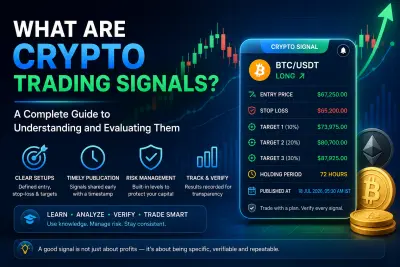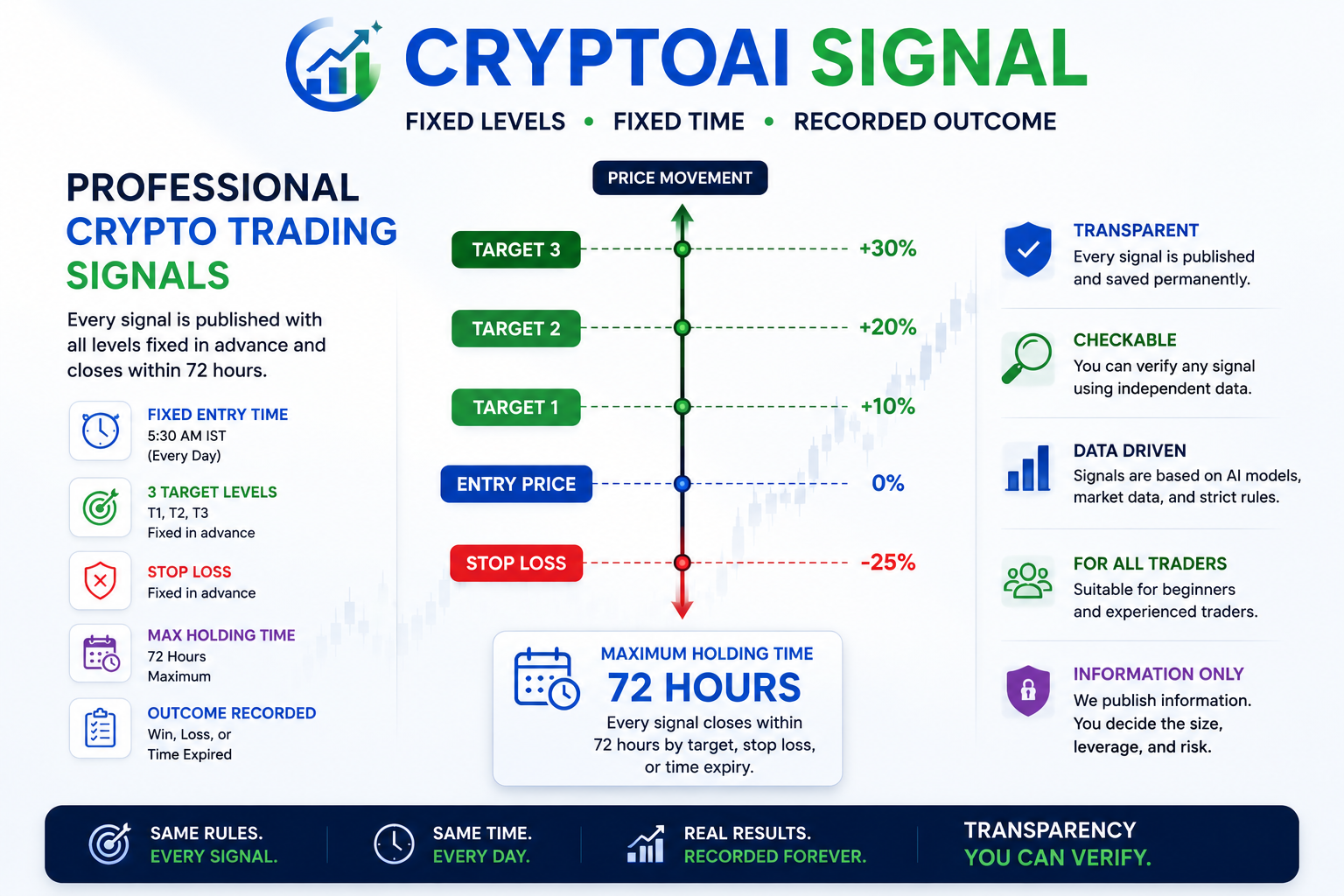
CryptoAI Signal is a crypto trading signal platform. It publishes trade setups for Binance Futures. Each setup has a fixed entry time, a stop loss, and three target levels. All of these are set before the trade begins. Every signal closes within 72 hours.
Contents
Quick Answer
CryptoAI Signal is a crypto trading signal platform. It publishes trade setups for Binance Futures. Each setup has a fixed entry time, a stop loss, and three target levels. All of these are set before the trade begins. Every signal closes within 72 hours.
Every published signal is saved with its outcome. It stays on the platform afterwards, whether the result was good or bad.
The full daily set of signals is published for free. The paid sections show a filtered and ranked selection from that same set.
The platform publishes information only. It does not place trades for you, hold your money, or give financial advice. It also makes no promise about what any signal will do.
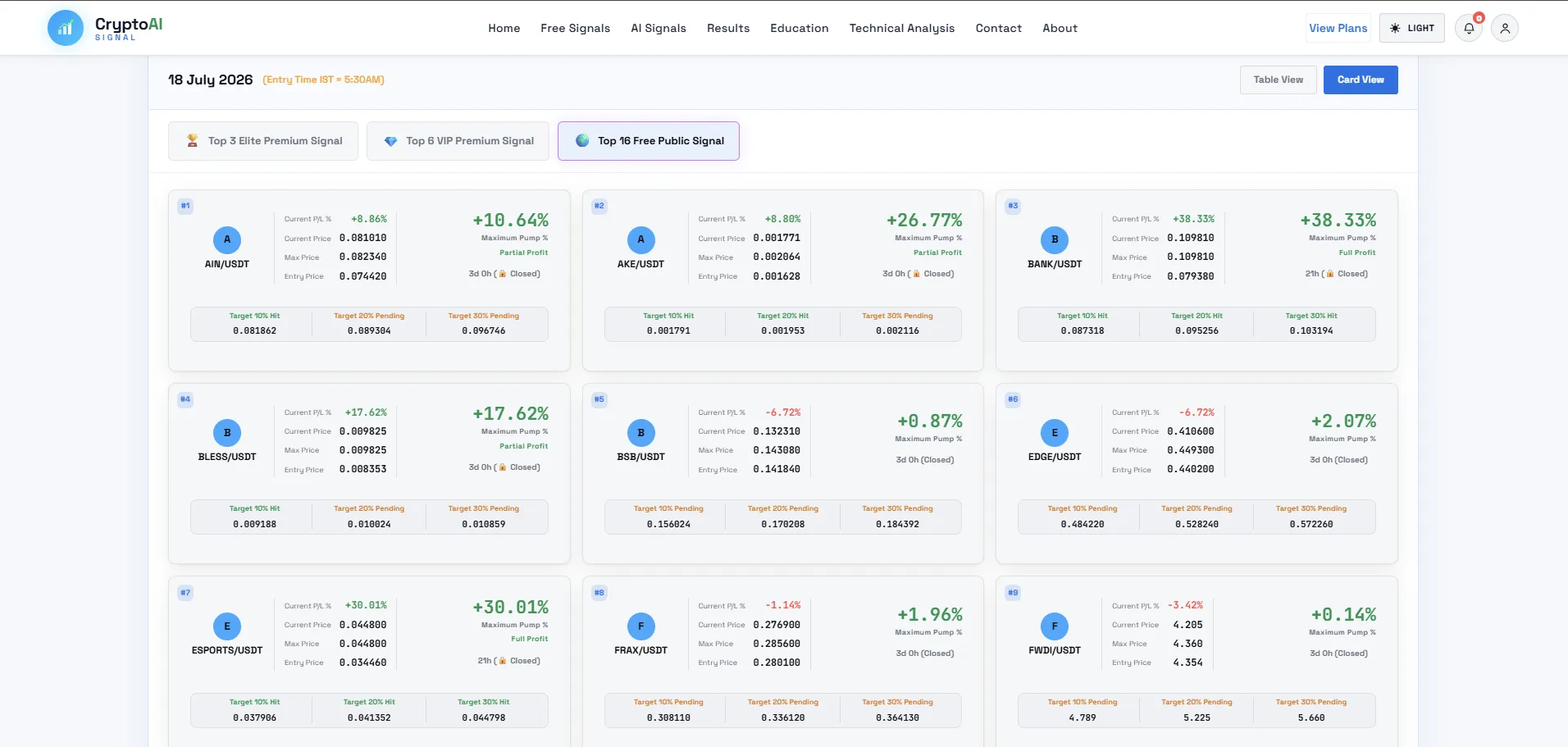
Top 16 Free Public Signal
Top 6 VIP Premium Signal
![Top 6 VIP Premium SignaL [ CARD ].png](/uploads/webp/b7a685b653b9ad355943a0195d1c649c.webp)
Top 3 Elite Premium Signal
![Top 3 Elite Premium SignaL [ CARD ].png](/uploads/webp/0badecb705d9d59a8b9980b05c80eee0.webp)
What CryptoAI Signal Is and Is Not
The crypto signal industry uses one label for very different products. So it helps to be clear about what this platform does before explaining how it works.
What it is
A signal platform for Binance Futures, publishing long positions only
A fixed structure: set entry time, set stop loss, set target levels, set maximum holding time
A permanent public record of published signals and how each one ended
A tiered service, where the full daily signal set is free
An information service — you decide whether to act, at what size, and with what leverage
What it is not
Not a trading bot. No trades are placed for you. The platform has no access to your exchange account.
Not financial advice. Signals are information, not instructions to buy or sell.
Not a fund service. No money is held or managed.
Not copy trading. Nothing is copied into your account automatically.
Not a guaranteed-return product. No result is promised for any signal or any period.
Not a scalping service. Signals run up to 72 hours, not minutes.
Not a short-selling service. Only long positions are published.
Not a news or market commentary site.
Why CryptoAI Signal Was Created
Background
CryptoAI Signal was built by its founder, Vikas Chauhan. He works on the platform as founder and product architect, with practical experience in cryptocurrency operations and algorithmic trading system development.
The platform was built after seeing how crypto trading signals are usually published, and how wide the gap is between what services claim and what they can actually show.
The gap
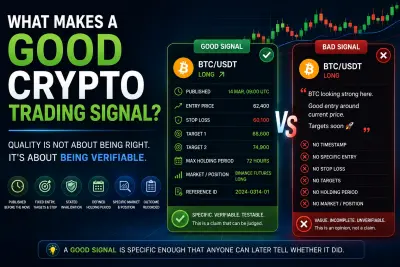
The problem in this industry is not that signals are hard to produce. The problem is that almost nothing published about them can be checked.
A service can publish a setup, delete it if it fails, and show only the ones that worked. It can publish at random times, so a setup looks like it was found before a price move that had already happened. It can keep a losing position open forever and never record the result.
None of this requires lying about any single signal. The record is simply built so that bad results never enter it.
CryptoAI Signal was built with the opposite rule: fix the publishing rules first, apply them the same way to every signal, and keep the full record no matter what happens. The point is not that this produces better setups. The point is that it produces a record you can test.
Problems in the Crypto Signal Industry
These are the practices that make most signal services impossible to judge. They are common patterns across the industry, not accusations against any one provider.
Claims that cannot be checked
The most common proof in this industry is a screenshot of a winning trade. A screenshot proves nothing useful. It does not show when the setup was published, what levels came with it, or what else was published that day and left out of the picture.
Without a full record of everything published in a period, one good example tells you nothing about the service.
Signals removed afterwards
A record that keeps only good results will always look strong, no matter how the service actually performs.
This is the most damaging practice in the industry because you cannot see it from outside. A reader cannot detect what is missing. The only defence is a service that keeps every published signal in every state, so the record can be examined for what it holds rather than trusted for what it shows.
Positions left open forever
A position with no time limit never has to produce a recorded result. It can stay open while it moves against the trader, then be quietly dropped or eventually recovered.
For the trader, this means money committed with no end point. For the service, it means a bad result never has to be recorded at all.
No defined risk before entry
Many signals are published as an entry level and a direction, with no level that says the idea has failed. The trader then has to decide during the trade when to give up, which is the hardest moment to decide anything well.
Without a level set in advance, there is no clear point at which a setup can be called a failure. Both the trader and the record lose the ability to tell a bad setup from a badly managed one.
Practice Effect on the trader Effect on the record Screenshot proof No way to judge the service No full record exists Removing signals Expectations set too high Record shows only good results No time limit Money committed with no end point Bad results never recorded No stop loss published Exit decided under pressure No clear point of failure
How the Platform Works
CryptoAI Signal publishes under a fixed set of rules. Every signal has the same structure and the same fields. The process that decides which setups get published is proprietary and is not described here — it is the core of the product. Everything else about how the system works is visible to anyone using the platform.
The publishing cycle
A signal is a published trade setup: a specific trading pair with price levels recorded before the trade begins.
When market conditions qualify, CryptoAI Signal publishes a new set of trading signals. Signals are published before their scheduled entry time. The standard entry time is 5:30 AM IST. It is shown on every published set and in each signal's trading rules, and it does not move with market conditions.
The number of signals in each published section is fixed, not open-ended. This puts a ceiling on how many setups can appear in one session, no matter how many opportunities the market offers.
The 72-hour maximum lifetime
Every signal has a maximum holding time of 72 hours. The platform shows this in the trading rules as 72h (3 Days).
Inside that window, a signal can reach its target levels or move against the setup. When the holding time is reached, the platform closes the signal at whatever the price is at that moment. There is no way to extend a signal past that point.
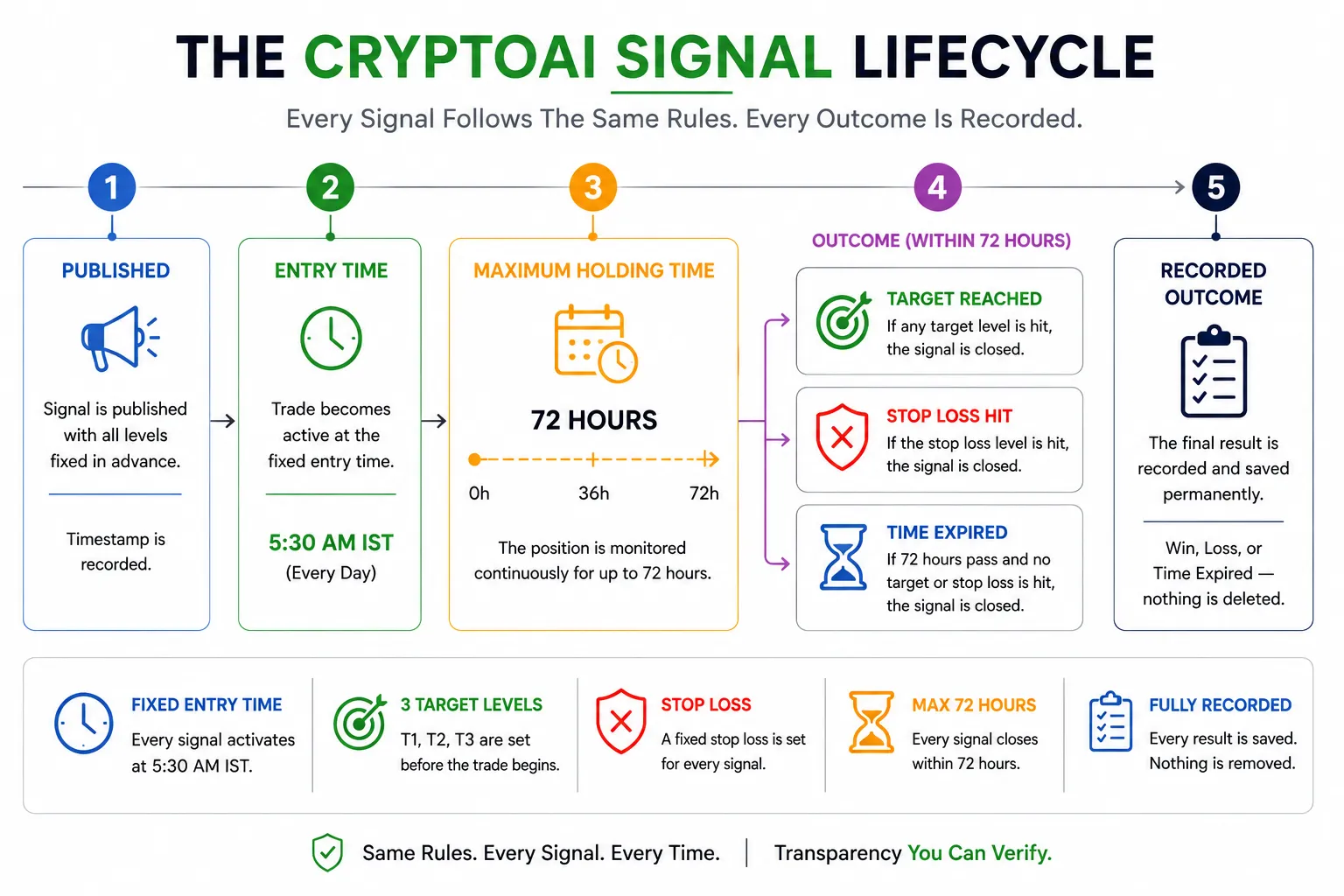
What happens after a signal is published
Once a signal is published, its values are fixed. The price levels recorded at publication are not changed later.
As each signal closes, its result is recorded against those original values. These records form the Results section, which grows with every signal the platform publishes.
What Is Inside Every Signal
Every signal on CryptoAI Signal has the same fields, in the same format, in every membership section. Nothing is added to some signals and held back from others.
Signals can be viewed as cards or in a table. Opening any signal brings up its trade detail page, which shows the full published record.
Signal fields
Field What it tells you Trading Pair The pair the setup applies to Trade Direction Long Position Published Time When the signal was published Entry Time (IST) The scheduled entry point Entry Price The price level recorded at publication Stop Loss The level where the setup is treated as failed, set at -25% from entry Target 1 (+10%) First target level, marked Hit or Pending Target 2 (+20%) Second target level, marked Hit or Pending Target 3 (+30%) Third target level, marked Hit or Pending Current Price The live market price Max Price The highest price reached since publication Current P/L % The change from the entry price to the current price Maximum Pump % The largest upward move measured from the entry price Holding Time Time passed since entry Trade Status The signal's recorded state Trading Rules Entry time, maximum holding time, trade direction
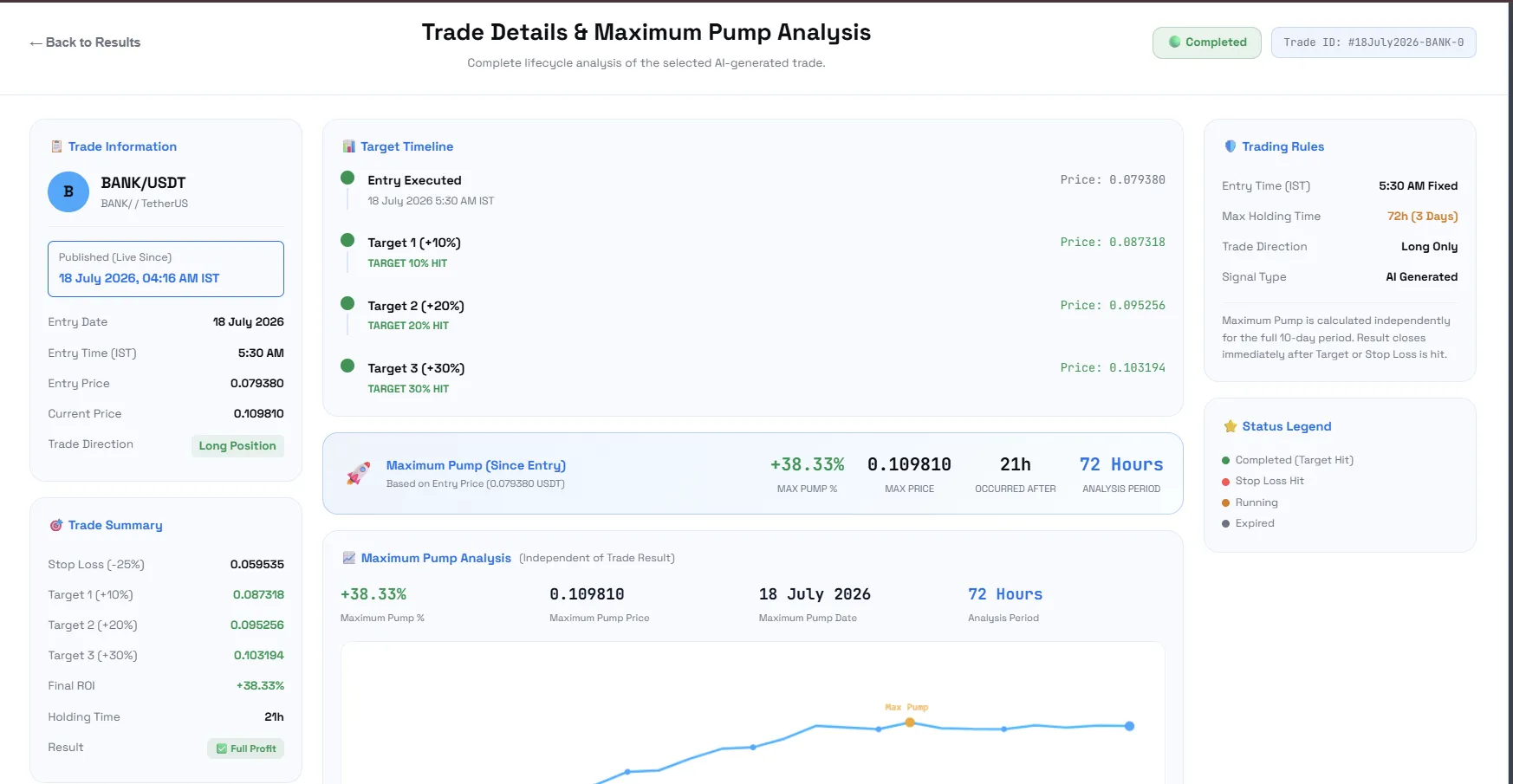
How the target levels work
A signal does not have one price goal. It has three, set at fixed percentage distances from the published entry price: 10%, 20% and 30%.
Each level has its own price and its own state. A level marked Hit means price reached it at some point after publication. A level marked Pending means it has not been reached.
This structure exists so that a partial result is recorded as a partial result. A signal that reaches 10% and 20% but not 30% is not recorded as a failure. It is also not recorded as if it reached its full goal. The record shows exactly which levels were reached and which were not.
Maximum Pump % is measured separately
The Maximum Pump % field is calculated on its own, apart from the trade result. It measures the largest upward move from the entry price, and it keeps measuring after the signal has closed.
So the two percentage figures on a signal answer different questions. The result tells you how the setup ended under the platform's rules. Maximum Pump % tells you how far price travelled from the entry level, whether or not the signal was still open at the time. A signal can close at its stop loss and still show a small positive Maximum Pump %, because the two numbers measure different things.
Membership Sections
CryptoAI Signal publishes signals across three sections, shown as separate views on the platform.
Section Access What it contains Top 16 Free Public Signal No payment needed The complete published signal set for the day Top 6 VIP Premium Signal Membership needed A filtered and ranked selection from that set Top 3 Elite Premium Signal Membership needed A further filtered and ranked selection
The same trading pair can appear in more than one section. This is expected. The premium sections are not separate signals. They are progressively selected and ranked from the same published set.
What membership actually provides
This structure has a result worth stating plainly.
The free section publishes the complete daily signal set. A paid membership does not unlock signals that free users cannot see. What it provides is the selection: which setups the platform's ranking places highest, and in what order.
If you are judging the platform, this matters. You can follow every signal it publishes without paying anything, and look at the record yourself before deciding whether the ranking is worth paying for.
How each section is ordered
The Top 6 VIP Premium Signal and Top 3 Elite Premium Signal sections show their signals in ranked order.
The Top 16 Free Public Signal section is not a ranking. It is shown in alphabetical order for public review, so the order signals appear in there says nothing about quality. The process that produces the premium rankings is proprietary and is not published.
Membership pricing and what each level includes are listed on the plans page.
How Risk Is Defined in Every Signal
Every signal on CryptoAI Signal has the same fixed risk structure, set before the trade begins. The levels are not adjusted per signal and are not changed after publication.
Every signal has a stop loss defined before publication
Each signal is published with a stop loss at -25% from the entry price, and three target levels at +10%, +20% and +30%.
These are fixed percentages applied to every signal, not values chosen one by one. The stop loss is recorded at publication, before the market has produced any result. So the point where the setup is treated as failed is known in advance, not decided afterwards.
⚠️ A -25% move on a leveraged position is not a -25% loss on your money. Your real loss depends on the leverage you choose and the size of the position you open. At higher leverage, the exchange can liquidate a position before price reaches the published stop loss level.
How outcomes are recorded
A signal closes when the stop loss is reached, or when the 72-hour holding time is reached — whichever comes first.
While a signal is live, the platform shows it as Running. Once it closes, the platform records the result on the signal card.
Recorded outcome Meaning Full Profit All three target levels were reached Partial Profit Some target levels were reached, others stayed Pending Stop Loss Hit Price reached the stop loss level
Signals that close without reaching any target and without hitting the stop loss are shown as closed, with their target levels still marked Pending and their holding time recorded. Every closed signal keeps its individual target states, so the record always shows which levels were reached rather than a single pass or fail.
What the platform does not decide for you
The risk structure above defines the shape of the setup. It does not define your exposure.
Position size is not specified. How much money you put into any signal is your decision, and it decides what a -25% move actually costs you.
Leverage is not specified either. CryptoAI Signal does not recommend a fixed leverage level, because the right leverage depends on your capital, your risk management and your trading experience. You choose it in your own exchange settings.
These two decisions affect your result more than the setup does. The same signal, taken at small size and low leverage, is a different trade from the same signal taken at maximum leverage.
Limitations You Should Know
Every trading service has limits. Most do not state them. These limits should be understood before you follow any signal published on the platform.
These are leveraged futures, not spot purchases
Signals on CryptoAI Signal apply to Binance Futures. Futures are leveraged derivative contracts. You are not buying and holding the cryptocurrency itself.
This changes the risk in three ways. Losses can be larger than the amount you put into the position. The exchange can liquidate a position automatically if your margin becomes too low, and this can happen before price reaches the level where you meant to exit. And because leverage multiplies price movement in both directions, a small move against you can produce a large loss on the money you committed.
⚠️ If you have not traded leveraged futures before, learn how liquidation and margin work before following any signal. The platform assumes you already understand these mechanics.
Long positions only
CryptoAI Signal publishes long positions. The trading rules on the platform state this as Long Only.
A long position gains when price rises and loses when price falls. Because every published signal is a long position, the platform has no way to produce a setup that gains from falling prices.
The result is direct. When most assets are falling, a long-only approach has fewer good conditions available to it than an approach that can trade in both directions. This is a structural property of the service, not a temporary state, and it will not change until short positions are added.
Any result you see on the platform reflects the market conditions of that period. Results from a rising market should not be treated as a guide to what happens in a falling one.
The Results section is still growing
The Results section records the outcome of signals published through the platform, and it grows with every new set that is published.
Performance statistics are not published today. They will be published once they can be calculated using a consistent method across the full set of platform-published signals — one definition of what counts as a result, applied to every signal the same way. A number produced any other way would not be reliable enough to publish.
This is not financial advice
CryptoAI Signal publishes trade setups as information. It does not give financial, investment or trading advice, it does not manage money, and it does not place trades for you.
No signal is a recommendation to buy or sell. Whether to act on any published setup, how much money to commit, and what leverage to use are entirely your decisions. The result of those decisions is your responsibility.
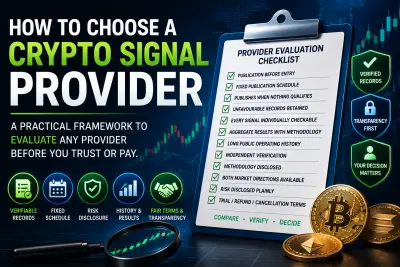
How the Platform Stays Checkable
Most claims made by signal services cannot be tested. A screenshot proves nothing about what was published, or when, or what happened to everything that was not shown. CryptoAI Signal is built so that the record does not depend on being believed.
A fixed entry time removes timing choice
Every signal has the same fixed entry time of 5:30 AM IST, and every signal is published before that time.
This removes one specific form of manipulation. A service that publishes at random times can wait for price to move, then present a setup as if it had been found beforehand. A fixed entry time keeps the reference point the same for every signal, whatever the market did.
Published signals are not edited or removed
Once a signal is published, its entry price, stop loss and three target levels are fixed. They are not adjusted later, and a signal is not removed from the record because its result was bad.
The Results section keeps signals in every state the platform records, including those that hit the stop loss and those that closed without reaching a target. Signals with bad results stay visible next to the rest, in the same view, on the same date.
This is what most separates a checkable record from a marketing record. A record that only holds good results tells you nothing, because you cannot see what was removed.
The complete set is published publicly
Because the free section holds the complete daily signal set, the public record is not a selection. Everything the platform published on a given day is visible without payment, including the setups that did not work.
This is what makes independent testing possible. A record that shows only the signals a service chose to highlight cannot be judged. A record that shows everything can.
A fixed holding time forces a conclusion
Because there is no way to extend a signal past 72 hours, no position can stay open forever while it recovers, and no signal can sit permanently undecided. Every published signal reaches a recorded conclusion within a known period.
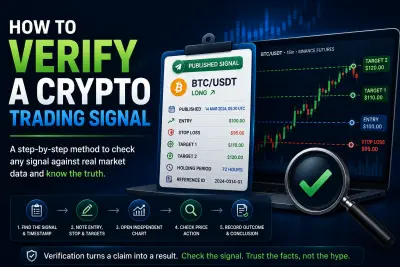
How to check a signal yourself
You do not need a paid membership to test any of this. The Top 16 Free Public Signal section is available without payment, and every signal has a detail page showing its full record.
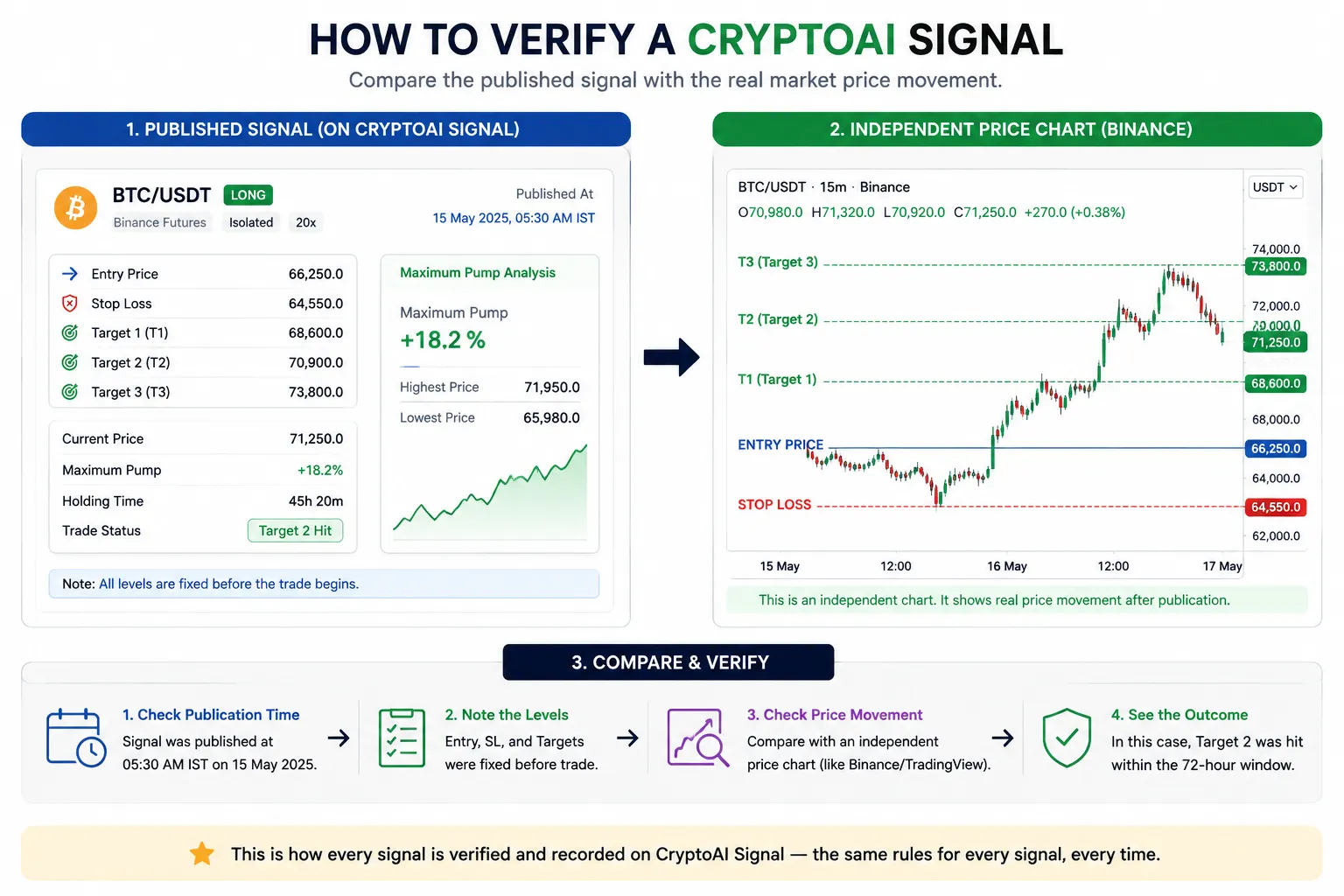
Open any signal and note four things: the published entry price, the stop loss level, the three target levels, and the entry date and time. Each signal also has its own trade identifier.
Then open the same trading pair on any independent charting platform, move to the entry date and time, and follow what price did over the next 72 hours. Compare that against the target and stop loss levels recorded on the signal before the trade began.
The point is not to confirm one result. The point is to establish that the levels shown on the record are the levels that were published, and that the recorded result matches what price actually did. Repeat it across several signals, including ones that did not reach their targets, and you will have tested the record instead of trusting it.
Our Transparency Principles
The mechanisms above exist because of four principles that guide how the platform publishes. They come after the mechanisms rather than before them, because a principle with no mechanism behind it is only a claim.
Data before marketing. Signals are published with their levels recorded in advance, and results are recorded against those levels. What the record shows is not adjusted to look better.
Transparency before promotion. The complete daily signal set is published without payment, and every signal has a detail page showing its full record. You can examine how the platform works before paying for anything.
Risk management before profit expectations. Every signal has a stop loss and a maximum holding time, set before the trade begins. The limits are part of the setup, not something added later.
Consistency before hype. The entry time, the target structure, the stop loss and the holding period are the same on every signal. Nothing is changed to make one result look better.
There are limits to what is shared. The process that selects and ranks signals is proprietary and is not published, because it is the core of the product. Business numbers such as user counts are not published either. What is published is the complete record of every signal and how it ended.
Who This Is For and Who It Is Not For
CryptoAI Signal suits one specific way of trading. It does not suit every trader. Using it against its design is more likely to cost you money than help you.
Who this suits
You cannot watch charts all day, and you want a defined set of setups to review instead of a constant stream
You already use a stop loss on every position, or you are willing to start
You understand how leverage and liquidation work on futures positions
You are comfortable making your own position size and leverage decisions
You are willing to judge a service over many signals rather than a few
You want to understand what you are trading, not hand it over
Who should not use this
You are looking for guaranteed returns, or any sign of expected profit
You want to trade with money you cannot afford to lose
You need short positions — the platform publishes long positions only
You want intraday or scalping signals, which this is not
You are unwilling to use a stop loss
You have never traded leveraged futures and are not ready to learn how liquidation works first
You want a service that trades for you — CryptoAI Signal publishes information and places nothing
If you are new to futures, the free section lets you follow signals and watch results without putting in any money at all. That is a reasonable place to start, and it costs nothing.
How to Use CryptoAI Signal
A signal tells you what was published and when. What you do with it is a separate set of decisions, and the platform makes none of them for you.
Before you follow any signal
Open the signal's detail page and read the full record, not just the summary card. The detail page shows the entry price, the stop loss, all three target levels and the entry time as they were published.
Check where the current market price sits compared to the published entry price. A setup is defined against a specific entry level. If price has already moved well past it, the conditions the signal was published under are not the conditions in front of you.
Decide your position size and leverage before you open anything, not afterwards.
While a signal is live
The platform shows a signal as Running while it is live, and updates its target states as levels are reached.
What the platform records and what happens in your account are separate. The platform tracks the published setup. Your position, your exit and your stop loss order on the exchange are yours to manage. Placing a stop loss order on the exchange is your responsibility, not something the platform does for you.
When a signal closes
A closed signal means the platform has finished recording that setup. It does not mean your position has been closed. If you are still holding a position when a signal closes, exiting it is your decision and your action.
Once a signal has closed, its record stays on the platform. Reviewing closed signals — including the ones that did not work — is the most useful thing you can do with the Results section, because it shows how the setups behave across different market conditions rather than one at a time.
About the Founder
CryptoAI Signal was built by its founder, Vikas Chauhan, who works on the platform as founder and product architect, with practical experience in cryptocurrency operations and algorithmic trading system development. He is responsible for the product design, the publishing rules described in this article, and the platform itself.
The platform is operated from India and publishes in English for a global audience.
Questions about anything in this article can be sent through the contact page. Corrections are welcome. If something here does not match what the platform actually does, it will be changed.
Risk Disclaimer
Trading cryptocurrency futures carries substantial risk. The following applies to everything published on CryptoAI Signal.
These are leveraged products. Losses can be larger than the money you put into a position. The exchange can liquidate a position before price reaches the level where you meant to exit.
Nothing published here is financial advice. CryptoAI Signal publishes trade setups as information. It is not a financial adviser, it does not manage money, and it does not place trades for you. No signal is a recommendation to buy or sell any asset.
No result is guaranteed. No trading approach can guarantee a profit. Any signal can reach its stop loss. Results recorded on the platform reflect the market conditions of that period and do not indicate what will happen in different conditions.
Your decisions are your own. Position size, leverage, entry, exit and risk management are your responsibility. Only trade with money you can afford to lose.
Getting Started
If you want to see how the platform works, start with the free section. It costs nothing, and it holds the complete daily signal set.
Create an account. The Top 16 Free Public Signal section is available without payment.
Read a signal in full. Open the trade detail page rather than the summary card, so you can see the entry price, stop loss, all three targets and the trading rules together.
Follow signals without trading first. Track a set of signals on a chart over their 72-hour window and compare results against what was published. This costs nothing and tells you more than any description can.
Learn how leverage works before putting money in, if you have not traded futures before.
Decide afterwards. Once you have watched enough signals close to form your own view, the paid sections are there if you want the ranking.
Conclusion
CryptoAI Signal publishes Binance Futures long setups under fixed rules: one entry time, a stop loss at -25%, three target levels, and a 72-hour limit on every trade. Every signal stays on the record with its result, whatever that result was.
The practical takeaway is this. You do not have to take any of it on trust. The complete daily set is free, every signal has a full detail page, and every published level can be compared against an independent price chart. Follow a few signals through their 72-hour window, check the record against the chart yourself, and decide from what you find rather than from what anyone claims.
Frequently Asked Questions
Is CryptoAI Signal free?
Partly. The Top 16 Free Public Signal section is available without payment and holds the complete daily signal set. The Top 6 VIP Premium Signal and Top 3 Elite Premium Signal sections need a membership. Pricing is listed on the plans page.
What do I actually get by paying?
The selection. The free section publishes every signal for the day. The premium sections show a filtered and ranked version of that same set. A membership gives you the ranking, not access to signals that are otherwise hidden.
Why does the same coin appear in more than one section?
Because the premium sections are drawn from the same published set as the free section. A setup that ranks highly will appear in the free section and in one or both premium sections. This is by design.
Is the free section ranked?
No. It is shown in alphabetical order, so the order signals appear in there says nothing about quality. Only the premium sections are ordered by ranking.
Is CryptoAI Signal financial advice?
No. The platform publishes trade setups as information. It is not a financial adviser and does not give investment or trading advice. No signal is a recommendation to buy or sell, and every decision about whether to act is yours.
Do you guarantee profits?
No, and no signal service can. Any published signal can reach its stop loss, and every signal carries the risk of a loss. The platform publishes setups under fixed rules and records what happened. It does not promise what will happen.
Why do you only publish long positions?
The platform is built to publish long positions, which gain when price rises. The trading rules show this as Long Only. It means the platform has fewer good conditions available in a falling market than a service that can also trade short.
Why is every trade capped at 72 hours?
So that every signal produces a recorded result within a known period. Without a limit, a position that has moved against you can be held open forever, and a bad result never has to be recorded. The cap removes that option.
Why is the entry time fixed at 5:30 AM IST?
A fixed entry time means every signal uses the same reference point, and signals cannot be released after a favourable move has already happened. Signals are published before the entry time.
Do you place trades on my behalf?
No. The platform has no access to your exchange account and places no orders. It publishes setups. You decide whether to act on them, at what size, and with what leverage.
Which exchange are the signals for?
Binance Futures. These are leveraged derivative contracts rather than spot purchases, which means losses can be larger than the money you committed, and liquidation is possible.
Do I need experience with leverage?
Yes. The platform assumes you understand how leverage, margin and liquidation work. If you do not, learn those mechanics before putting money in. You can follow the free signals on a chart without trading while you do.
What is the difference between Current P/L % and Maximum Pump %?
Current P/L % is the change from the entry price to the current price. Maximum Pump % is the largest upward move measured from the entry price, calculated apart from the trade result and continuing after the signal has closed. They answer different questions and will often show different numbers.
How can I check whether a signal was accurate?
Open the signal's detail page and note the entry price, stop loss, target levels and entry time. Then open the same pair on any independent charting platform, move to that date and time, and compare what price actually did against the levels published beforehand.
What happens if a signal closes without reaching a target?
It stays on the record with its target levels marked Pending and its holding time recorded. A closed signal means the platform has finished recording that setup. It does not close any position you are holding. Exiting your own position remains your decision.
Do you publish performance statistics?
Not yet. Statistics such as accuracy or average return will be published once they can be calculated using a consistent method across the full set of platform-published signals. Until then, the individual signal records in the Results section are what the platform publishes, and they can be checked one by one.